
Kenilworth.
By Sir Walter Scott
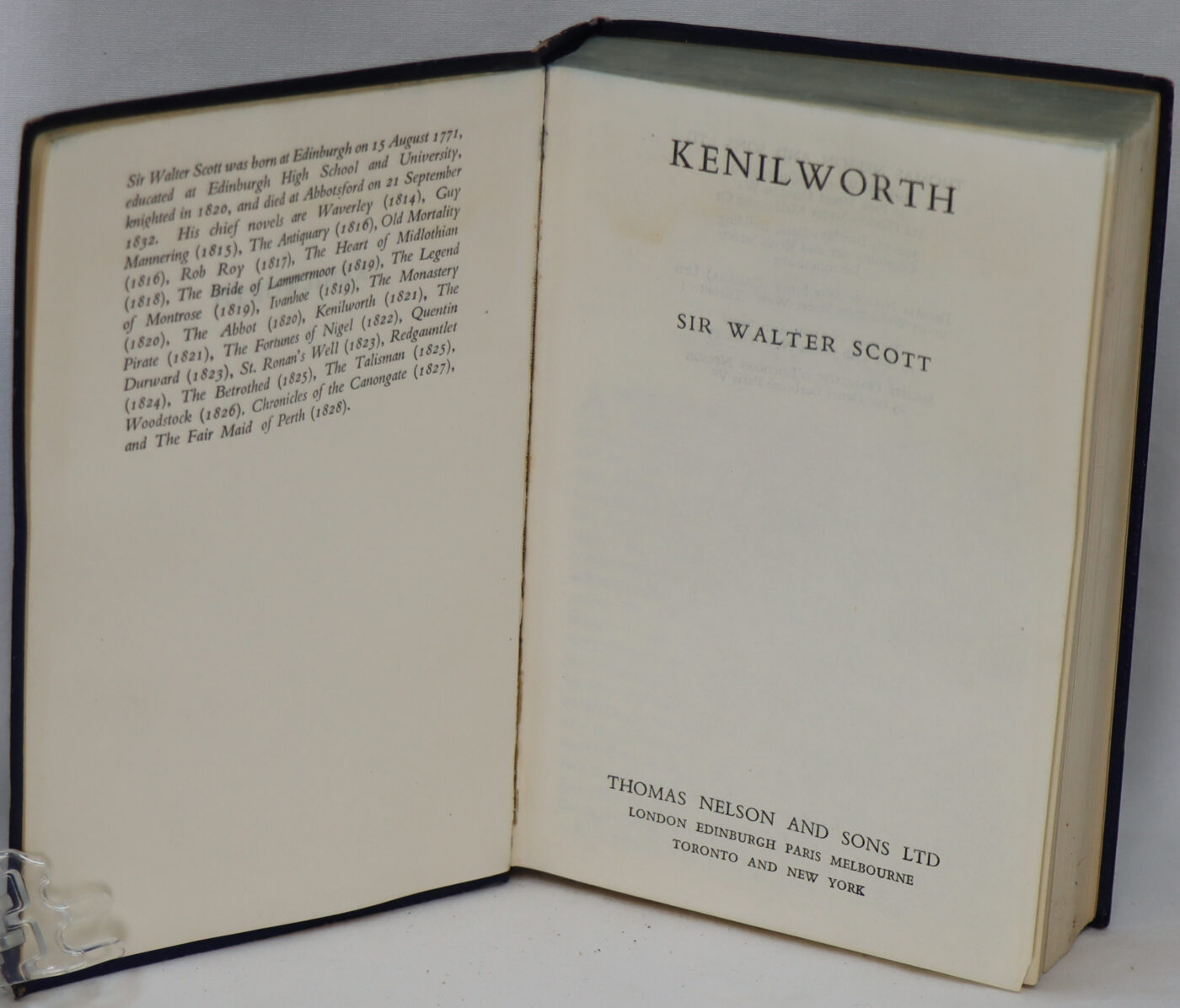
Printed: Circa 1940
Publisher: Thomas Nelson & Sons. London
| Dimensions | 13 × 16 × 3 cm |
|---|---|
| Language |
Language: English
Size (cminches): 13 x 16 x 3
Condition: Good (See explanation of ratings)
£17.00
Buy Now

Item information
Description
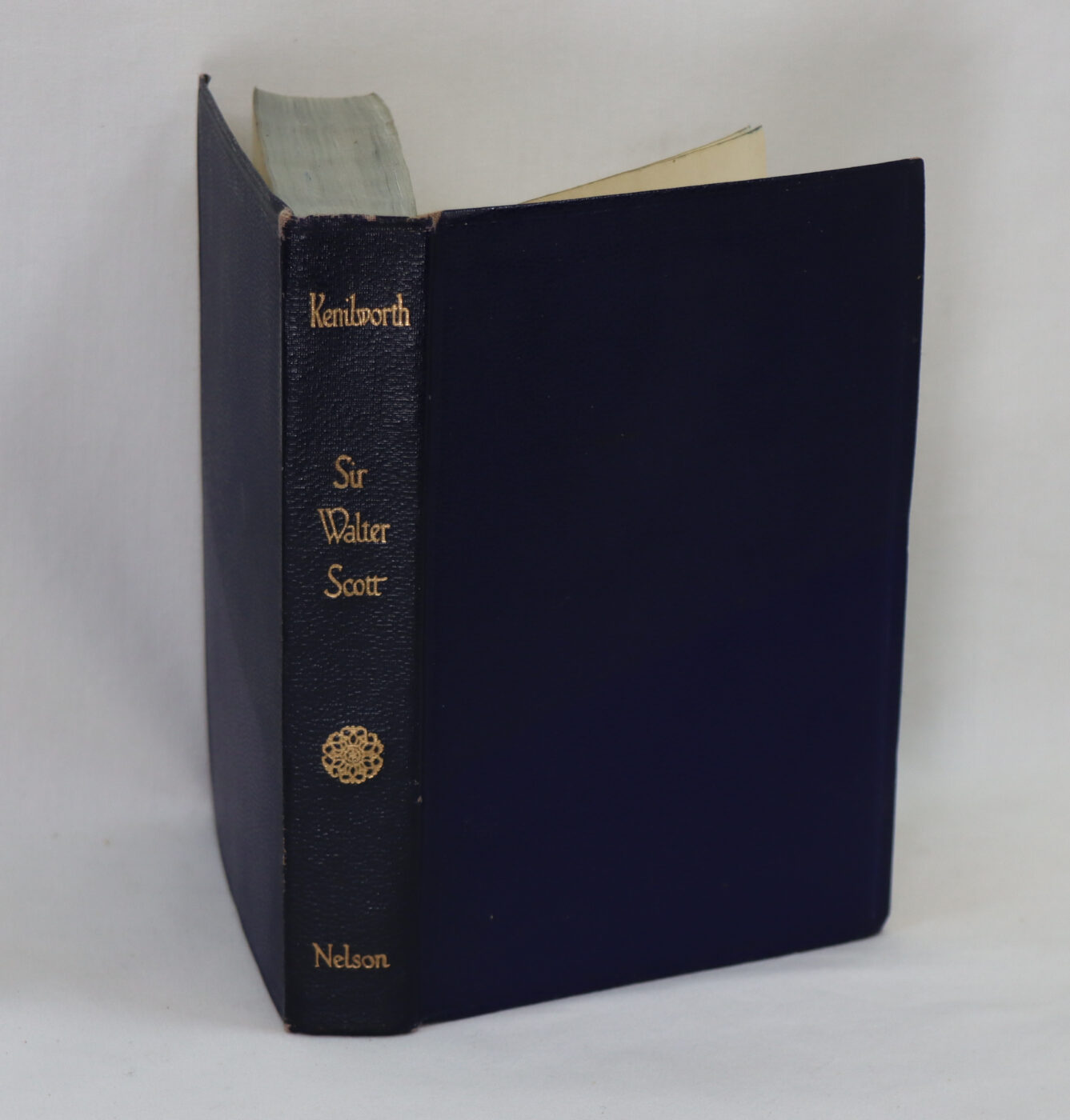
Softback. Navy leatherette cloth binding with gilt title on the spine.
We provide an in-depth photographic presentation of this item to stimulate your feeling and touch. More traditional book descriptions are immediately available.
- Note: This book carries a £5.00 discount to those that subscribe to the F.B.A. mailing list
It is a pleasure to touch and feel this lovely book. A book which has been treasured throughout its life.
Kenilworth. A Romance is a historical romance novel by Sir Walter Scott, one of the Waverley novels, first published on 13 January 1821. Set in 1575, it leads up to the elaborate reception of Queen Elizabeth at Kenilworth Castle by the Earl of Leicester, who is complicit in the murder of his wife Amy Robsart at Cumnor.
The novel was another huge success for Scott, who at this stage was still publishing anonymously, and was adapted for plays and several operas over the rest of the 19th century. Despite taking serious liberties with the known facts, its account has dominated understanding of the real events it recounts. Though there was certainly a great scandal over the death of Amy Ronsart, it remains unclear to historians whether her death was anything more than the accident the extensive inquest concluded it to be. There have been numerous adaptations of the novel, as plays, musicals, operas and in ballet. But these were mainly before World War One, and the novel has apparently never been filmed, except for a BBC television series that is lost.
Kenilworth is set in the reign of Queen Elizabeth I, and centres on the secret marriage of Robert Dudley and Amy Robsart, daughter of Sir Hugh Robsart. Amy passionately loves her husband, and the Earl loves her in return, but he is driven by ambition. He is courting the Queen’s favour, and only by keeping his marriage to Amy secret can he hope to rise to the height of power that he desires. At the end of the book, the Queen discovers the truth, to the shame of the Earl. The disclosure has come too late, for Amy has been murdered by the Earl’s even more ambitious steward, Varney. The title refers to Dudley’s Kenilworth Castle in Kenilworth, Warwickshire. The novel opens at Cumnor Place, near Abingdon in Berkshire (now Oxfordshire).
Kenilworth is a novel of selfishness versus selflessness and ambition versus love. Amy and the Earl both struggle internally with selfishness and love, while Varney and Tressilian each typify the extremes of the two qualities. Perhaps the finest point of this work is its characterization. The Earl is shown as an ambition-driven man who will stoop to deceit and almost anything else in order to attain his goals, but with one saving grace—he loves Amy, and in the end gives up his pride and ambition to confess their marriage. Amy Robsart is a pretty, spoiled child whose tragic circumstances teach her maturity and determination, although such lessons come too late to save her. Tressilian is the serious, steadfast lover of Amy, and continues to try to save her from herself throughout the book and finally dies of a broken heart. Varney is the chief villain of the work. His greed and ambition know no bounds. It is he that pushes the Earl beyond what he would normally do to secure power, and it is he that finally murders Amy Robsart.
This is part of the esteemed Nelson Classics series published by Thomas Nelson & Sons, which was widely distributed in the UK during the 1930s and 1940s.
Sir Walter Scott, 1st Baronet (15 August 1771 – 21 September 1832), was a Scottish novelist, poet and historian. Many of his works remain classics of European and Scottish literature. He is known for his Waverley novels (1814–1831), which were, for nearly a century, among the most popular and widely read novels in Europe. He is also known for his narrative poems Marmion (1808) and The Lady of the Lake (1810). He greatly influenced European and American literature.
As an advocate and legal administrator by profession, he combined writing and editing with his daily work as Clerk of Session and Sheriff-Depute of Selkirkshire. He was prominent in Edinburgh’s Tory establishment, active in the Highland Society, a long time president of the Royal Society of Edinburgh (1820–1832), and a vice president of the Society of Antiquaries of Scotland (1827–1829). His knowledge of history and literary facility equipped him to establish the historical novel genre as an exemplar of European Romanticism. He became a baronet of Abbotsford in the County of Roxburgh on 22 April 1820; the title became extinct upon his son’s death in 1847.
Want to know more about this item?
We are happy to answer any questions you may have about this item. In addition, it is also possible to request more photographs if there is something specific you want illustrated.
Ask a question
Related products
Share this Page with a friend
