
Ikats.Woven Silks from Central Asia.
ISBN: 9780631161714
Printed: 1988
Publisher: Basil Blackwood. Oxford
| Dimensions | 21 × 30 × 1 cm |
|---|---|
| Language |
Language: English
Size (cminches): 21 x 30 x 1
Condition: Good (See explanation of ratings)
£19.00
Buy Now


Item information
Description
Paperback. Carpet design binding with blue title.
We provide an in-depth photographic presentation of this item to stimulate your feeling and touch. More traditional book descriptions are immediately available
- Note: This book carries a £5.00 discount to those that subscribe to the F.B.A. mailing list
For conditions, please view our photographs. A nice clean rare copy from the library gathered by the famous Cambridge Don, computer scientist, food and wine connoisseur, Jack Arnold LANG.
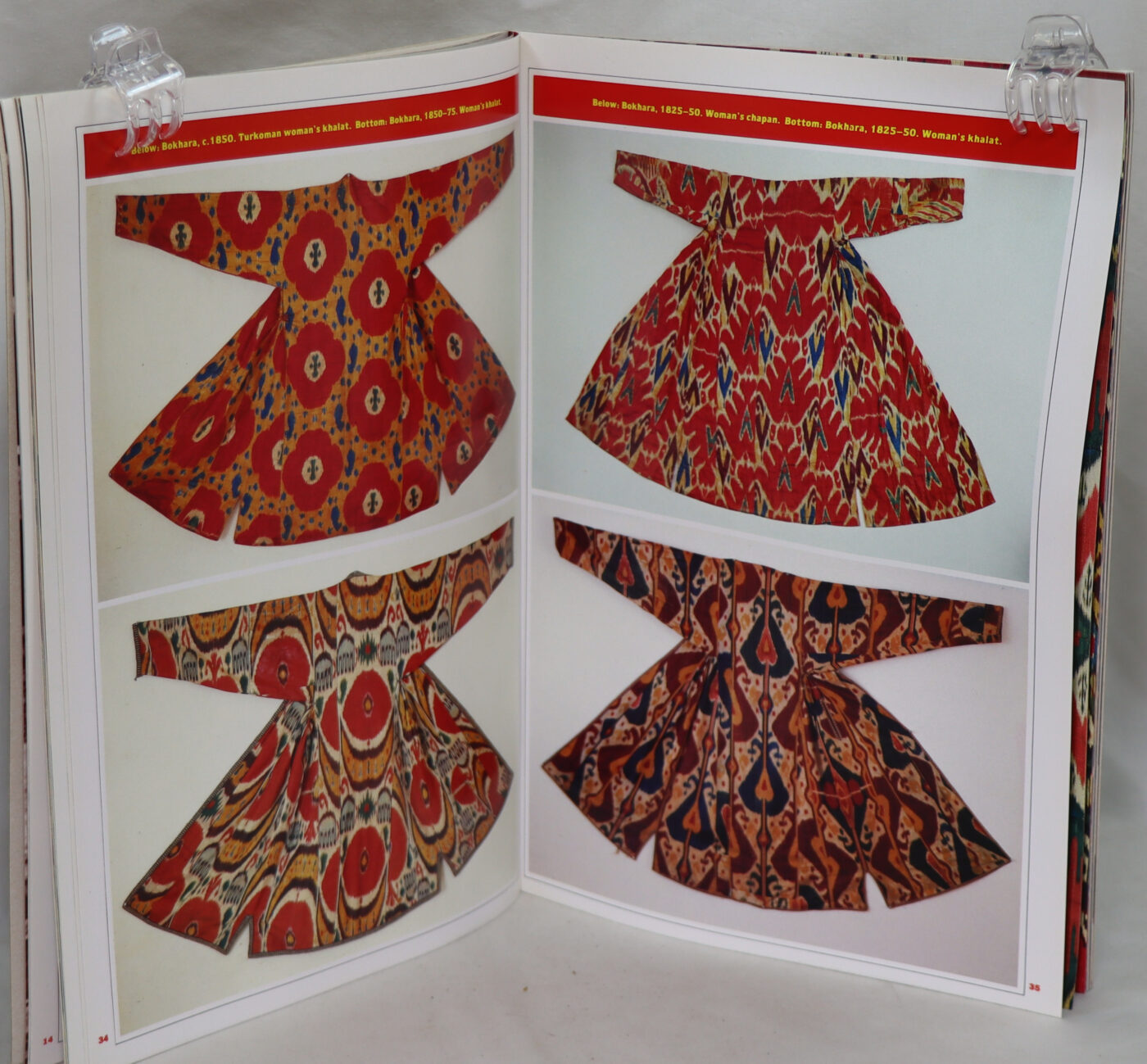
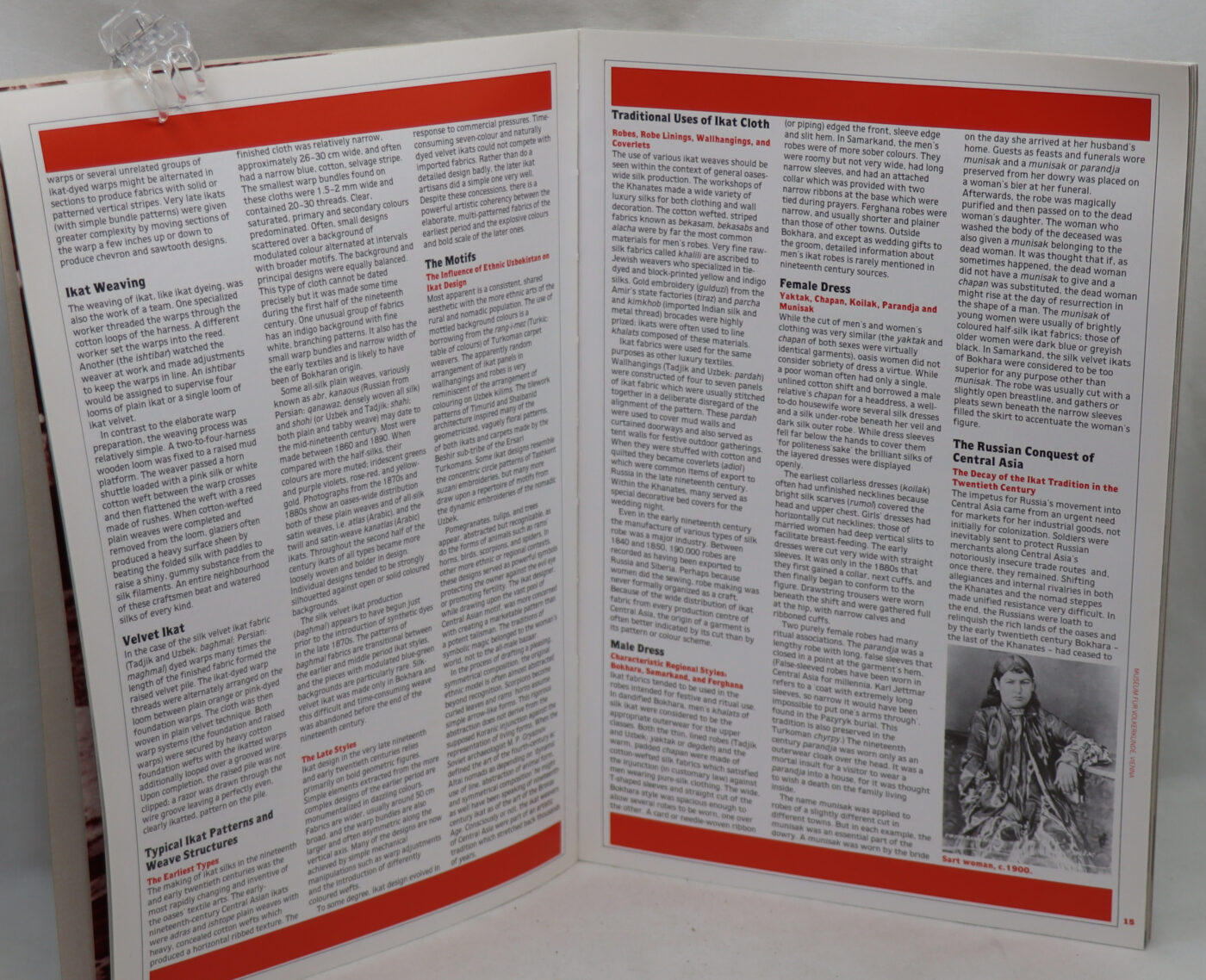
Ikat fabric was used for centuries in the traditional garments and furnishings of Central Asian tribes such as the Uzbecks and the Tadjiks. This book is intended as an introduction to Ikats, reproducing over 50 examples from the author’s private collection of Ikats. It aims to demonstrate both the magical effects created by Ikat weavers over the past two hundred years and the role Ikats played in the social and ceremonial life of the Central Asian peoples. The anecdotal introduction outlines the history of silk weaving and trading and explains how Ikats were made and who bought and used them. This book is both a history and a record of a virtually extinct craft. It is aimed at craftsmen, collectors, historians and anyone interested by the culture and trade of the East.
Review: This is a beautiful book for anyone interested in Ikats. Nicely illustrated and good writing. As someone who plans to be in Uzbekistan next year to study textiles, I find this book a very helpful read.
Ikat (literally “to bind” in Malayo-Polynesian languages) is a dyeing technique from Southeast Asia used to pattern textiles that employs resist dyeing on the yarns prior to dyeing and weaving the fabric. In Southeast Asia, where it is the most widespread, ikat weaving traditions can be divided into two general groups of related traditions. The first is found among Daic-speaking peoples (Laos, northern Vietnam, and Hainan). The second, larger group is found among the Austronesian peoples (Indonesia, Philippines, Malaysia, Brunei, and Timor-Leste) and spread via the Austronesian expansion to as far as Madagascar. It is most prominently associated with the textile traditions of Indonesia in modern times, from where the term ikat originates. Similar unrelated dyeing and weaving techniques that developed independently are also present in other regions of the world, including India, Central Asia, Ryukyu Islands (where it is called Iichiiri or Tucciri), Japan (where it is called kasuri), Africa, and the Americas.
In ikat, the resist is formed by binding individual yarns or bundles of yarns with a tight wrapping applied in the desired pattern. The yarns are then dyed. The bindings may then be altered to create a new pattern and the yarns dyed again with another colour. This process may be repeated multiple times to produce elaborate, multicolored patterns. When the dyeing is finished all the bindings are removed and the yarns are woven into cloth. In other resist-dyeing techniques such as tie-dye and batik the resist is applied to the woven cloth, whereas in ikat the resist is applied to the yarns before they are woven into cloth. Because the surface design is created in the yarns rather than on the finished cloth, in ikat both fabric faces are patterned. Ikat can be classified into three general types: warp ikat or weft ikat, in which either the warp or weft yarns are dyed, respectively; and double ikat, where both the warp and weft yarns are dyed.
A characteristic of ikat textiles is an apparent “blurriness” to the design. The blurriness is a result of the extreme difficulty the weaver has lining up the dyed yarns so that the pattern comes out perfectly in the finished cloth. The blurriness can be reduced by using finer yarns or by the skill of the craftsperson. Ikat with little blurriness, multiple colours and complicated patterns are more difficult to create and therefore often more expensive. However, the blurriness that is so characteristic of ikat is often prized by textile collectors.
Want to know more about this item?
We are happy to answer any questions you may have about this item. In addition, it is also possible to request more photographs if there is something specific you want illustrated.
Ask a question
Related products

Share this Page with a friend
