
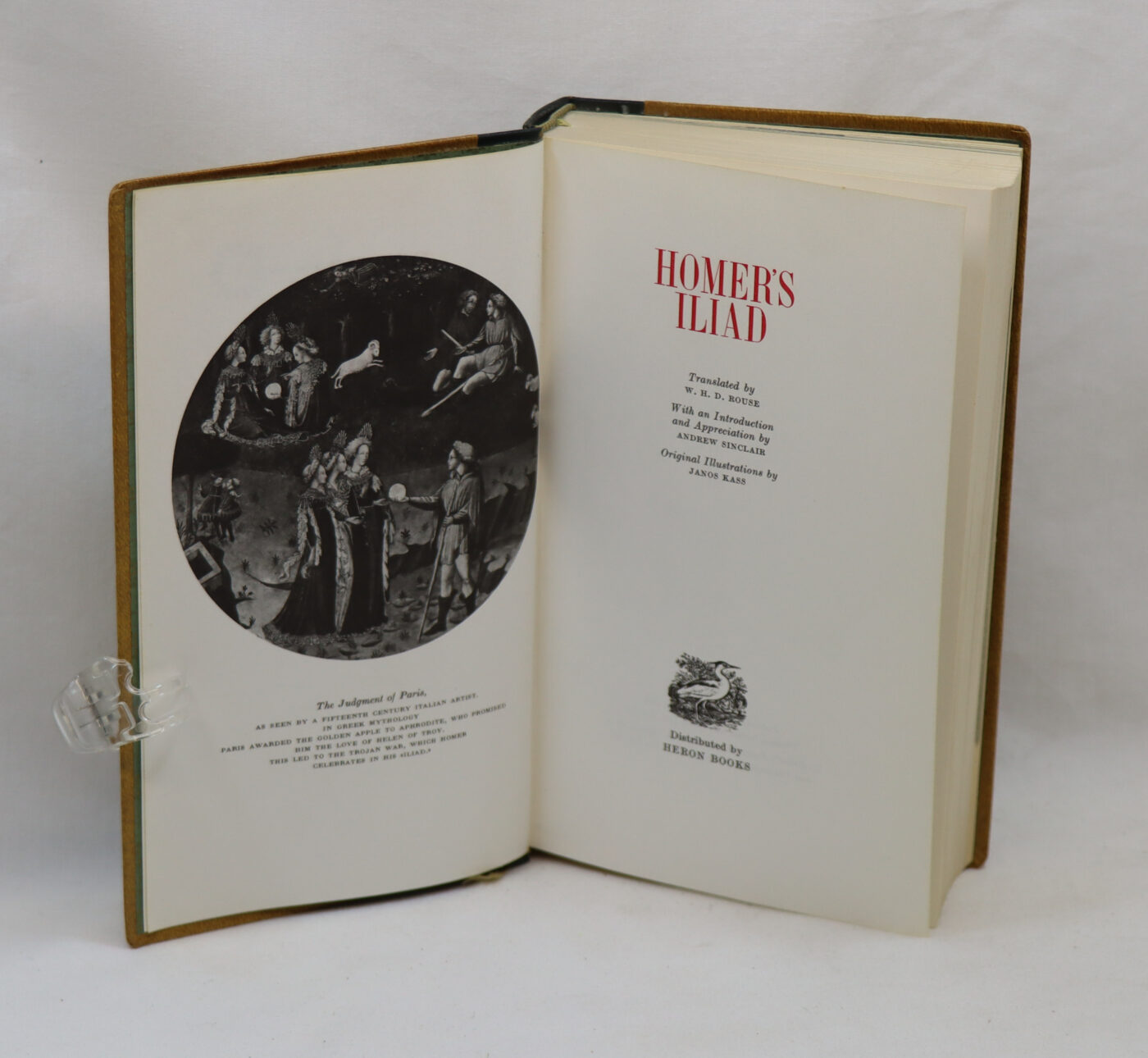
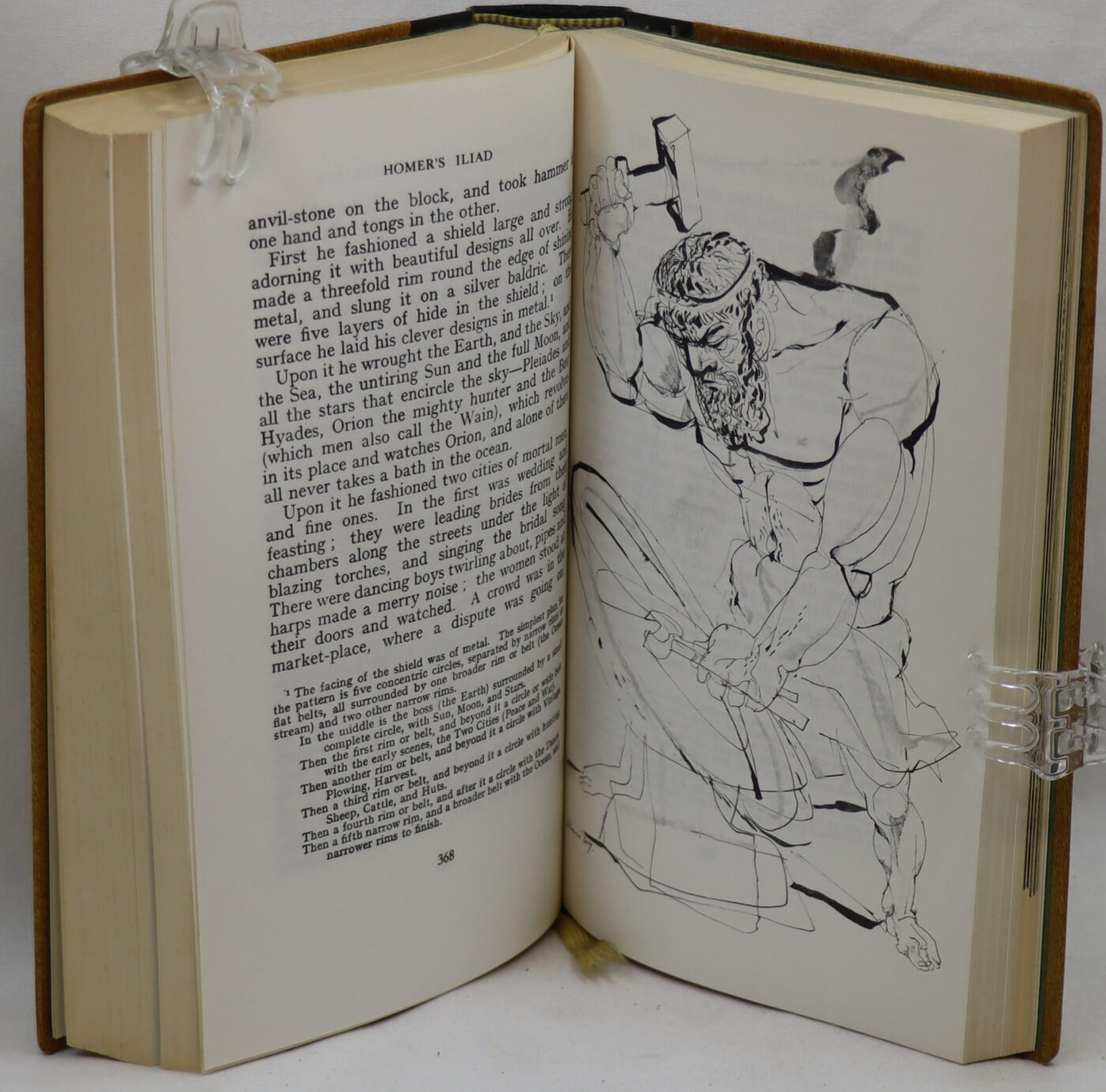
Homer's Iliad.
By Homer
Printed: Circa 1990
Publisher: Heron Books. London
| Dimensions | 13 × 21 × 3 cm |
|---|---|
| Language |
Language: English
Size (cminches): 13 x 21 x 3
Condition: Good (See explanation of ratings)
£8.00
Buy Now
Item information
Description
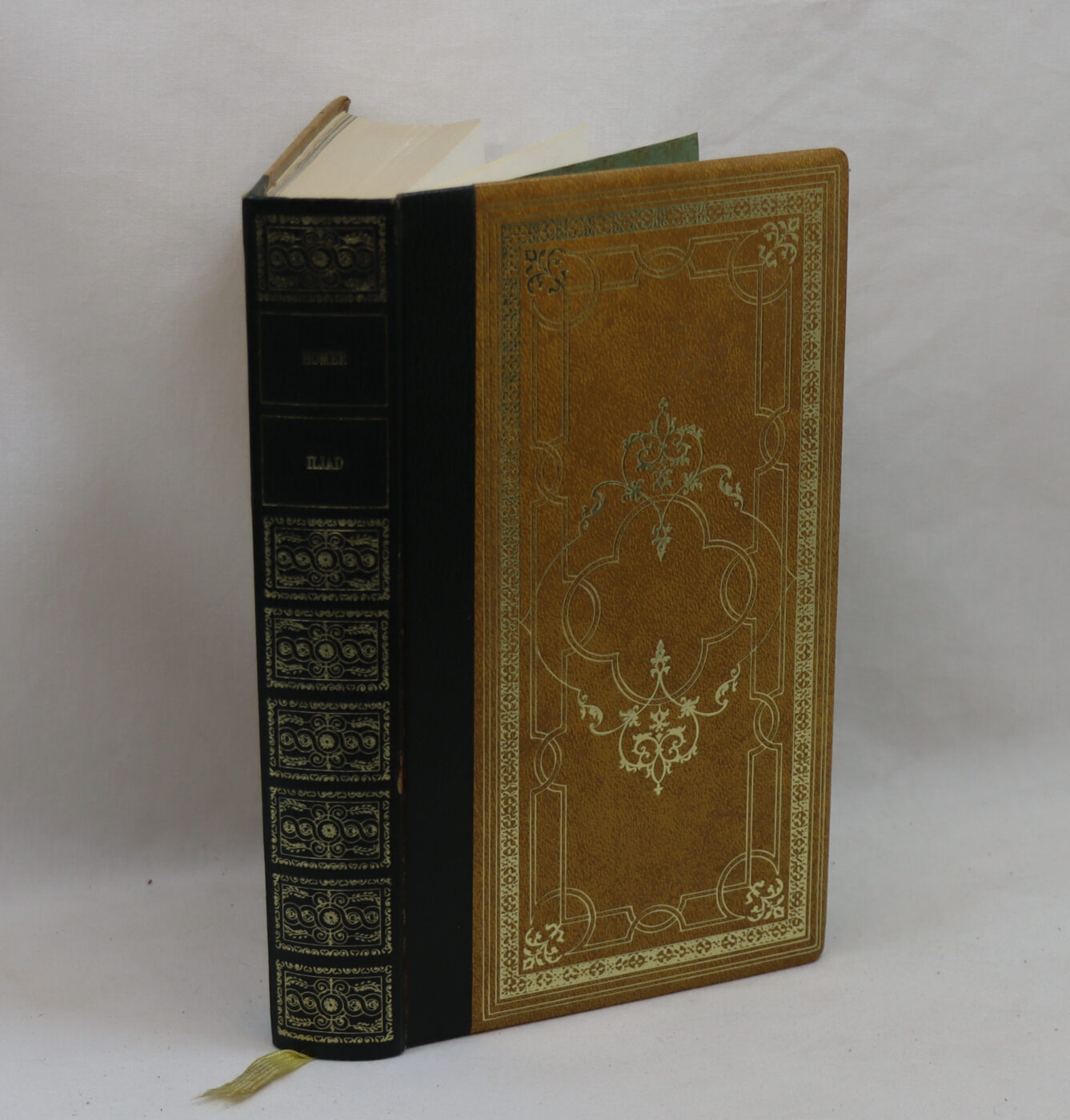
Green cloth spine with gilt title and decoration. Tan cloth boards.
We provide an in-depth photographic presentation of this item to stimulate your feeling and touch. More traditional book descriptions are immediately available.
- A £2 reduction when collected from FBA shop
‘The first great book, and the first great book about the suffering and loss of war’ Guardian
One of the foremost achievements in Western literature, Homer’s Iliad tells the story of the darkest episode in the Trojan War. At its centre is Achilles, the greatest warrior-champion of the Greeks, who refuses to fight after being humiliated by his leader Agamemnon. But when the Trojan Hector kills Achilles’ close friend Patroclus, he storms back into battle to take revenge – knowing this will ensure his own early death. E. V. Rieu’s acclaimed translation of The Iliad was one of the first titles published in Penguin Classics, and now has classic status itself.
Originally translated by E. V. RIEU Revised and updated by PETER JONES with D. C. H. RIEU Edited with an Introduction and notes by PETER JONES
The Iliad ([a poem] about Ilion (Troy)’) is one of two major surviving ancient Greek epic poems attributed to Homer. It is one of the oldest extant works of literature still widely read by modern audiences. Like the Odyssey, the poem is divided into 24 books and was written in dactylic hexameter. It contains 15,693 lines in its standard edition. The Iliad is often regarded as the first substantial piece of European literature and is central to the study of classical philology.
Set towards the end of the Trojan War, a 10-year siege of the city of Troy by a coalition of Mycenaean Greek states, the poem depicts significant events in the war’s final weeks. In particular, it traces the anger (μῆνις) of Achilles, a celebrated warrior, from a fierce quarrel between him and King Agamemnon, to the death of the Trojan prince Hector. The narrative moves between wide battleground scenes and more personal interactions. Contrary to popular belief, the Iliad does not depict the fall of Troy nor mention the Trojan Horse used by the Greeks to conquer the city, which are attributed to later sources.
The Iliad and the Odyssey were likely composed in Homeric Greek, a literary mixture of Ionic Greek and other dialects, around the 8th century BC though some modern scholars have argued for a mid-7th-century BC date. The poem’s composition, historicity, and authorship are extensively debated (the Homeric Question), with Homeric scholars likewise debating whether the Iliad and the Odyssey were composed independently, and whether they survived via an oral or also written tradition. The poem’s formulae, use of similes, and epithets are often explored by scholars. The Iliad was widely esteemed by the ancient Greeks and formed part of their standard education; the poem’s conflation of different regional dialects, and its depiction of various Greek factions uniting to fight Troy, gave it strong resonance across the Hellenistic world. It was performed by professional reciters known as rhapsodes at Greek festivals such as the Panathenaia.
Critical themes in the Iliad include kleos (glory), pride, fate, and wrath. Despite being predominantly known for its tragic and serious themes, the poem also contains instances of comedy and humor. It is frequently described as a “heroic” epic, centred around issues such as war, violence, and the heroic code. The poem contains detailed descriptions of ancient warfare, including battle tactics and equipment. However, it also explores social and domestic aspects of ancient culture in scenes behind the walls of Troy and in the Greek camp. Additionally, the Olympian gods play a major role, aiding their favoured warriors and cities on the battlefield and intervening in personal disputes. Their anthropomorphic characterisation in the poem humanised them for Ancient Greek audiences, giving a concrete sense of their cultural and religious tradition.
Want to know more about this item?
We are happy to answer any questions you may have about this item. In addition, it is also possible to request more photographs if there is something specific you want illustrated.
Ask a question
Related products






Share this Page with a friend
