
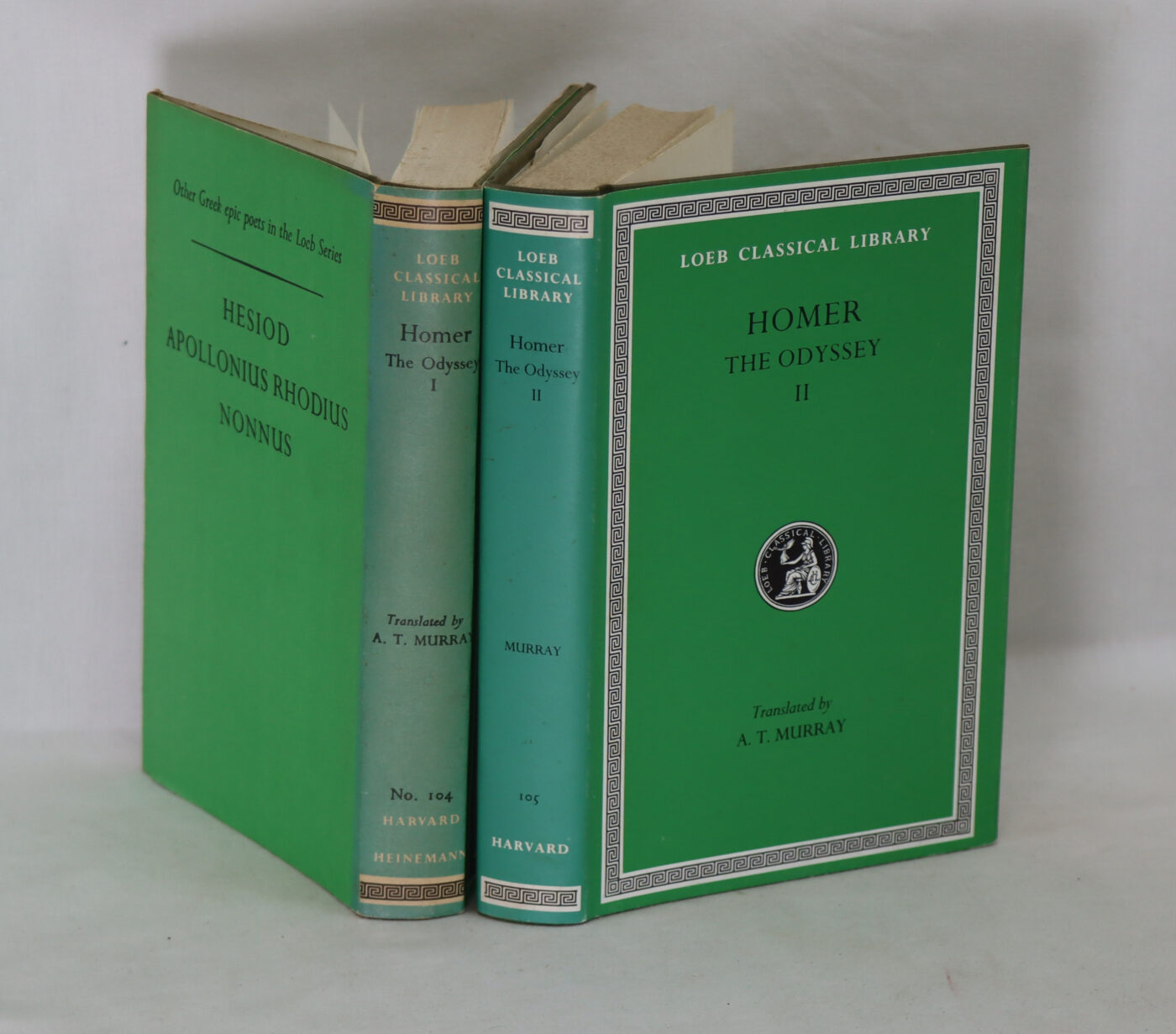
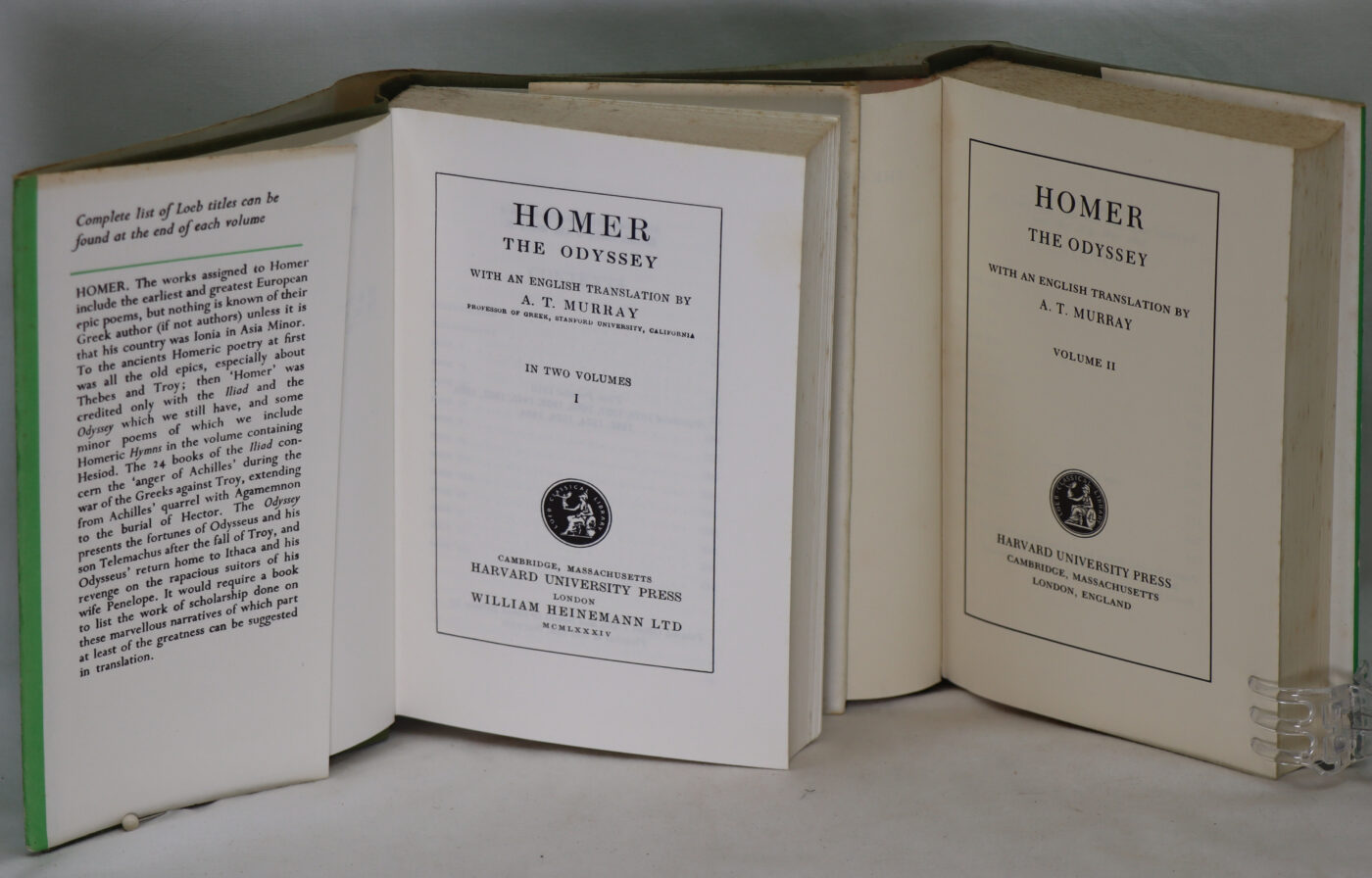
Homer. The Odyssey. Vols. I & II
By A T Murray
Printed: 1984-1991
Publisher: Harvard University Press.
| Dimensions | 12 × 17 × 2 cm |
|---|---|
| Language |
Language: English
Size (cminches): 12 x 17 x 2
Condition: Very good (See explanation of ratings)
£50.00
Buy Now

Item information
Description
In the original dust cover. Green cloth binding with gilt title on the spine. Dimensions are for one volume.
We provide an in-depth photographic presentation of this item to stimulate your feeling and touch. More traditional book descriptions are immediately available.
- Note: This book carries a £5.00 discount to those that subscribe to the F.B.A. mailing list
A classic and well known rendition. Please view the photographs.
The Odyssey ( Ὀδύσσεια, romanized: Odýsseia) is one of two major epics of ancient Greek literature attributed to Homer. It is one of the oldest surviving works of literature and remains popular with modern audiences. Like the Iliad, the Odyssey is divided into 24 books. It follows the heroic king of Ithaca, Odysseus, also known by the Latin variant Ulysses, and his homecoming journey after the ten-year long Trojan War. His journey from Troy to Ithaca lasts an additional ten years, during which time he encounters many perils and all of his crewmates are killed. In Odysseus’s long absence, he is presumed dead, leaving his wife Penelope and son Telemachus to contend with a group of unruly suitors competing for Penelope’s hand in marriage.
The Odyssey was first written down in Homeric Greek around the 8th or 7th century BC; by the mid-6th century BC, it had become part of the Greek literary canon. In antiquity, Homer’s authorship was taken as true, but contemporary scholarship predominantly assumes that the Iliad and the Odyssey were composed independently, forming as part of long oral traditions. Given widespread illiteracy, the poem was performed for an audience by an aoidos or rhapsode.
Key themes in the epic include the ideas of nostos (νόστος; ‘return’, homecoming), wandering, xenia (ξενία; ‘guest-friendship’), testing, and omens. Scholars still explore the narrative significance of certain groups in the poem, such as women and slaves, who have larger roles than in other works of ancient literature. This focus is especially remarkable when contrasted with the Iliad, which centres the exploits of soldiers and kings during the Trojan War.
The Odyssey is regarded as one of the most significant works of the Western canon. The first English translation of the Odyssey was in the 16th century. Adaptations and re-imaginings continue to be produced across a wide variety of media. In 2018, when BBC Culture polled experts around the world to find literature’s most enduring narrative, the Odyssey topped the list.
Homer (possibly born c. the 8th century BCE) was an Ancient Greek poet who is credited as the author of the Iliad and the Odyssey, two epic poems that are foundational works of ancient Greek literature. Despite doubts about his authorship, Homer is considered one of the most revered and influential authors in history.
The Iliad centers on a quarrel between King Agamemnon and the warrior Achilles during the last year of the Trojan War. The Odyssey chronicles the ten-year journey of Odysseus, king of Ithaca, back to his home after the fall of Troy. The epics depict man’s struggle, the Odyssey especially so, as Odysseus perseveres through punishment of the gods.The poems are in Homeric Greek, also known as Epic Greek, a literary language which shows a mixture of features of the Ionic and Aeolic dialects from different centuries; the predominant influence is Eastern Ionic.Most researchers believe that the poems were originally transmitted orally. Despite being predominantly known for their tragic and serious themes, the Homeric poems also contain instances of comedy and laughter.
The Homeric poems shaped aspects of ancient Greek culture and education, fostering ideals of heroism, glory, and honor. To Plato, Homer was simply the one who “has taught Greece” (τὴν Ἑλλάδα πεπαίδευκεν, tēn Helláda pepaídeuken). In Dante Alighieri’s Divine Comedy, Virgil refers to Homer as “Poet sovereign”, king of all poets; in the preface to his translation of the Iliad, Alexander Pope acknowledges that Homer has always been considered the “greatest of poets”. From antiquity to the present day, Homeric epics have inspired many famous works of literature, music, art, and film.
The question of by whom, when, where, and under what circumstances the Iliad and Odyssey were composed continues to be debated. Scholars generally regard the two poems as the works of separate authors. It is thought that the poems were composed at some point around the late eighth or early seventh century BCE. Many accounts of Homer’s life circulated in classical antiquity, the most widespread being that he was a blind bard from Ionia, a region of central coastal Anatolia in present-day Turkey.] Modern scholars consider these accounts legendary.
Want to know more about this item?
We are happy to answer any questions you may have about this item. In addition, it is also possible to request more photographs if there is something specific you want illustrated.
Ask a question
Related products
Share this Page with a friend
