
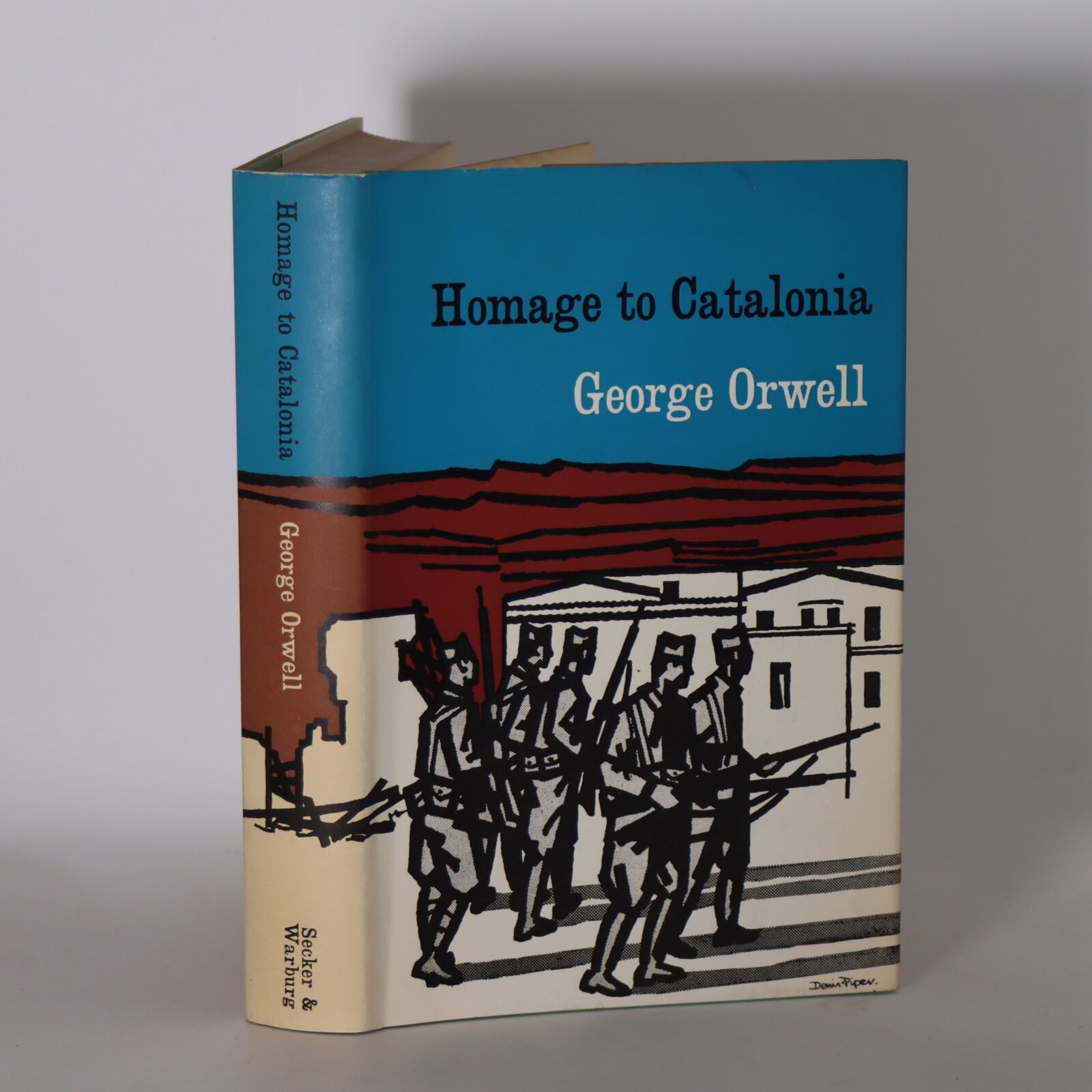
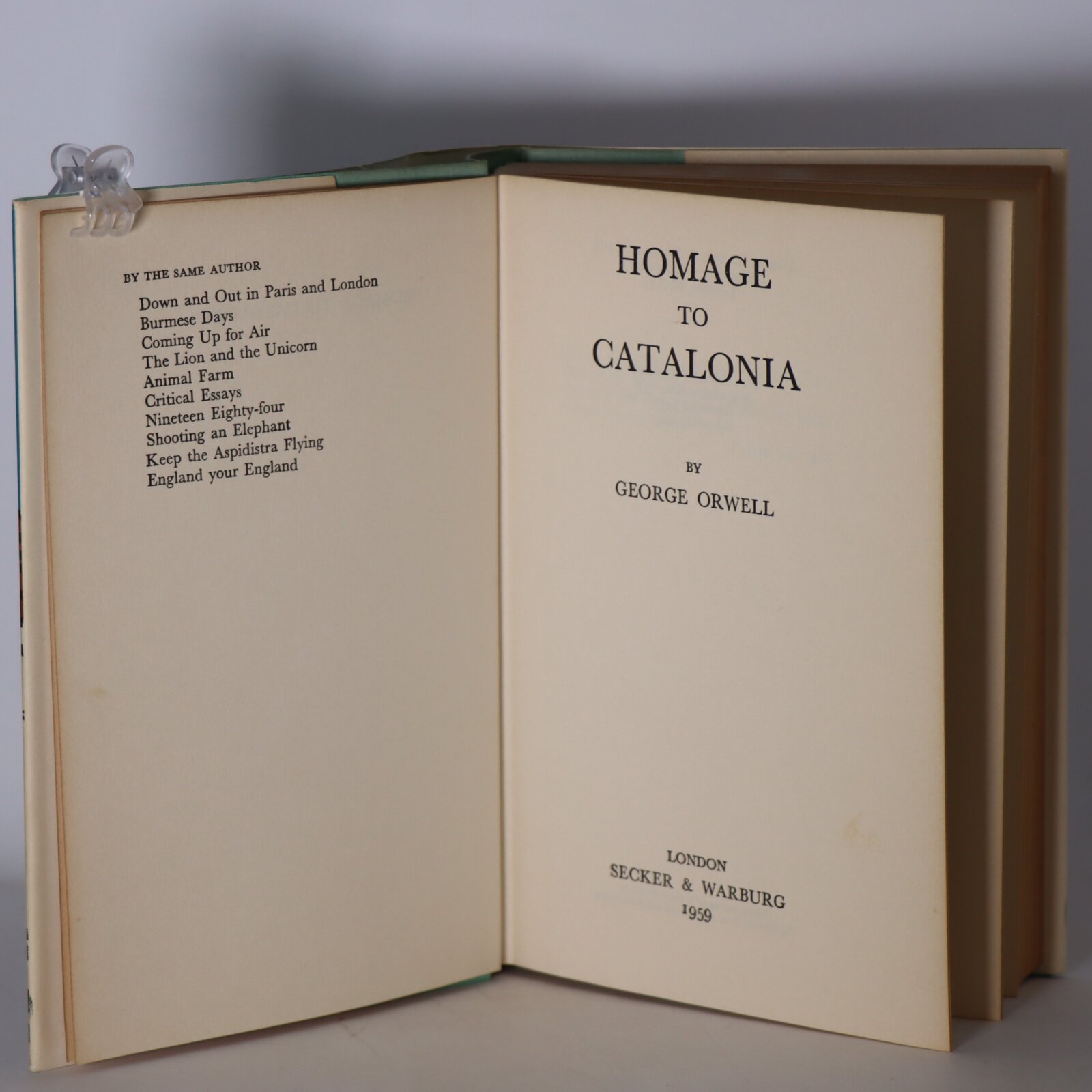
Homage to Catalonia.
By George Orwell
Printed: 1959
Publisher: Secket & Warburgh. London
Edition: Reprint
| Dimensions | 14 × 20 × 3 cm |
|---|---|
| Language |
Language: English
Size (cminches): 14 x 20 x 3
Condition: Fine (See explanation of ratings)
£21.00
Buy Now

Item information
Description
In the original dustsheet. Green cloth binding with gilt title on the spine.
F.B.A. provides an in-depth photographic presentation of this item to stimulate your feel and touch. More traditional book descriptions are immediately available.
A very nicely kept book
Homage to Catalonia is George Orwell's personal account of his experiences and observations fighting in the Spanish Civil War for the POUM militia of the Republican army. Published in 1938 (about a year before the war ended) with little commercial success, it gained more attention in the 1950s following the success of Orwell's better-known works Animal Farm (1945) and Nineteen Eighty-Four (1949). Covering the period between December 1936 and June 1937, Orwell recounts Catalonia’s
revolutionary fervour during his training in Barcelona, his boredom on the front lines in Aragon, his involvement in the inter factional May Days conflict back in Barcelona on leave, his getting shot in the throat back on the front lines, and his escape to France after the POUM was declared an illegal organisation. The war was one of the defining events of his political outlook and a significant part of what led him to write in 1946, “Every line of serious work that I have written since 1936 has been written, directly or indirectly, against totalitarianism and for democratic socialism, as I understand it”.
Eric Arthur Blair (25 June 1903 – 21 January 1950), better known by his pen name George Orwell, was an English novelist, essayist, journalist, and critic. His work is characterised by lucid prose, social criticism, opposition to totalitarianism, and support of democratic socialism. Orwell produced literary criticism and poetry, fiction and polemical journalism. He is known for he allegorical novella Animal Farm (1945) and the dystopian novel Nineteen Eighty-Four (1949). His non-fiction works, including The Road to Wigan Pier (1937), documenting his experience of working-class life in the industrial north of England, and Homage to Catalonia (1938), an account of his experiences soldiering for the Republican faction of the Spanish Civil War (1936–1939), are as critically respected as his essays on politics and literature, language and culture. Blair was born in India and raised and educated in England. After school he became an Imperial policeman in Burma, before returning to Suffolk, England, where he began his writing career as George Orwell—a name inspired by a favourite location, the River Orwell. He lived from occasional
pieces of journalism, and also worked as a teacher or bookseller whilst living in London. From the late 1920s to the early 1930s, his success as a writer grew and his first books were published. He was wounded fighting in the Spanish Civil War, leading to his first period of ill health on return to England. During the Second World War he worked as a journalist and for the BBC. The publication of Animal Farm led to fame during his lifetime. During the final years of his life, he worked on Nineteen Eighty-Four, and moved between Jura in Scotland and London. It was published in June 1949, less than a year before his death.
Orwell’s work remains influential in popular culture and in political culture, and the adjective “Orwellian” describing totalitarian and authoritarian social practices—is part of the English language, like many of his neologisms, such as “Big Brother”, “Thought Police”, “Room 101”, “Newspeak”, “memory hole”, “doublethink”, and “thoughtcrime”. In 2008, The Times ranked George Orwell second among “The 50 greatest British writers since 1945”.
Want to know more about this item?
We are happy to answer any questions you may have about this item. In addition, it is also possible to request more photographs if there is something specific you want illustrated.
Ask a question
Related products
Share this Page with a friend
