
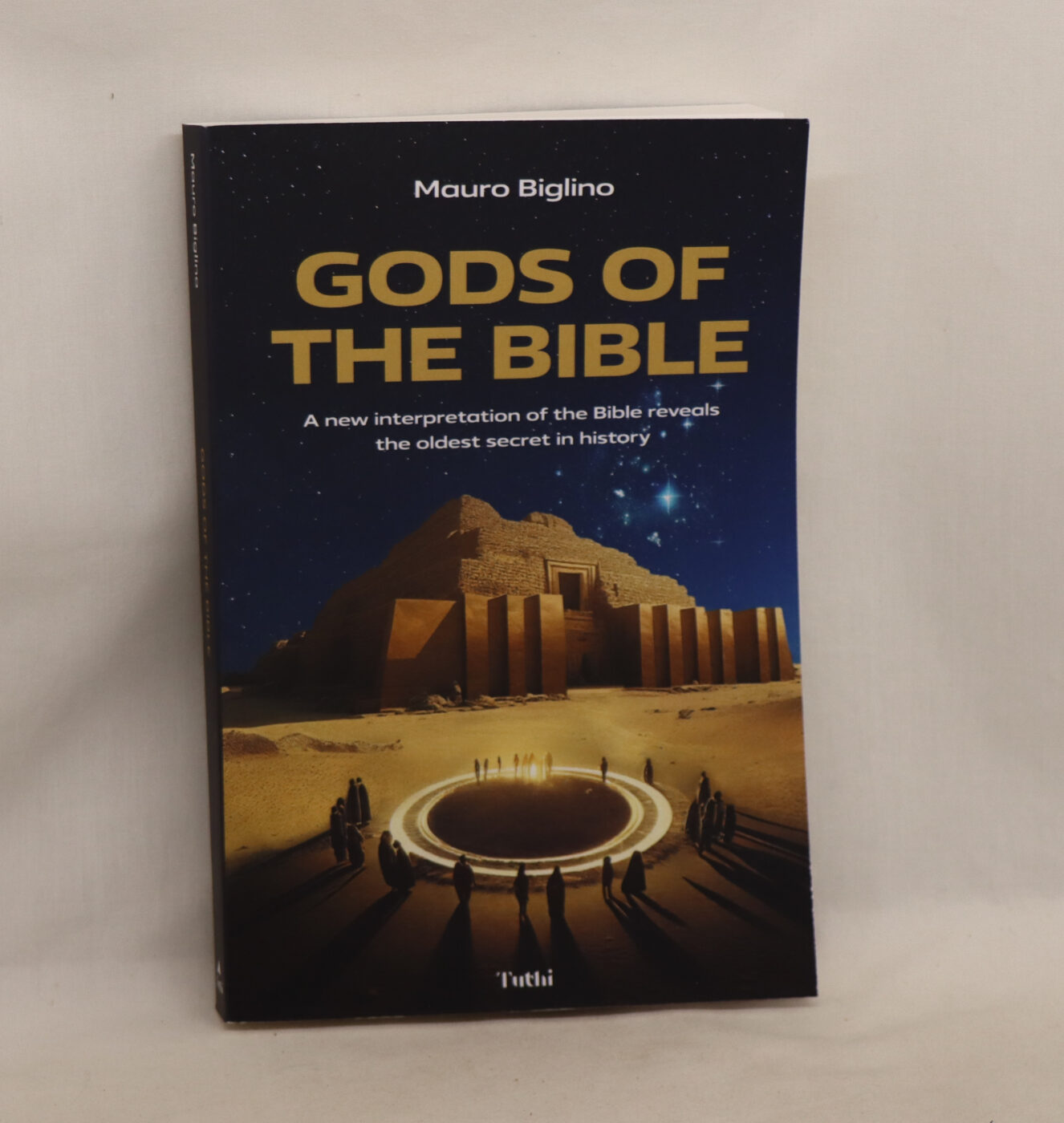
Gods of the Bible.
By Mauro Biglino
ISBN: 9788894611755
Printed: 2023
Publisher: Tuthi. Torino
| Dimensions | 15 × 23 × 2 cm |
|---|---|
| Language |
Language: English
Size (cminches): 15 x 23 x 2
Condition: As new (See explanation of ratings)
£15.00
Buy Now


Item information
Description
Paperback. Black cover with tan title and pyramid on the front board.
We provide an in-depth photographic presentation of this item to stimulate your feeling and touch. More traditional book descriptions are immediately available
-
THIS FROST PAPERBACK is a NEW book which a member of the Frost family has checked for condition, cleanliness, completeness and readability. When the buyer collects their book from Frost’s shop, the delivery charge of £3.00 is deducted.
If you read the Bible literally, everything becomes understandable and plain because the biblical authors did not feel the need, as we do, to advocate for a precise monotheistic theological perspective or a moral authority of religious order. Through the pages of this book “God” will show himself in a light entirely unsuspected to most readers. The final portrait that will emerge will reveal the image of a character very different from what many of our readers are accustomed to.
The Bible, falsifications and mistranslations: From the necessity of harmonizing the biblical text with the theological and monotheistic conception of God of Western culture arises a whole series of falsifications and mistranslations, in view of which that first innocent printing typo I had discovered twenty-five years ago really seems like a “speck in the eye of the brother.” Instead, here we talk about massive logs that have remained in our eyes for hundreds and thousands of years, so long that we even ignore our blindness.
God or Gods? In this book, I focus on the identity and character of Yahweh and the meaning of the term “Elohim.” When we read the term “God” in the Bible, this usually comes from the Hebrew term “Elohim.” However, at least when I worked for Edizioni San Paolo, the term “Elohim” was left untranslated into the interlinear edition of the Bible that we prepared for scholars and academia. In the Bibles available to the public, the same term was translated as “God.” Therefore, where people read “God” and believe that the biblical authors wrote the equivalent of the word “God,” scholars read the term “Elohim.” This was to alert them that this word is problematic, to say the least, for the unbiased translator.
“My reading will result in most passages being unorthodox to a religious perspective. Some would say even heretical. For this reason, for all passages that indicate an unconventional, unexpected, and non-heterodox reading, we reproduce the original Hebrew text with the literal translation verbatim, word for word.”
Review: Mauro Biglino’s Gods of the Bible is a bold, provocative work that invites readers to re-examine the foundational texts of the Judeo-Christian tradition through an unorthodox but deeply inquisitive lens. Drawing on his experience as a Vatican translator and expert in ancient Hebrew, Biglino strips back centuries of theological interpretation to propose that the Bible, particularly the Old Testament, may not be describing a singular, omnipotent spiritual deity—but rather a pantheon of very tangible, powerful beings with advanced technology and knowledge. At its core, Biglino’s argument hinges on a literal translation of key Hebrew terms—most notably “Elohim,” which he contends is a plural noun that has been conventionally mistranslated as “God.” He further suggests that the “divine interventions” and miraculous events in the Bible might be better understood as the actions of extraterrestrial entities rather than spiritual metaphors. It’s a viewpoint that disrupts traditional theology but opens a fascinating speculative avenue about our origins, our past, and who—or what—may have once walked among us.
Parallels with Mormon Beliefs: What makes Gods of the Bible especially compelling is how some of its ideas resonate, even if unintentionally, with elements found in Latter-day Saint (Mormon) theology. While the two worldviews are not identical, several thematic parallels emerge:
-
Plurality of Gods: Mormon doctrine, particularly as elaborated in the King Follett Discourse by Joseph Smith, affirms the existence of a plurality of gods. Smith taught that God was once a man and that humans have the potential to become like God—a concept that aligns intriguingly with Biglino’s reinterpretation of “Elohim” as multiple powerful beings with physical characteristics.
-
Gods with Physical Bodies: In LDS theology, God the Father and Jesus Christ are described as having tangible, glorified bodies. Biglino’s hypothesis that the biblical “gods” were corporeal beings who interacted directly and physically with humanity echoes this idea, although his take is framed in the context of ancient astronauts rather than exalted beings.
-
Extraterrestrial Possibility: While Mormonism doesn’t officially teach about ancient aliens, it does hold expansive cosmological views—such as the belief in inhabited worlds beyond Earth and the eternal progression of souls. Biglino’s suggestion that humanity’s ancient interactions may have involved beings from elsewhere in the cosmos aligns with the LDS openness to a broader, inhabited universe.
-
Lost Knowledge and Suppressed Truths: Both Biglino and Mormonism share a concern with lost or obscured knowledge. Biglino accuses religious institutions of deliberately misrepresenting ancient texts, while Mormonism speaks of a Great Apostasy and the need for restored truths through new revelation.
-
Final Thoughts: Gods of the Bible may challenge traditional religious readers, but it thrives as a work that encourages fresh thought and intellectual curiosity. While not intended to align with Mormon doctrine, Biglino’s book intersects with Latter-day Saint theology in ways that highlight both traditions’ willingness to think beyond the theological status quo.
For readers with a background in Mormonism, Gods of the Bible may not provide confirmation—but it does offer a parallel path of exploration that encourages a larger, more cosmic understanding of divine possibility. It is a radical book, yes, but one that asks compelling questions about who we are, where we come from, and what truths still lie hidden in the pages of ancient scripture.
Mauro Biglino: Translator of 19 books of the Old Testament with Edizioni San Paolo, the scholar in ancient languages Mauro Biglino stood out in the eyes of the general public from 2010 with his outstanding literal reinterpretation of the Bible, expressed in a series of best-selling essays. His work has won over aficionados, scholars and all sorts of readers. His books take the reader by the hand and – free of any preconceptions or theological filters – accompany them through a fascinating narration of biblical verses, which are analysed in their original form in ancient Hebrew.
Want to know more about this item?
We are happy to answer any questions you may have about this item. In addition, it is also possible to request more photographs if there is something specific you want illustrated.
Ask a question
Related products


Share this Page with a friend
