
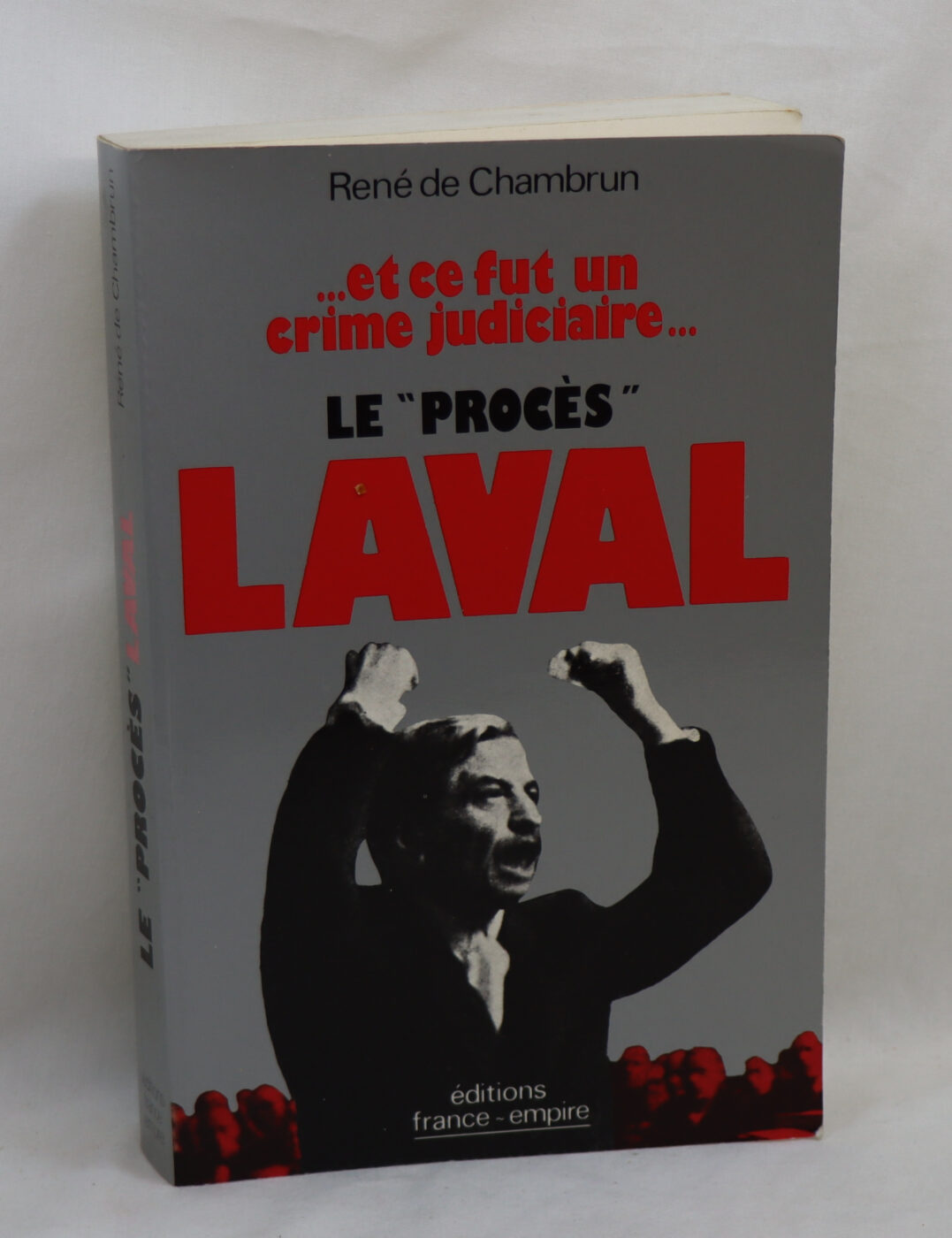
Et Ce Fut un Crime Judiciaire le Proces Laval.
By Rene de Chambrun
Printed: 1984
Publisher: Editions France Empire. Paris
| Dimensions | 15 × 24 × 3 cm |
|---|---|
| Language |
Language: French
Size (cminches): 15 x 24 x 3
Condition: Very good (See explanation of ratings)
£16.00
Buy Now

Item information
Description
Paperback. Grey cover with red title.
We provide an in-depth photographic presentation of this item to stimulate your feeling and touch. More traditional book descriptions are immediately available.
- Note: This book carries a £5.00 discount to those that subscribe to the F.B.A. mailing list
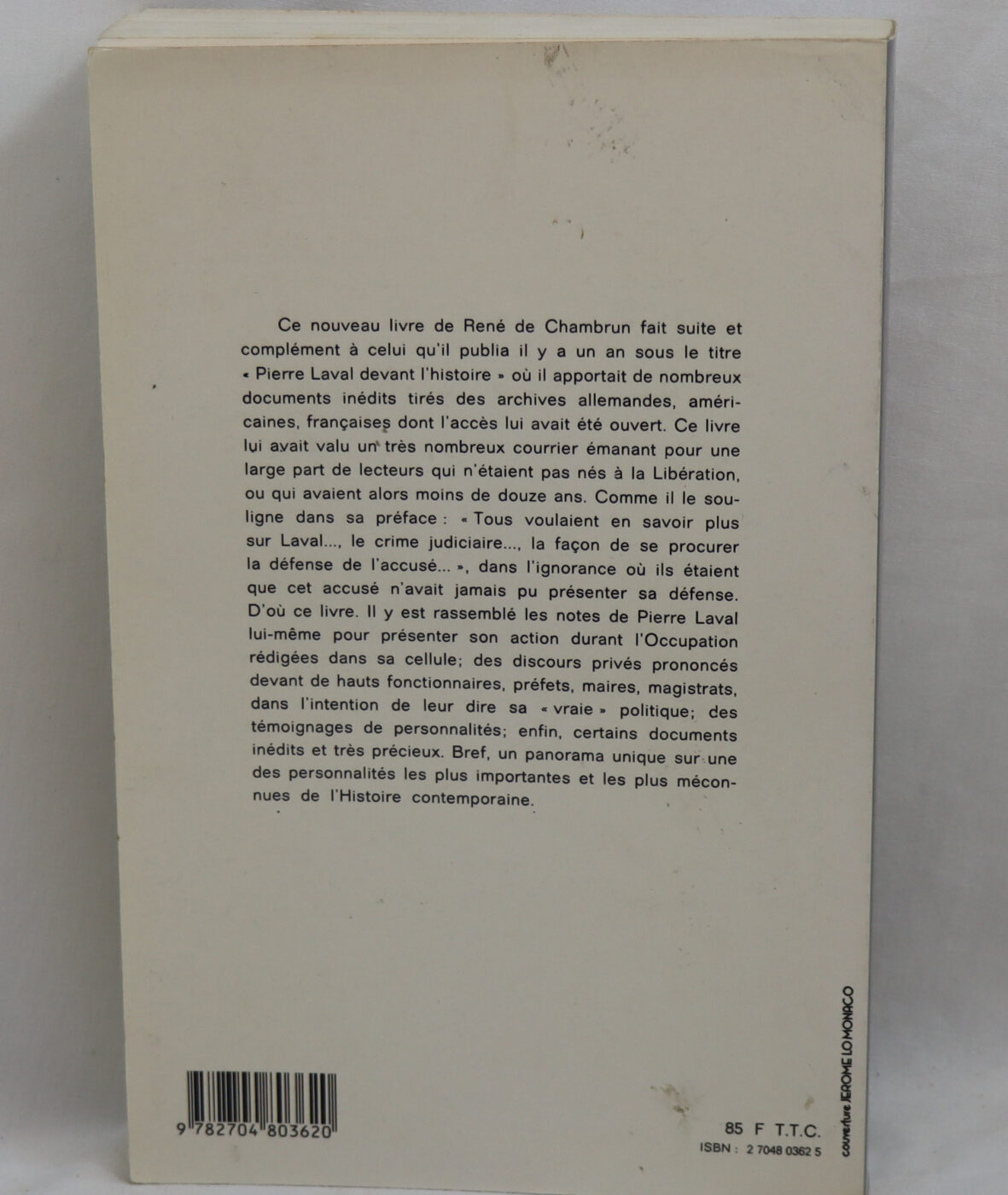
Please view our photographs and read the rubric on the rear cover. In English: Et Ce Fut un Crime Judiciaire le Proces Laval. By Rene de Chambrun Printed: 1984 Publisher: Editions France Empire. Paris Language: French Size (inches): 6 x 9.6 x 1.2 Condition: Very good
The English translation for the title and bibliographic details provided is:
“And It Was a Judicial Crime: The Laval Trial”
Bibliographic Details
- Author: René de Chambrun
- Publication Date: 1984
- Publisher: Éditions France-Empire, Paris
- Language: French
- Format / Size: ~6 x 9.6 x 1.2 inches (Octavo format, 378 pages)
- Condition: Very good
Historical Context
The author, René de Chambrun, was the son-in-law of Pierre Laval, the Prime Minister of the collaborationist Vichy regime in France during World War II. In this book, Chambrun presents a legal defense and historical critique arguing that Laval’s swift trial and execution for treason in 1945 amounted to a biased and deeply flawed “judicial crime”.
Note: If you are looking for an English-language edition of René de Chambrun’s work on this topic, it was published in the United States in 1984 under the title Pierre Laval: Traitor or Patriot? by Charles Scribner’s Sons.
Book Content
The book is a highly partisan historical and legal critique of the 1945 treason trial of Pierre Laval, the head of the collaborationist Vichy government during World War II. Written by his son-in-law, René de Chambrun, the book uses private documents, court transcripts, and personal accounts to argue that the trial was a “judicial crime” engineered to execute Laval quickly without allowing a proper legal defense. Chambrun outlines what he considers severe procedural violations, including biased judges, rushed timelines, and suppressed evidence, attempting to reframe Laval not as a traitor, but as a patriot who tried to shield France from worse German atrocities.
The structural arrangement of Et Ce Fut un Crime Judiciaire: Le Procès Laval divides its 378 pages into two distinct foundational parts.
René de Chambrun organized the book not as a traditional chronological narrative, but as a formal legal brief. The structure splits the volume into the author’s primary legal polemic and a massive archival text repository:
Part I: The Legal Argument (Première Partie)
The first portion of the book contains Chambrun’s analytical breakdown of the events leading up to and during the October 1945 trial. It is structured into thematic chapters focusing on procedural violations:
- The Political Context: Examines the post-liberation atmosphere in France and the political necessity felt by Charles de Gaulle’s provisional government to quickly dispose of Vichy’s leadership.
- The Instruction (Pre-Trial Phase): Argues that the judicial investigation led by Pierre Bouchardon was intentionally rushed, giving Laval virtually no time to review the massive state dossier compiled against him.
- The High Court Hearings: A blow-by-blow critique of the court sessions. Chambrun focuses heavily on the open hostility of the jury (which consisted partly of resistance fighters and politicians who explicitly shouted insults at Laval), the bias of Presiding Judge Paul Mongibeaux, and Prosecutor André Mornet.
- The Defense Walkout: Details the pivotal moment where Laval and his lawyers refused to return to the courtroom due to the systemic denial of basic legal rights, resulting in Laval being sentenced to death in absentia while locked in his cell.
- The Execution: Relates the dramatic final hours, including Laval’s attempted suicide by poison in his cell, the rushed stomach pumping, and his subsequent execution by firing squad while barely conscious.
Part II: The Dossier and Evidence (Deuxième Partie)
The largest physical portion of the book (spanning pages 53 to 182) acts as an extensive documentary appendix. Rather than narrative prose, these sections are broken down by the specific legal documents Chambrun introduces to refute the treason charges:
- The Secret Exchanges: Reconstitutes transcripts and letters showing Laval’s internal arguments with German authorities (such as Sauckel and Abetz) regarding the forced labor draft (STO) and the protection of French national sovereignty.
- The Written Defense Notes: Reproduces the exact notes, defenses, and rebuttals that Laval drafted in his cell but was legally barred from presenting or expanding upon during the truncated trial.
Market Price Estimate: Because this specific 1984 French paperback edition by Éditions France-Empire is out of print, its value depends entirely on the secondhand collector’s market.
- Original Retail Price: Originally sold for approximately €13.00 – €16.00.
- Current Secondhand Market Value: For a copy in “Very Good” condition, it typically sells online for approx. £13.00 to £16.00 on European used-book platforms like Fnac or Chasse aux Livres.
Want to know more about this item?
We are happy to answer any questions you may have about this item. In addition, it is also possible to request more photographs if there is something specific you want illustrated.
Ask a question
Related products

Share this Page with a friend
