
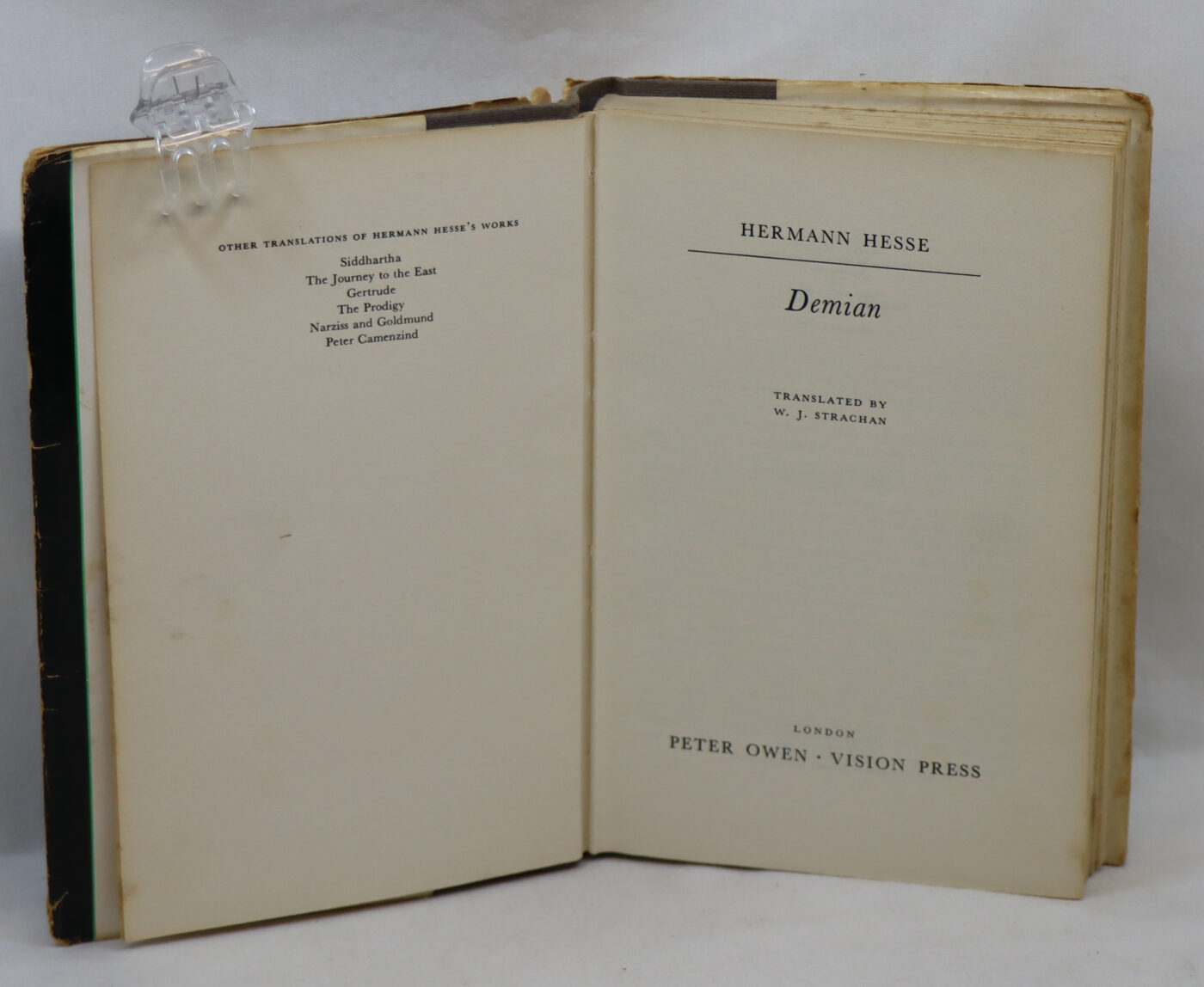
Demian.
By Herman Hesse
Printed: 1965
Publisher: Peter Owen Vision Press. London
| Dimensions | 13 × 19 × 2 cm |
|---|---|
| Language |
Language: English
Size (cminches): 13 x 19 x 2
Condition: Fair (See explanation of ratings)
£40.00
Buy Now


Item information
Description
In the original dust jacket. Grey cloth binding with gilt title on the spine.
We provide an in-depth photographic presentation of this item to stimulate your feeling and touch. More traditional book descriptions are immediately available
- Note: This book carries a £5.00 discount to those that subscribe to the F.B.A. mailing list
Please view our photographs. An original book from the library gathered by the famous Cambridge Don, computer scientist, food and wine connoisseur, Jack Arnold LANG.
This book was acquired by Jack’s clever mother.
A doctor of great knowledge.
From the Nobel Prize winning author of Siddhartha, Steppenwolf and The Glass Bead Game. Emil Sinclair boasts of a theft that he has not committed and subsequently finds himself blackmailed by a bully. He turns to Max Demian, in whom he finds a friend and spiritual mentor … Published shortly after the First World War and before Siddharta and Steppenwolf, Demian marks a significant turning point in Hesse’s literary career. It is the first time Hermann Hesse used the novel overtly as a means to explore ideas of the self, the meaning and purpose of existence, as well as his own ideas and interpretations of theosophy and Eastern Philosophy. As such it is ranked among the finest of his works.
Demian: The Story of a Boyhood is a bildungsroman by Hermann Hesse, first published in 1919; a prologue was added in 1960. Demian was first published under the pseudonym “Emil Sinclair”, the name of the narrator of the story, but Hesse was later revealed to be the author; the tenth edition was the first to bear his name.
Hermann Karl Hesse ( 2 July 1877 – 9 August 1962) was a German-Swiss poet and novelist, and winner of the 1946 Nobel Prize in Literature. His interest in Eastern religious, spiritual, and philosophical traditions, combined with his involvement with Jungian analysis, helped to shape his literary work. His best-known novels include Demian, Steppenwolf, Siddhartha, Narcissus and Goldmund, and The Glass Bead Game, each of which explores an individual’s search for authenticity, self-knowledge, and spirituality.
Hesse was a widely read author in German-speaking countries during his lifetime, but his more enduring international fame did not come until a few years after his death, when, in the mid-1960s, his works became enormously popular with post-World War II generation readers in the United States, Europe, and elsewhere.
Want to know more about this item?
We are happy to answer any questions you may have about this item. In addition, it is also possible to request more photographs if there is something specific you want illustrated.
Ask a question
Related products






Share this Page with a friend
