
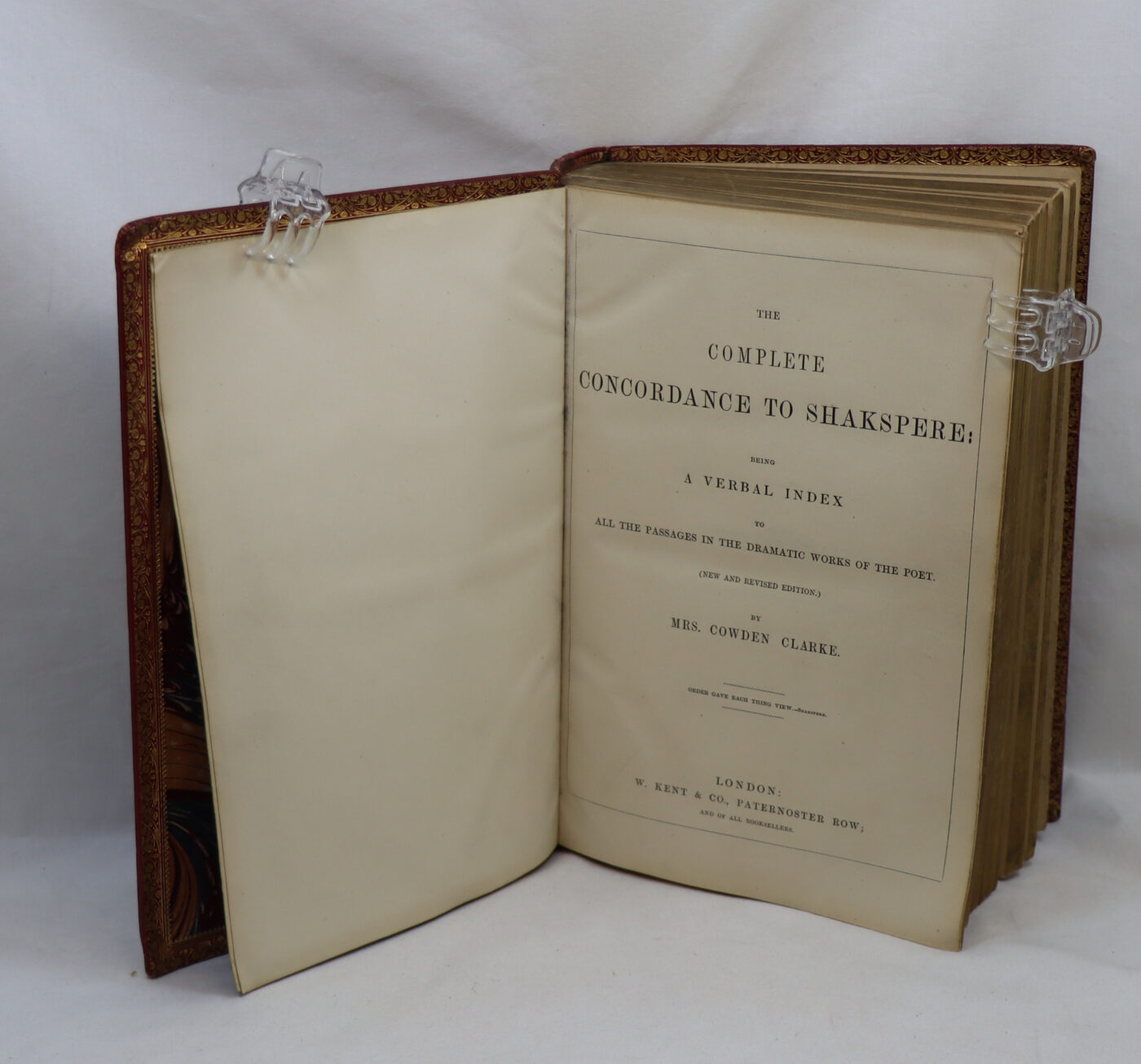
Concordance to Shakespere.
By Mary Cowden Clarke
Printed: 1881
Publisher: W Kent & Co. London
| Dimensions | 19 × 26 × 5 cm |
|---|---|
| Language |
Language: English
Size (cminches): 19 x 26 x 5
Condition: Very good (See explanation of ratings)
£178.00
FREE shipping
Buy Now

Item information
Description
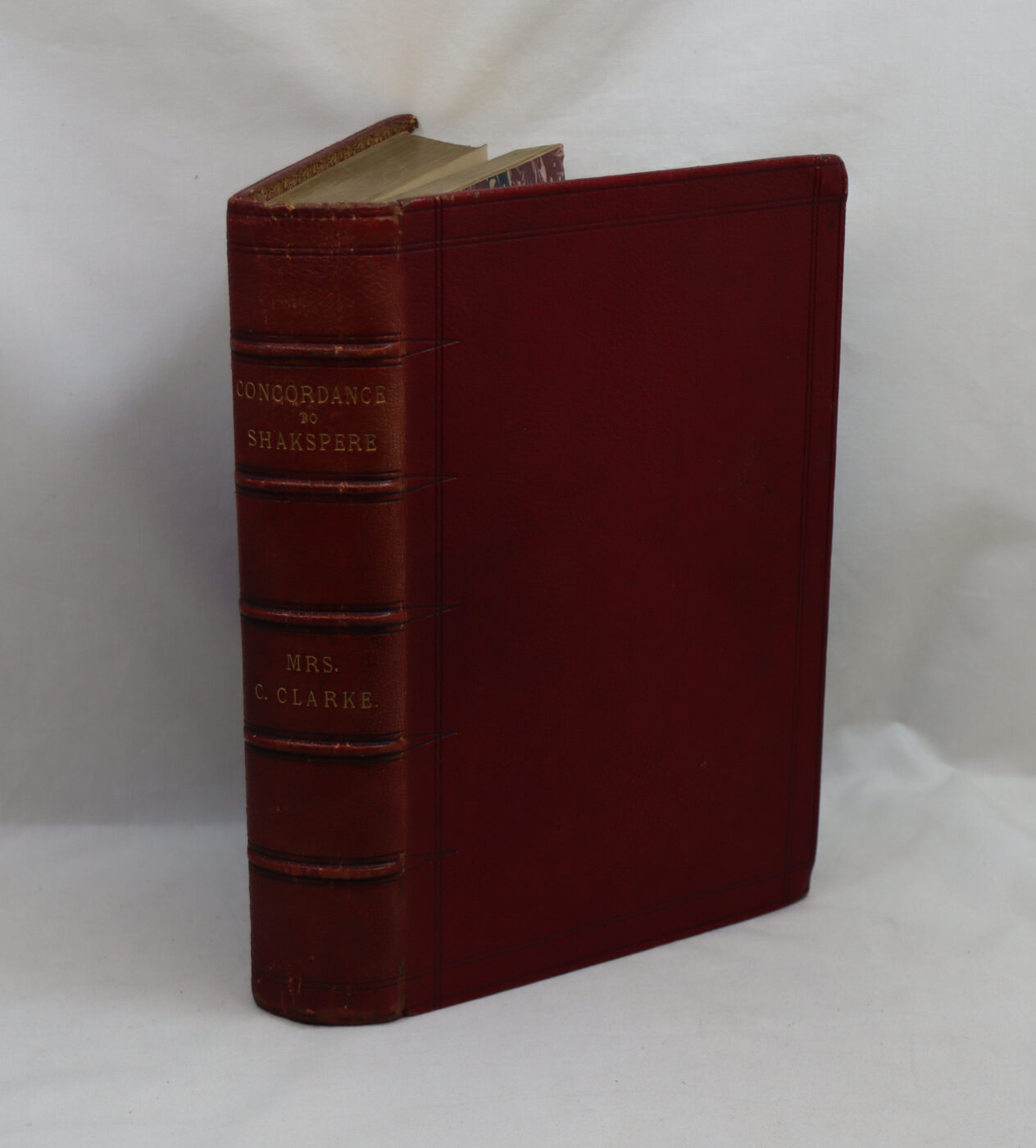
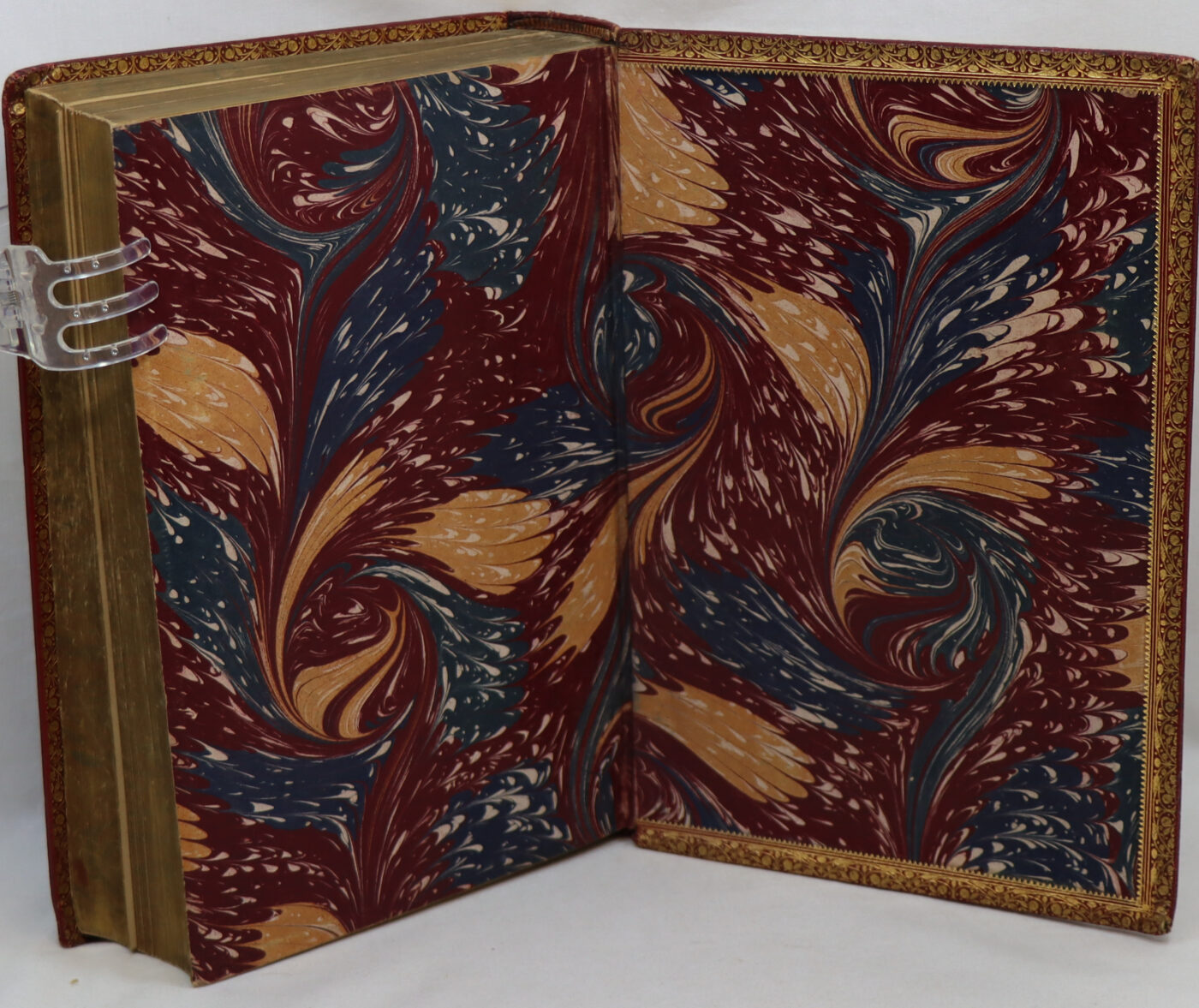
Maroon grained leather binding with gilt title and raised banding on the spine. all edges gilt.
We provide an in-depth photographic presentation of this item to stimulate your feeling and touch. More traditional book descriptions are immediately available
- Note: This book carries a £5.00 discount to those that subscribe to the F.B.A. mailing list
For conditions, please view our photographs. A nice clean very rare book from the library gathered by the famous Cambridge Don, computer scientist, food and wine connoisseur, Jack Arnold LANG.
This signed book was Jack’s mother’s personal copy.
Mary Cowden Clarke’s monumental work, The Complete Concordance to Shakspere, was first published in monthly parts between 1844 and 1845, and then in book form in 1845. It was the standard work of its kind for many years and went through numerous editions and reprints throughout the 19th and early 20th centuries.
The publisher W. Kent & Co. (or simply W. Kent) was a publisher for various editions of the work in the 19th century, with records showing editions as late as 1875.
Reprint of the New and Revised Edition 1881. Missing are the explanation of Clarke’s spelling of “Shakespere” and a list of her other published works, the third a “Preface to New and Revised Edition.”
Daughter of the music publisher Vincent Novello, Mary Cowden Clarke (1809–98) grew up in London amid her father’s literary and artistic circle. Charles and Mary Lamb were family friends, and their Tales from Shakespeare (1807) inspired the young Mary to become a scholar of the Bard. This monumental concordance – which took twelve years to compile and a further four to see through the press – was first published between 1844 and 1845 in eighteen monthly parts, and then in book form in 1845. The preface opens with a statement that reflects Cowden Clarke’s great admiration and ambition: ‘Shakspere [sic], the most frequently quoted, because the most universal-minded Genius that ever lived, of all Authors best deserves a complete Concordance to his Works.’ It was to remain the standard work of its kind for half a century and is still a fascinating and diverting source of information on Shakespeare’s extraordinary vocabulary.
Mary Victoria Cowden Clarke (née Novello; pen names, M. H. and Harry Wandsworth Shortfellow; 22 June 1809 – 12 January 1898) was an English author, and compiler of a concordance to Shakespeare.
A concordance is an alphabetical list of the principal words used in a book or body of work, listing every instance of each word with its immediate context. Historically, concordances have been compiled only for works of special importance, such as the Vedas, Bible, Qur’an or the works of Shakespeare, James Joyce or classical Latin and Greek authors, because of the time, difficulty, and expense involved in creating a concordance in the pre-computer era. A concordance is more than an index, with additional material such as commentary, definitions and topical cross-indexing which makes producing one a labor-intensive process even when assisted by computers. In the precomputing era, search technology was unavailable, and a concordance offered readers of long works such as the Bible something comparable to search results for every word that they would have been likely to search for. Today, the ability to combine the result of queries concerning multiple terms (such as searching for words near other words) has reduced interest in concordance publishing. In addition, mathematical techniques such as latent semantic indexing have been proposed as a means of automatically identifying linguistic information based on word context.
Want to know more about this item?
We are happy to answer any questions you may have about this item. In addition, it is also possible to request more photographs if there is something specific you want illustrated.
Ask a question
Related products
Share this Page with a friend
