
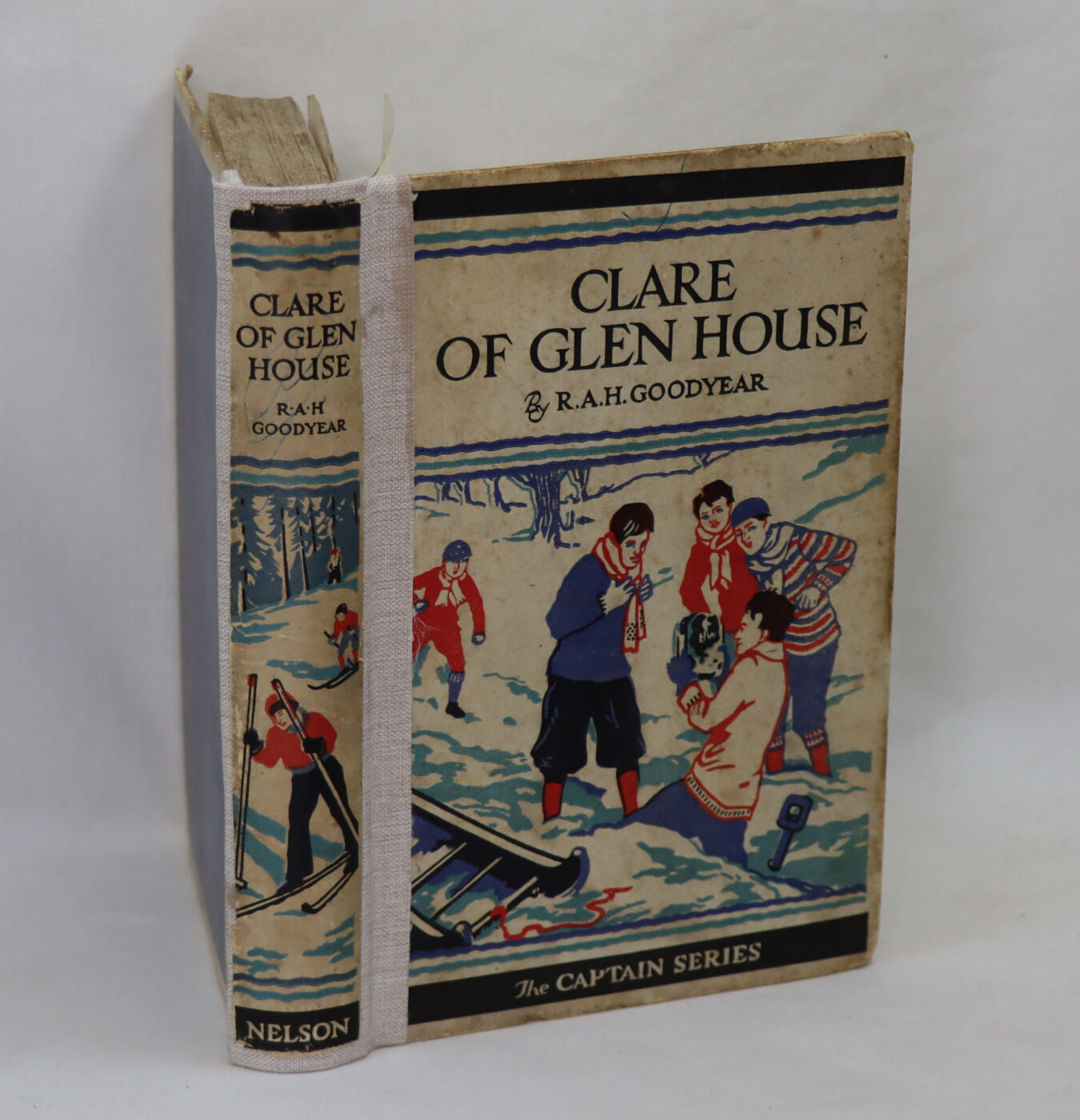
Clare of Glen House.
By R A H Goodyear
Printed: circa 1950
Publisher: Thomas Nelson & Sons. London
| Dimensions | 13 × 19 × 2 cm |
|---|---|
| Language |
Language: English
Size (cminches): 13 x 19 x 2
Condition: Fair (See explanation of ratings)
£24.00
Buy Now


Item information
Description
Cream board binding with black title and children on the front board and repaired spine.
We provide an in-depth photographic presentation of this item to stimulate your feeling and touch. More traditional book descriptions are immediately available.
- Note: This book carries a £5.00 discount to those that subscribe to the F.B.A. mailing list
Clare of Glen House is a vintage children’s/school story novel by the British author Robert Arthur Hanson Goodyear, published by Thomas Nelson & Sons. It is commonly associated with Nelson’s Peerless Series of undated, inexpensive hardcovers, which saw heavy distribution during the mid-20th century. Because these Thomas Nelson editions were typically issued as un-dated reprints, precise first-edition dates can be tricky to pin down, though c. 1950 is highly consistent with the publisher’s output of Goodyear’s work.
Vintage copies of this specific title occasionally appear on the secondary and antiquarian book market, often ranging anywhere from £10 to £40 depending on condition and whether the original dust jacket is included.
Robert Arthur Hanson (R.A.H.) Goodyear (1877 – 24 November 1948) was an English author of children’s stories, primarily in a boys’ school setting. Born in Barnsley in Yorkshire, Goodyear attended Holgate School, Barnsley. At the age of only seventeen he wrote a serial called “The Football Rivals” and sent it to Robert Hamilton Edwards, who had just successfully launched The Boy’s Friend periodical. Edwards was impressed and the story made its debut in the first Christmas number of the half penny Boy’s Friend (number 47) in 1895. Shortly afterwards he sent some stories to Alfred Barratt (better known as the novelist R Andom) who was then Editor of Henderson’s Nugget Library. Barratt liked them and published them (including number 82 entitled The School’s Dishonour).
From these two auspicious beginnings, Goodyear went on to write many more stories and serials for both editors and also for the “Athletic News” (and other sporting papers, for which he wrote chiefly on football”), “Tit-Bits”, “Cassell’s Saturday Journal” and “Pearson’s Weekly”. After some years of writing for the popular weeklies and various libraries he turned his attention to writing hard-cover boys’ school stories, which became very successful as prizes and gifts. In all he wrote over 50 such novels between 1920 and 1938.
He also produced guides for writers. In private life one of his favourite pastimes was producing village plays, some of which he also wrote. He was a keen old boys’ book collector and contributed many articles to the Story Paper Collector, the Collectors’ Digest (later amalgamated as the Story Paper Collectors’ Digest) and Collectors’ Miscellany. He died in November 1948 at his home in Scarborough, North Yorkshire. His home was named “Wintergleam” which was also the name of the school in his 1928 novel With Wat At Wintergleam.
Want to know more about this item?
We are happy to answer any questions you may have about this item. In addition, it is also possible to request more photographs if there is something specific you want illustrated.
Ask a question
Related products
Share this Page with a friend
