
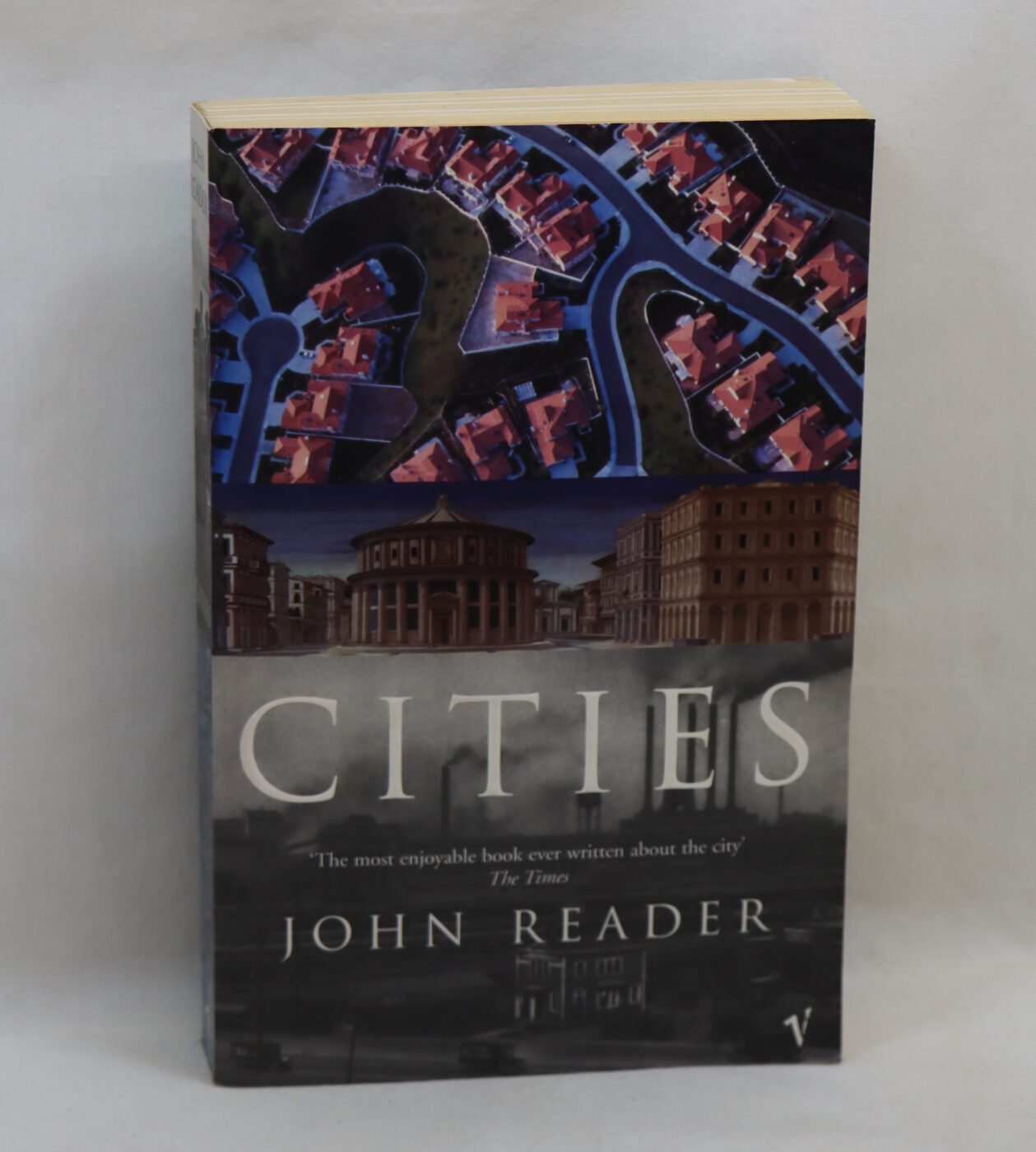
Cities.
By John Reader
ISBN: 9780802142733
Printed: 2005
Publisher: Vintage. London
| Dimensions | 13 × 20 × 3 cm |
|---|---|
| Language |
Language: English
Size (cminches): 13 x 20 x 3
Condition: Good (See explanation of ratings)
£15.00
Buy Now

Item information
Description
Paperback. Grey cover with white title.
We provide an in-depth photographic presentation of this item to stimulate your feeling and touch. More traditional book descriptions are immediately available
- Note: This book carries a £5.00 discount to those that subscribe to the F.B.A. mailing list
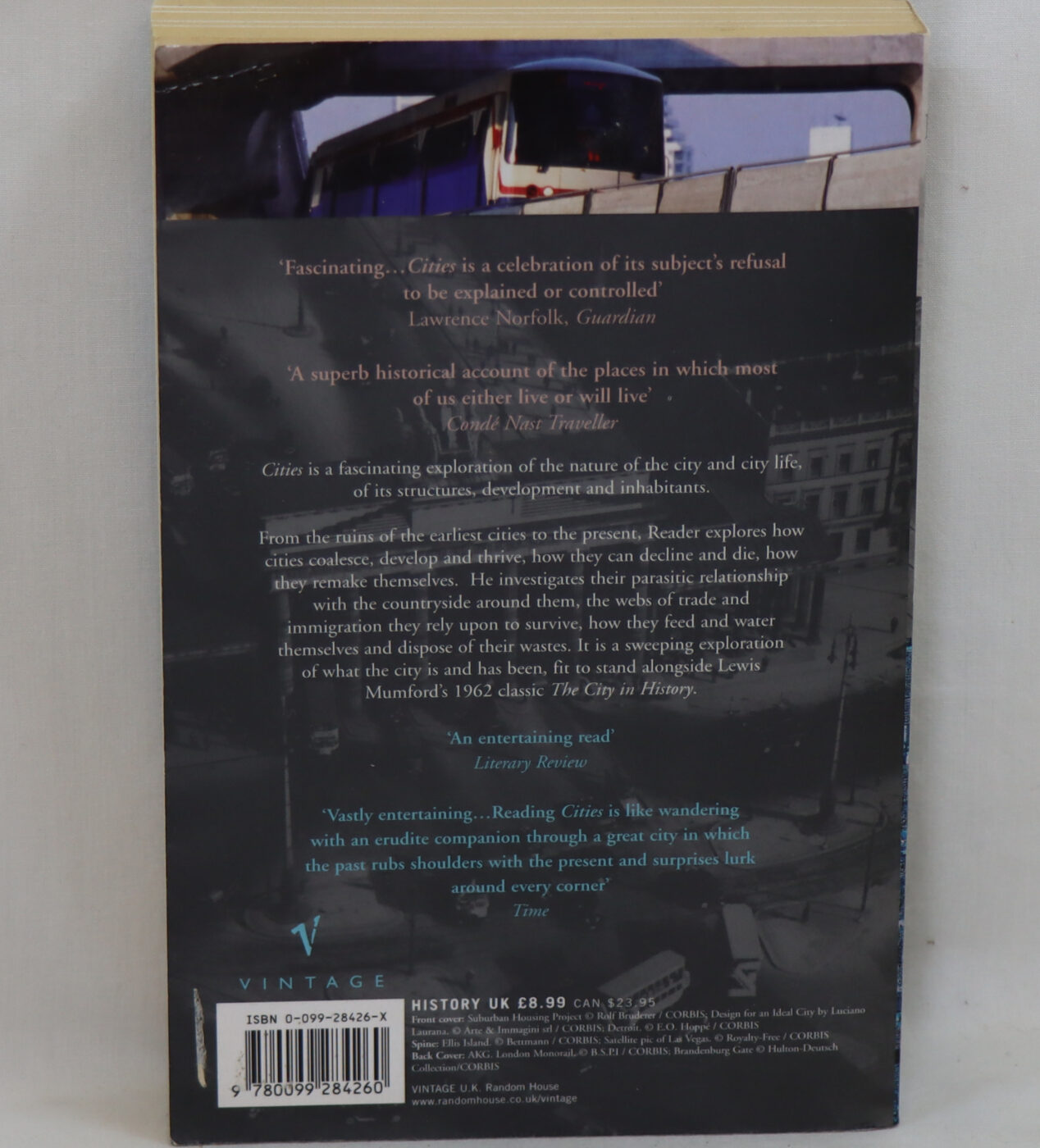
In Cities, the acclaimed historian John Reader takes us on a journey of the city–from its earliest example in the Ancient Near East to today’s teeming centers of compressed existence, such as Mumbai and Tokyo. Cities are home to half the planet’s population and consume nearly three-quarters of its natural resources. For Reader, they are our most natural artifacts, the civic spirit of our collective ingenuity. He gives us the ecological and functional context of how cities evolved throughout human history–the connection between pottery making and childbirth in ancient Anatolia, plumbing and politics in ancient Rome, and revolution and street planning in nineteenth-century Paris. This illuminating study helps us to understand how urban centers thrive, decline, and rise again–and prepares us for the role cities will play in the future.
Review: Cities, by John Reader is more a work of anthropology and sociology through the lens of civilization than it is a detailed chronology of the development of cities and the indexing of their various constituent parts and behaviors. Although it certainly functions as the latter in many instances. Whereas many books about the built environment focus on particular urban elements (e.g. city history, or suburban sprawl, or architecture, or aesthetics, or walkability, etc.) John’s book is an account of the essence of cities. Their relation to human civilization, the natural world, the ecology of earth, the growing of food, and as shelter. It’s about the forces that shaped them in the past and the forces that are influencing them today. While not a perfect book, I’m rating this work so highly for the value of its many insights. It is here that the breadth of the author’s knowledge, wisdom, and life experience shine through. He consistently extracts and connects various elements of sociology and history to shed light on perspectives that both illuminate and simplify the behaviors of our complex man-made society and systems. He connects far-flung dots. It is for this reason that I could not put this book down, anxiously awaiting each page turn to see what new insight I would be greeted with to enhance my perspective of this human life on earth (which, in most cases, is in cities).
NOTE: This is an original book from the library gathered by the famous Cambridge Don, computer scientist, food and wine connoisseur, Jack Arnold LANG. Note: Jack founded the Michelin Guide ‘Midsummer House’- Cambridge’s paramount restaurant. This dining experience is hidden amongst the grassy pastures and grazing cattle of Midsummer Common and perched on the banks of the River Cam. The Midsummer House experience is imaginatively curated to delight and amaze, so the surprise set menu changes regularly and is ‘Midsummer’s’ playground to showcase.
In 2008, Jack was one of the co-founders of the Raspberry Pi Foundation, alongside other members of the Department, and acted as the Foundation’s Chair. The project’s original goals were modest: to build and distribute low-cost computers for prospective applicants to our Computer Science degree. Initially the project was a “success disaster”, as Jack would say, as demand far outstripped the low-scale manufacturing plans. Ultimately the Raspberry Pi became the UK’s most successful computer with more than 60 million sold to date. Jack was drawn to the educational possibilities of the Raspberry Pi, its potential uses in emerging economies and the way it could support self-directed learning.
Want to know more about this item?
We are happy to answer any questions you may have about this item. In addition, it is also possible to request more photographs if there is something specific you want illustrated.
Ask a question
Related products




Share this Page with a friend
