
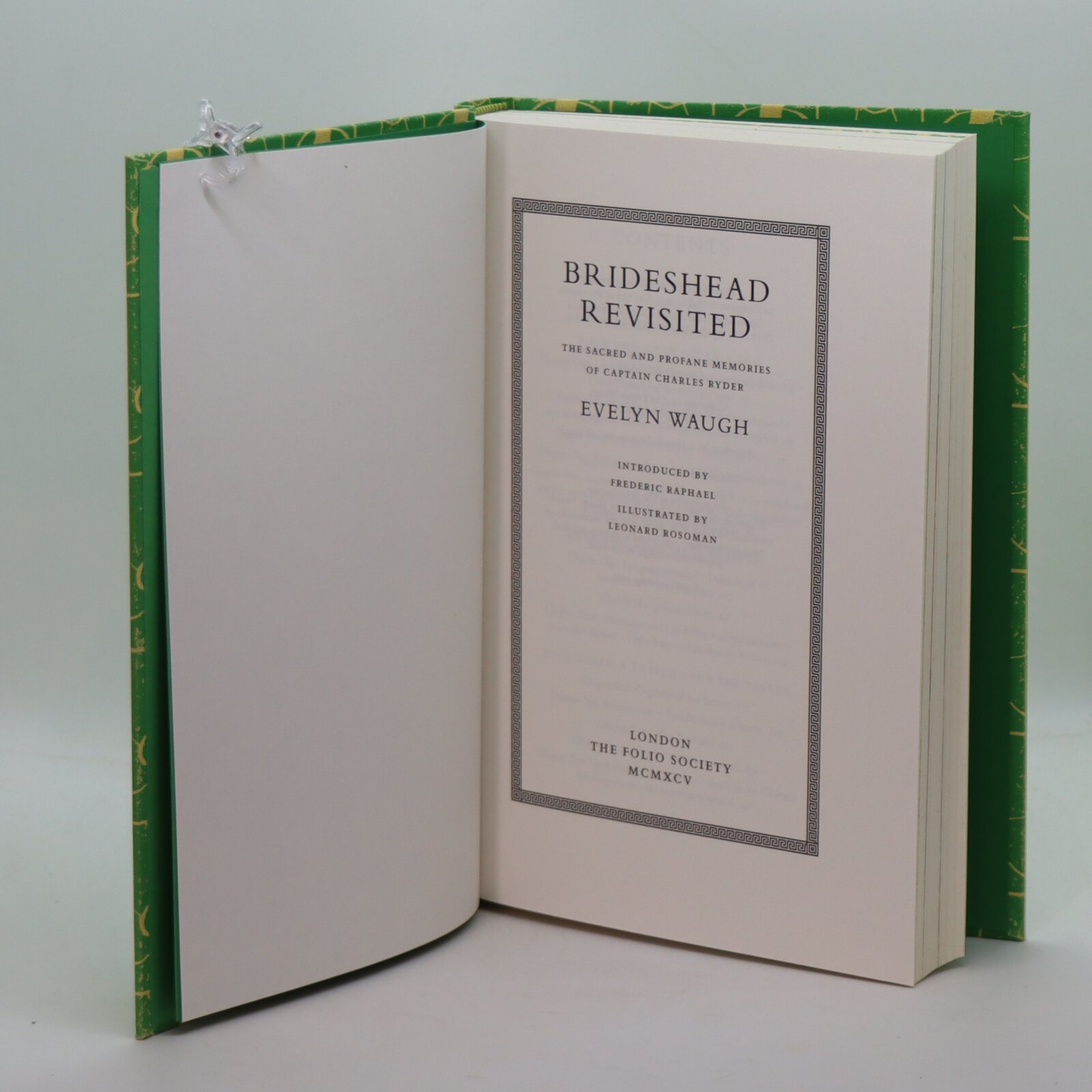
Brideshead Revisited.
By Evelyn Waugh
ISBN: 9780369401267
Printed: 1997
Publisher: Folio Society. London
Edition: Fourth printing
| Dimensions | 17 × 25 × 3.5 cm |
|---|---|
| Language |
Language: English
Size (cminches): 17 x 25 x 3.5
Condition: Fine (See explanation of ratings)
£15.00
Buy Now


Item information
Description
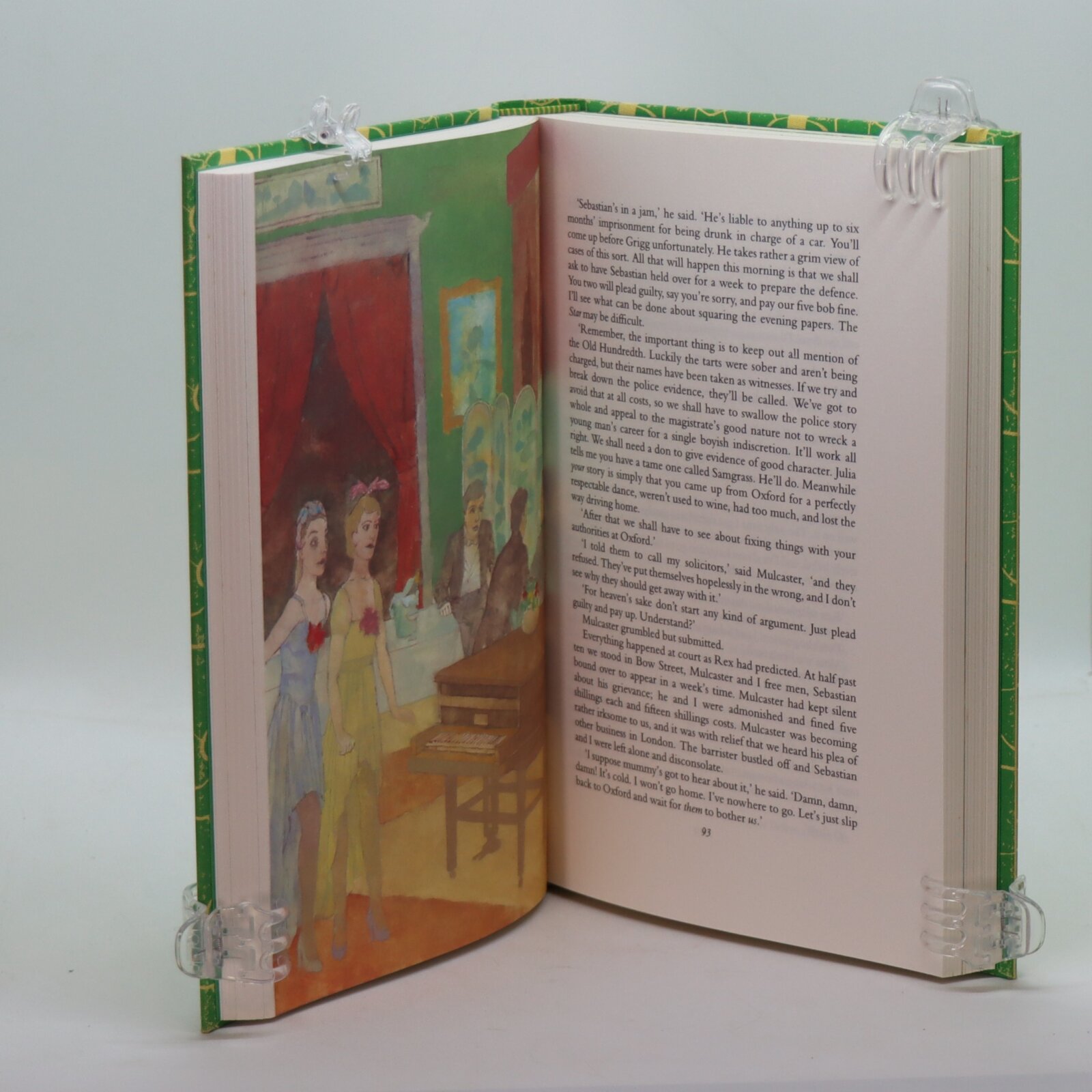
In a fitted box. Green cloth binding with all over yellow pattern of a hatted lady’s head. Gilt title on the spine.
Brideshead Revisited, The Sacred & Profane Memories of Captain Charles Ryder is a novel by English writer Evelyn Waugh, first published in 1945. It follows, from the 1920s to the early 1940s, the life and romances of the protagonist Charles Ryder, most especially his friendship with the Flytes, a family of wealthy English Catholics who live in a palatial mansion called Brideshead Castle. Ryder has relationships with two of the Flytes: Sebastian and Julia. The novel explores themes including nostalgia for the age of English aristocracy and Catholicism. A faithful and well-received television adaptation of the novel was produced in an 11-part miniseries by Granada Television in 1981.
Arthur Evelyn St. John Waugh (28 October 1903 – 10 April 1966) was an English writer of novels, biographies, and travel books; he was also a prolific journalist and book reviewer. His most famous works include the early satires Decline and Fall (1928) and A Handful of Dust (1934), the novel Brideshead Revisited (1945), and the Second World War trilogy Sword of Honour (1952–1961). He is recognised as one of the great prose stylists of the English language in the 20th century.
Waugh was the son of a publisher, educated at Lancing College and then at Hertford College, Oxford. He worked briefly as a schoolmaster before he became a full-time writer. As a young man, he acquired many fashionable and aristocratic friends and developed a taste for country house society. He travelled extensively in the 1930s, often as a special newspaper correspondent; he reported from Abyssinia at the time of the 1935 Italian invasion. He served in the British armed forces throughout the Second World War, first in the Royal Marines and then in the Royal Horse Guards. He was a perceptive writer who used the experiences and the wide range of people whom he encountered in his works of fiction, generally to humorous effect. Waugh’s detachment was such that he fictionalised his own mental breakdown which occurred in the early 1950s.
Waugh converted to Catholicism in 1930 after his first marriage failed. His traditionalist stance led him to strongly oppose all attempts to reform the Church, and the changes by the Second Vatican Council (1962–65) greatly disturbed his sensibilities, especially the introduction of the vernacular Mass. That blow to his religious traditionalism, his dislike for the welfare state culture of the postwar world, and the decline of his health all darkened his final years, but he continued to write. He displayed to the world a mask of indifference, but he was capable of great kindness to those whom he considered his friends. After his death in 1966, he acquired a following of new readers through the film and television versions of his works, such as the television serial Brideshead Revisited (1981).
Want to know more about this item?
We are happy to answer any questions you may have about this item. In addition, it is also possible to request more photographs if there is something specific you want illustrated.
Ask a question
Related products

Share this Page with a friend
