
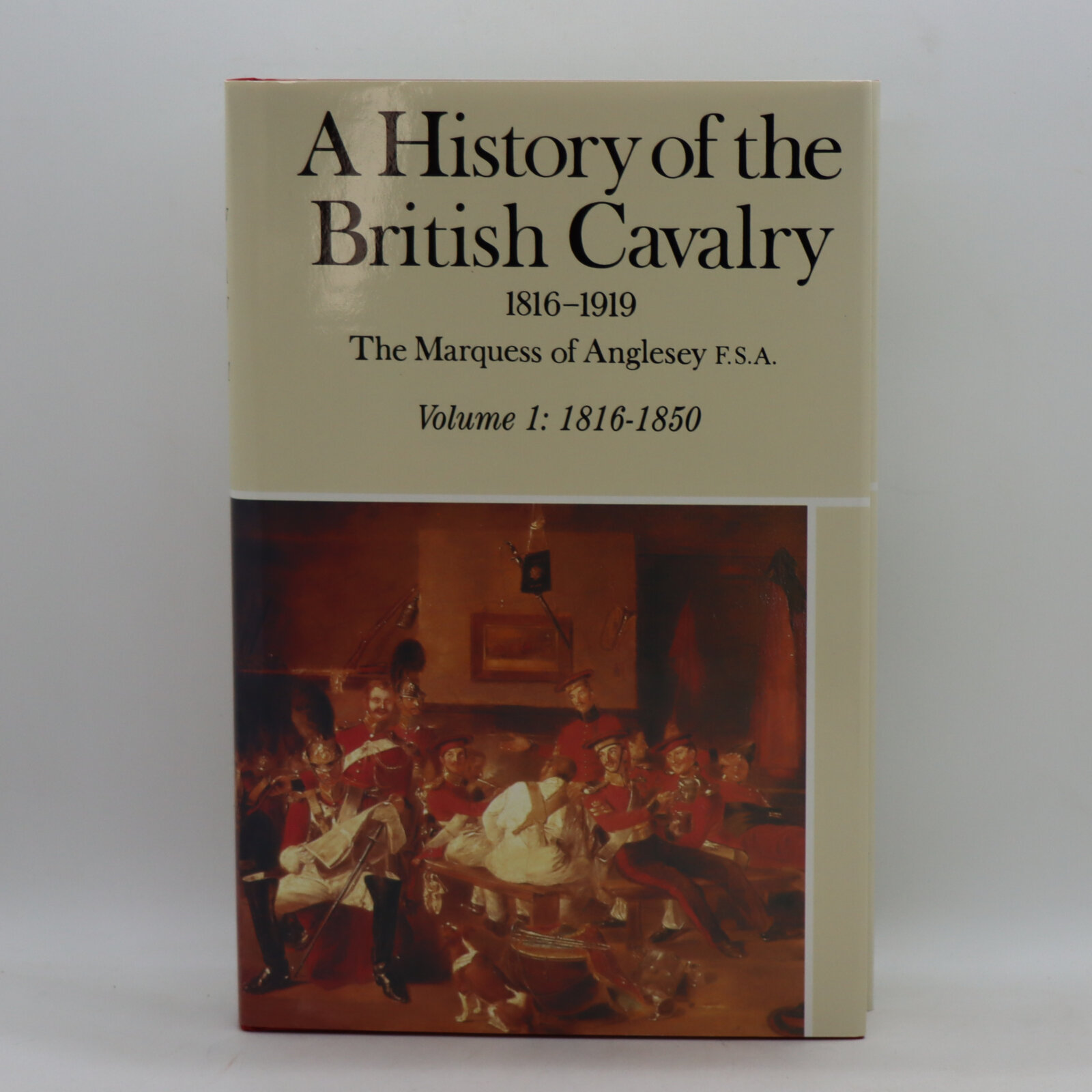
A History of the British Cavalry. Volume 1. 1816-1850.
By The Marquess of Anglesey
ISBN: 9781473814981
Printed: 1998
Publisher: Leo Cooper Books. Barnsley
| Dimensions | 16 × 24 × 4 cm |
|---|---|
| Language |
Language: English
Size (cminches): 16 x 24 x 4
Condition: As new (See explanation of ratings)
£22.00
Buy Now
Your items


Item information
Description
In the original dustsheet. Red cloth binding with gilt title on the spine.
F.B.A. provides an in-depth photographic presentation of this item to stimulate your feeling and touch. More traditional book descriptions are immediately available.
The first volume, after a prologue in which the origins and early development of mounted warfare are discussed, including the Waterloo Campaign of 1815, covers the period from 1816-1850. During this period, the Cavalry were chiefly in action in India, fighting in a number of wars from the Nepal War, through to the First Afghan and First and Second Sikh Wars.
George Charles Henry Victor Paget, 7th Marquess of Anglesey DL, FSA, FRHistS, FRSL (8 October 1922 – 13 July 2013), styled Earl of Uxbridge until 1947, was a British peer and a military historian. He gained the rank of major in the Royal Horse Guards (Blues) and fought in the Second World War. Postwar he served as Lieutenant-Colonel and Commandant of the Anglesey and Caernarvonshire Army Cadet Force1948–50, and as a captain in 635th (Royal Welch) Light Anti-Aircraft Regiment, Royal Artillery, in the Territorial Army 1950–52.He held the office of Deputy Lieutenant of Anglesey in 1960, Vice-Lieutenant of Anglesey between 1960 and 1983 and Lord Lieutenant of Gwynedd between 1983 and 1989. Lord Anglesey wrote the books The Capel Letters 1814–1817 (1955), consisting of the edited correspondence between the first Marquess’s sister in England and his nieces; One Leg: The Life and Letters of 1st Marquess of Anglesey (1961), a biography of his ancestor; Sergeant Pearman’s Memoirs (1968); and A History of the British Cavalry 1816–1919, Volumes I–VIII, which began appearing in 1973, and has been described as “the definitive history” of this branch of the army.
He was Vice-President of the Society for Army Historical Research and a Member of the Council of the National Army Museum. He was Hon. President of the Crimean War Research Society. He was awarded an Honorary D.Litt by the University of Wales in 1984, and the Royal United Services Institute for Defence Studies awarded him the Chesney Gold Medal for his contribution to military history in 1996. He chaired the Historic Buildings Council for Wales (1977–1992) and was the founding President of the Friends of Friendless Churches (1966–1984). He served as a Vice-Chairman of the National Trust (1975–1985) and was a President of the National Museum of Wales (1962–1968). He was a member of the Royal Fine Art Commission (1965–1971) and a Trustee both of the National Portrait Gallery (1979–1991) and of the National Heritage Memorial Fund (1980–1992).
Want to know more about this item?
We are happy to answer any questions you may have about this item. In addition, it is also possible to request more photographs if there is something specific you want illustrated.
Ask a question
Related products
Share this Page with a friend
