
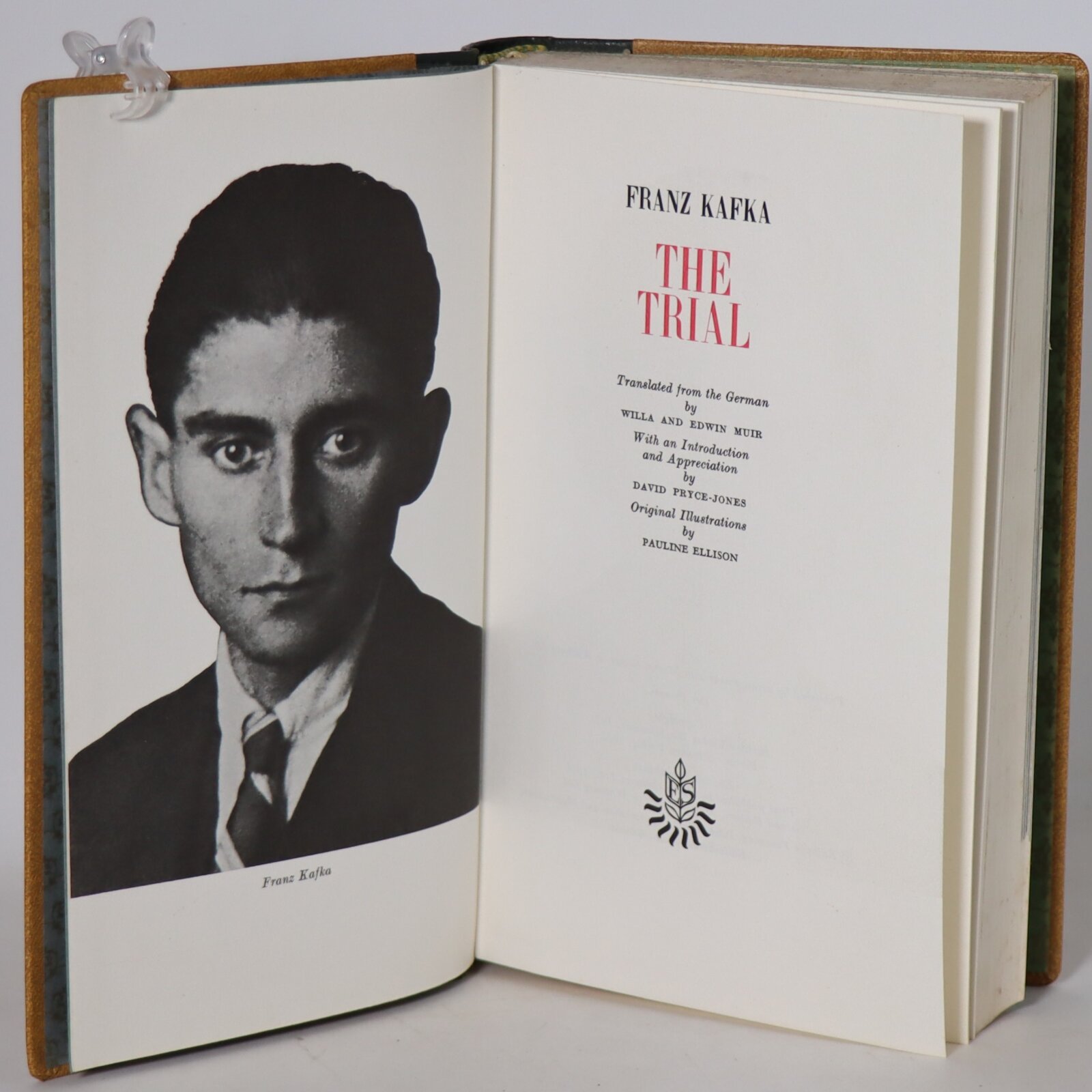
The Trial.
By Franz Kafka
Printed: 1935
Publisher: Folio Society. London
| Dimensions | 13 × 23 cm |
|---|---|
| Language |
Language: English
Size (cminches): 13 x 23
Condition: Fine (See explanation of ratings)
£18.00
Buy Now

Item information
Description
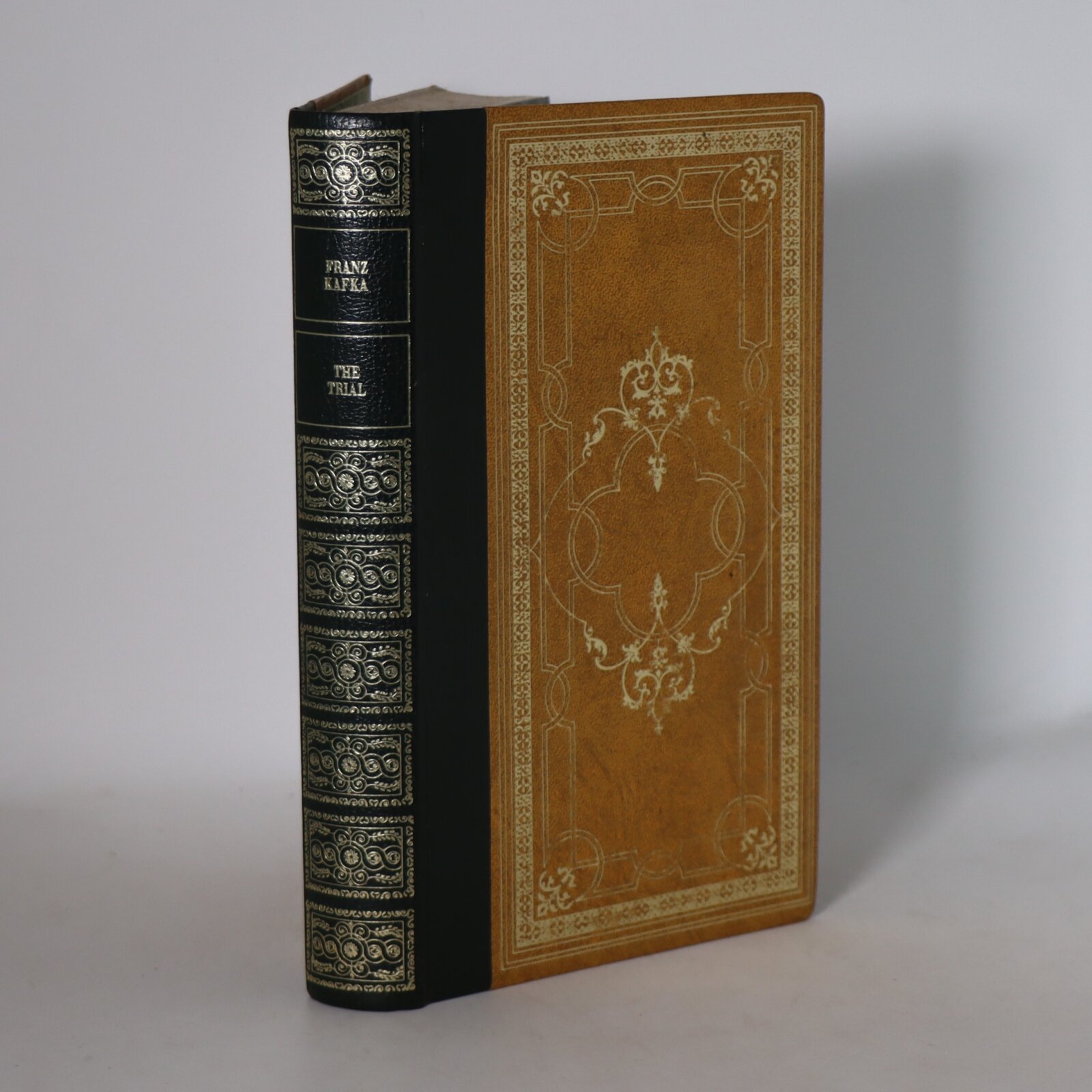
Black leatherette spine with gilt decoration and title. Yellow boards with gilt design on the front board.
F.B.A. provides an in-depth photographic presentation of this item to stimulate your feel and touch. More traditional book descriptions are immediately available.
The Trial (German: Der Process, later Der Proceß, Der Prozeß and Der Prozess) is a novel written by Franz Kafka in 1914 and 1915 and published posthumously on 26 April 1925. One of his best known works, it tells the story of Josef K., a man arrested and prosecuted by a remote, inaccessible authority, with the nature of his crime revealed neither to him nor to the reader. Heavily influencedby Dostoevsky’s Crime and Punishment and The Brothers Karamazov, Kafka even went so far as to
call Dostoevsky a blood relative. Like Kafka’s two other novels, The Trial was never completed, although it does include a chapter which appears to bring the story to an intentionally abrupt ending. After Kafka’s death in 1924 his friend and literary executor Max Brod edited the text for publication by Verlag Die Schmiede. The original manuscript is held at the Museum of Modern Literature, Marbach am Neckar, Germany. The first English-language translation, by Willa and Edwin Muir, was published in 1937. In 1999, the book was listed in Le Monde’s 100 Books of the Century and as No. 2 of the Best German Novels of the Twentieth Century.
Franz Kafka (3 July 1883 – 3 June 1924) was a German-speaking Bohemian novelist and short story writer, widely regarded as one of the major figures of 20th-century literature. His work fuses elements of realism and the fantastic. It typically features isolated protagonists facing bizarre or surrealistic predicaments and incomprehensible socio-bureaucratic powers. It has been interpreted as exploring themes of alienation, existential anxiety, guilt, and absurdity. His best-known works
include the short story “The Metamorphosis” and novels The Trial and The Castle. The term Kafkaesque has entered English to describe situations like those found in his writing. Kafka was born into a middle-class German-speaking Czech Jewish family in Prague, the capital of the Kingdom of Bohemia, then part of the Austro-Hungarian Empire, today the capital of the Czech Republic. He trained as a lawyer and after completing his legal education was employed full-time by an insurance company, forcing him to relegate writing to his spare time. Over the course of his life, Kafka wrote hundreds of letters to family and close friends, including his father, with whom he had a strained and formal relationship. He became engaged to several women but never married. He died in 1924 at the age of 40 from tuberculosis.
Few of Kafka’s works were published during his lifetime: the story collections Contemplation and A Country Doctor, and individual stories (such as “The Metamorphosis”) were published in literary magazines but received little public attention. In his will, Kafka instructed his executor and friend Maxn Brod to destroy his unfinished works, including his novels The Trial, The Castle, and Amerika, but Brod ignored these instructions, and had the bulk of his work published. Kafka’s work has influenced a vast range of writers, critics, artists, and philosophers during the 20th and 21st centuries.
Want to know more about this item?
We are happy to answer any questions you may have about this item. In addition, it is also possible to request more photographs if there is something specific you want illustrated.
Ask a question
Related products


Share this Page with a friend
