
Russia under Western Eyes.
By Martin Malia
ISBN: 9780674781207
Printed: 2000
Publisher: Havard University Press. Massachusetts
| Dimensions | 16 × 23 × 3 cm |
|---|---|
| Language |
Language: English
Size (cminches): 16 x 23 x 3
Condition: Good (See explanation of ratings)
£9.00
Buy Now
Item information
Description
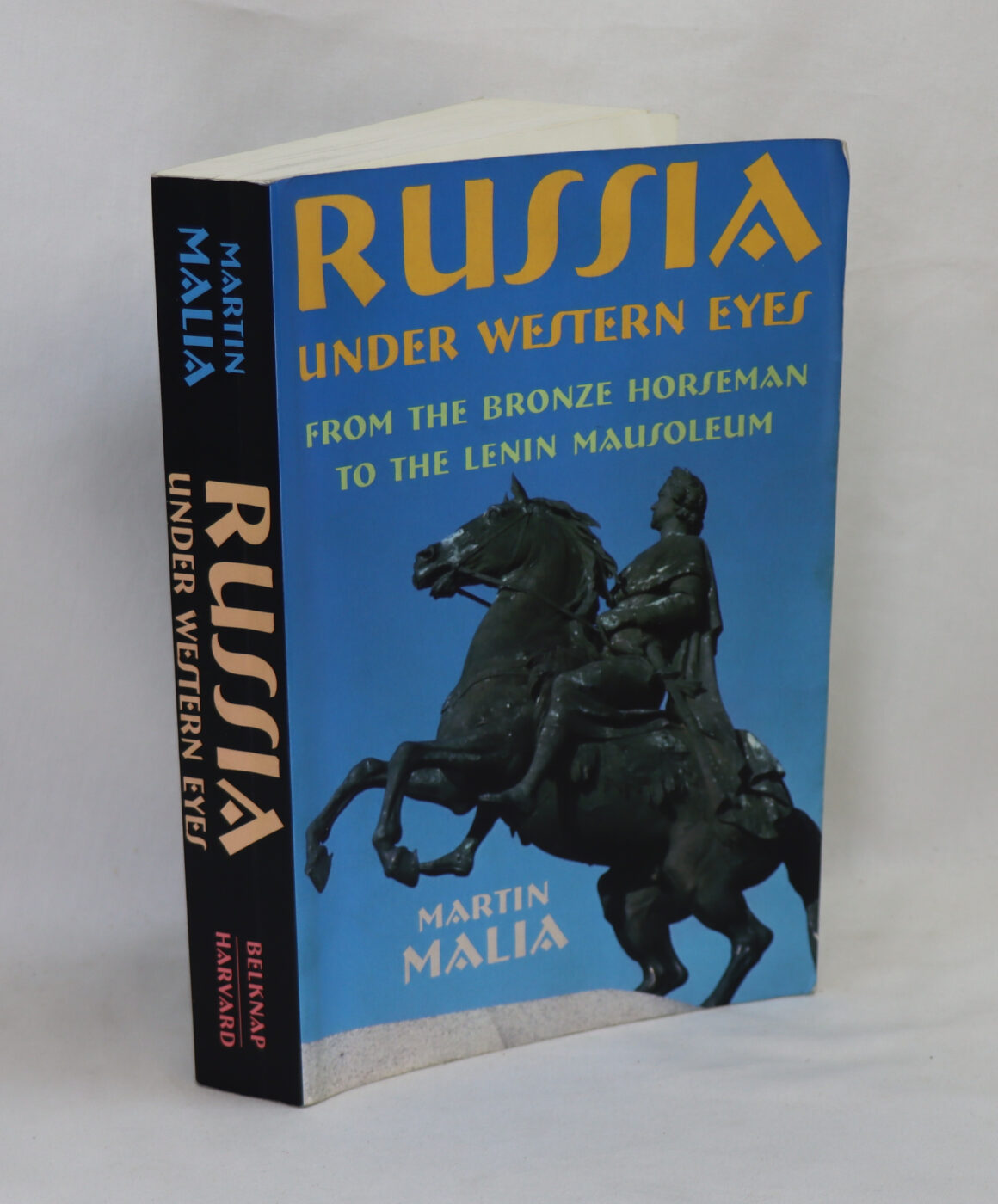
Paperback. Black cover with orange title.
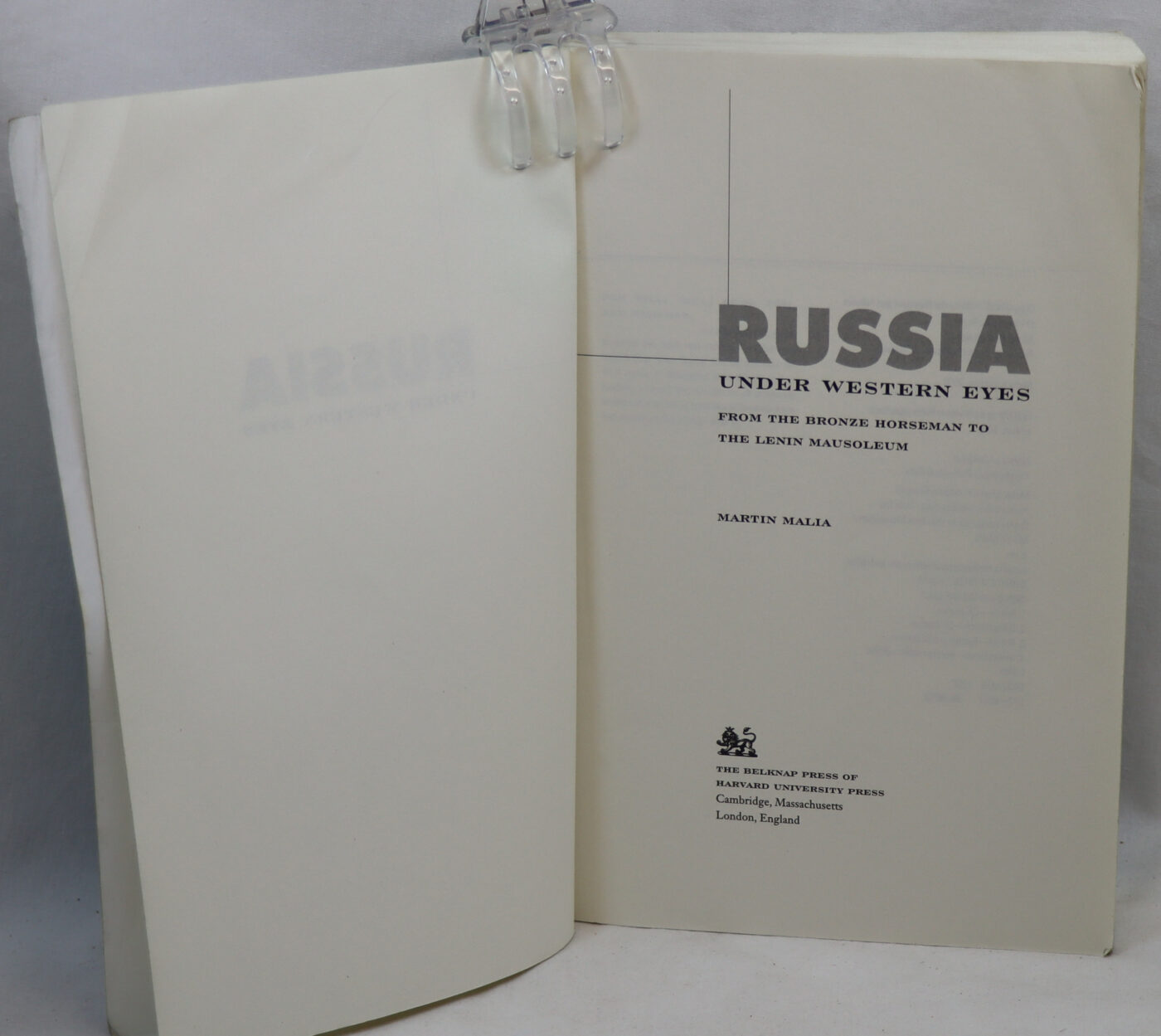
We provide an in-depth photographic presentation of this item to stimulate your feeling and touch. More traditional book descriptions are immediately available.
- A £2 reduction when collected from FBA shop
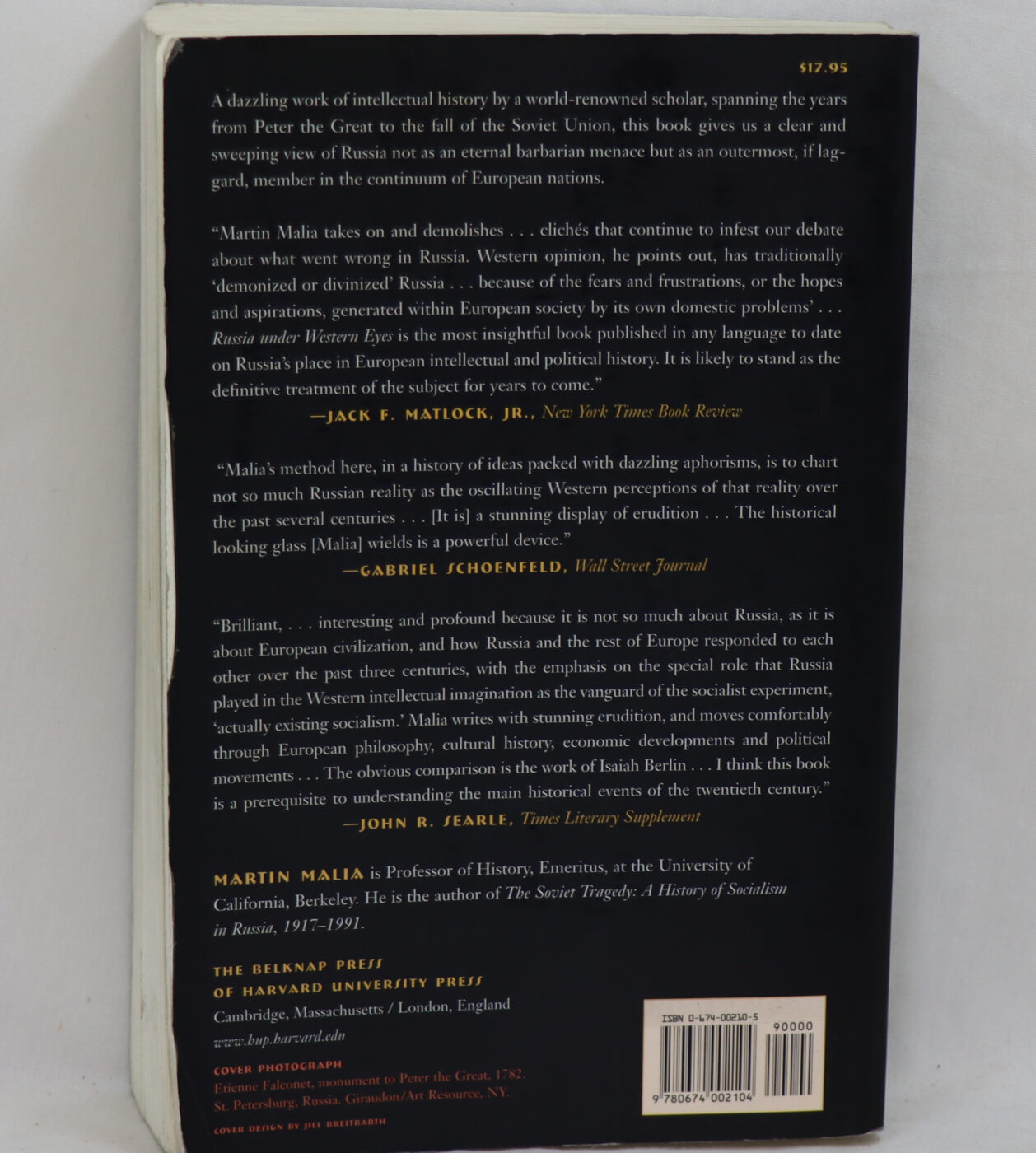
Please view our photographs and read the rubric on the book’s cover. A copy of Russia Under Western Eyes: From the Bronze Horseman to the Lenin Mausoleum by Martin Malia (ISBN 9780674781207) in Good condition typically sells for £5 to £9 (or around $7 to $16 USD) on the secondhand market.
Summary of the Book
Written by UC Berkeley historian Martin Malia, this 528-page work traces how Western Europe and North America perceived Russia from the reign of Peter the Great (1700) to the collapse of the Soviet Union (1991). Malia argues that Western views of Russia—oscillating between seeing it as an enlightened progressive partner or an alien despotism—often reflected Europe’s own internal political and ideological anxieties rather than Russian reality alone.
Biography of Martin Malia
Martin Edward Malia (1924–2004) was a prominent American historian specializing in Russian and European intellectual history, best known for his long tenure at the University of California, Berkeley, and for predicting the collapse of the Soviet Union shortly before its dissolution.
Early Life & Education
- Background & Service. Born in Springfield, Massachusetts, Malia served in the U.S. Navy during World War II.
- Education. He graduated with a bachelor’s degree in French from Yale University in 1944, and later obtained his master’s degree (1947) and Ph.D. in history (1951) from Harvard University.
Academic Career
- Early Roles. He started his academic career at Harvard in the 1950s and served as a special assistant for Russian book acquisitions at the Library of Congress.
- UC Berkeley & Later Years. In 1958, Malia joined the faculty at UC Berkeley, where he taught for over 30 years until retiring as professor emeritus in 1991. He remained active in scholarship until passing away in Oakland, California, in 2004 at the age of 80.
The “Z” Article & Soviet Analysis
- Structural Critique. Malia challenged mainstream “revisionist” scholars by arguing that Marxist-Leninist ideology made the Soviet system inherently unreformable.
- The Pseudonymous “Z” Essay. Writing under the pen name “Z” in a January 1990 Daedalus article titled “To the Stalin Mausoleum,” Malia famously predicted that Mikhail Gorbachev’s reforms would precipitate the collapse of communism rather than save it. The essay drew intense speculation in Washington regarding its anonymous author before Malia acknowledged writing it.
Major Publications
- Alexander Herzen and the Birth of Russian Socialism, 1812–1855 (1961): An exploration of the early Russian revolutionary intelligentsia.
- The Soviet Tragedy: A History of Socialism in Russia, 1917–1991 (1994): A seminal work tracing Soviet totalitarianism back to core socialist ideology.
- Russia Under Western Eyes (1999) & History’s Locomotives (2006): Analytical works examining centuries of Western perspectives on Russia and comparative European revolutions, the latter published posthumously.
A deeper look at Malia’s core arguments in Russia Under Western Eyes or The Soviet Tragedy?
Martin Malia’s scholarship centers on two major ideas: how the West has historically projected its own hopes and fears onto Russia (Russia Under Western Eyes), and why the Soviet communist experiment was structurally doomed from its inception (The Soviet Tragedy).
Russia Under Western Eyes (1999)
In this work, Malia examines three centuries of European and American attitudes toward Russia, from Peter the Great (c. 1700) to the fall of the USSR (1991).
- A Mirror of Western Anxieties: Malia argues that Western perceptions of Russia rarely reflected objective Russian reality. Instead, Europeans used Russia as a screen onto which they projected their own domestic political debates, fears, and utopian ideals.
- The Pendulum of Perception: Western views swung dramatically depending on Europe’s internal intellectual climate:
- Enlightened & Progressive: When Western intellectuals favored rationalism and state-led modernization—such as Voltaire admiring Catherine the Great, or 1920s–30s Western leftists praising Stalin’s Five-Year Plans—Russia was celebrated as a dynamic, forward-looking model.
- Despotic & Alien: When Europe shifted toward Romanticism, constitutional liberalism, or Cold War anti-communism—such as during the reign of Nicholas I or high Stalinism—Russia was condemned as an eternal, backward “Oriental despotism.”
- The “West–East Cultural Gradient”: Malia rejects the idea that Russia is fundamentally non-European or eternally doomed to autocracy. Instead, he frames Europe as a cultural gradient moving from the Atlantic coast eastward. Russia was simply the easternmost, laggard member of the European family, attempting to catch up to Western modernization in delayed and often distorted ways.
The Soviet Tragedy (1994)
In The Soviet Tragedy, Malia critiques the dominant “revisionist” school of Soviet history, which emphasized social factors, grassroots pressures, and bureaucratic inertia over ideology.
- The Primacy of Ideology: Malia’s central thesis is that Marxist-Leninist ideology was the primary driver of Soviet history, not a mere cover for traditional Russian authoritarianism or power politics. Because the Bolsheviks genuinely attempted to abolish private property, markets, and civil society to build a non-capitalist utopia, totalitarian coercion became the only way to hold society together.
- Leninism as the Root of Stalinism: Against historians who viewed Stalinism as a betrayal of Lenin’s original ideals, Malia argues for direct continuity. Once the Bolsheviks dismantled the market and political pluralism in 1917–1921, a Stalin-style police state was the logical institutional outcome required to enforce an unnatural economic order.
- Why the System Could Not Be Reformed: Malia contends that the Soviet Union was an “ideocratic” regime—its entire legitimacy rested on the infallibility of its socialist blueprint. Consequently, Mikhail Gorbachev’s glasnost (openness) and perestroika (restructuring) could not modernize the system; by introducing truth and market mechanisms, Gorbachev dissolved the ideological glue holding the USSR together.
Key Differences Between the Two Works
| Attribute | Russia Under Western Eyes (1999) | The Soviet Tragedy (1994) |
| Core Focus | European intellectual history & perceptions of Russia | Internal mechanics & collapse of the Soviet Union |
| Primary Villain / Driver | Western ideological projections & wishful thinking | Integral Marxist-Leninist utopianism |
| View of Russia’s Nature | Part of the European cultural continuum (delayed modernization) | A normal European society hijacked by an impossible ideology |
Want to know more about this item?
We are happy to answer any questions you may have about this item. In addition, it is also possible to request more photographs if there is something specific you want illustrated.
Ask a question
Related products
Share this Page with a friend
