
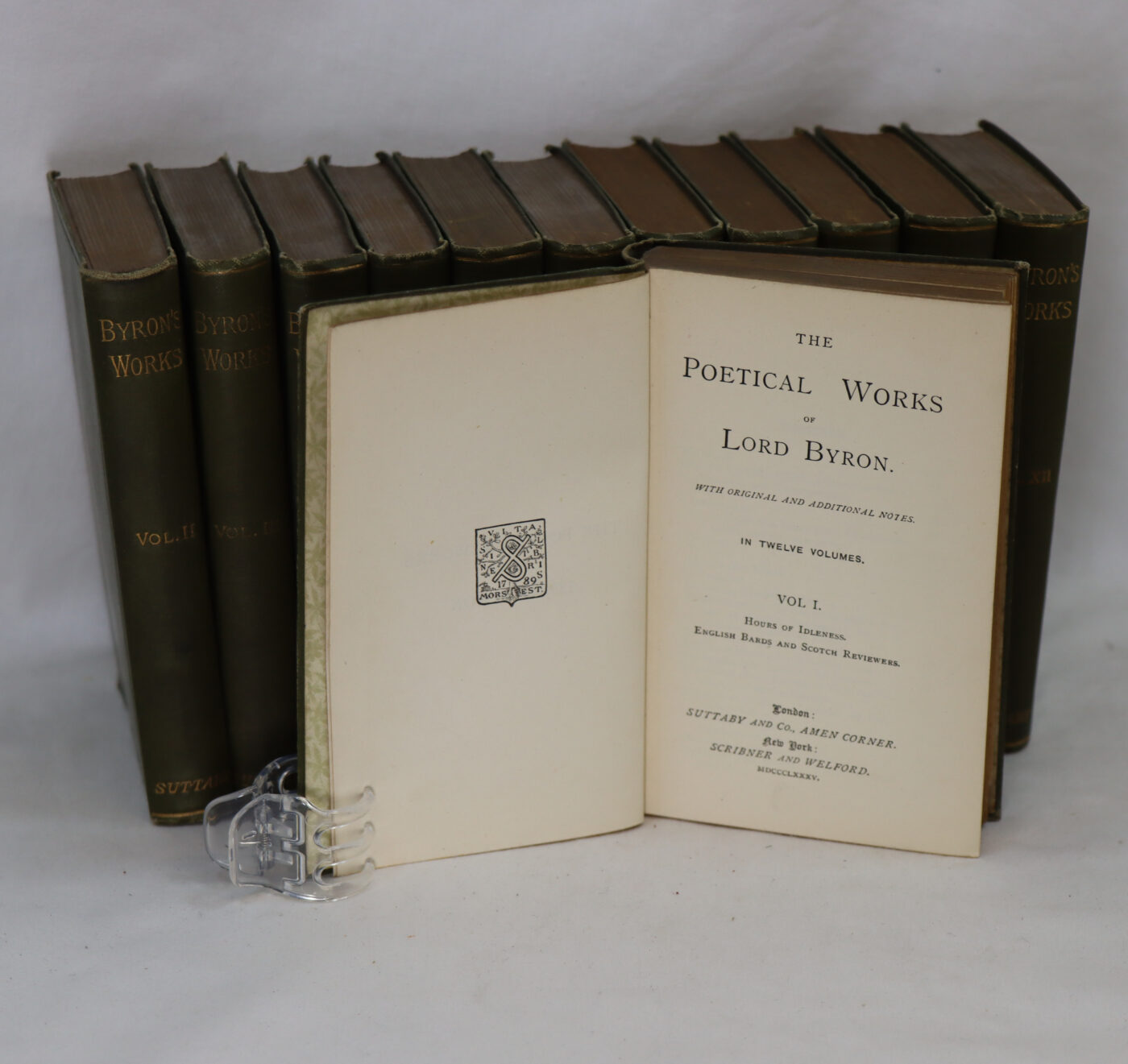
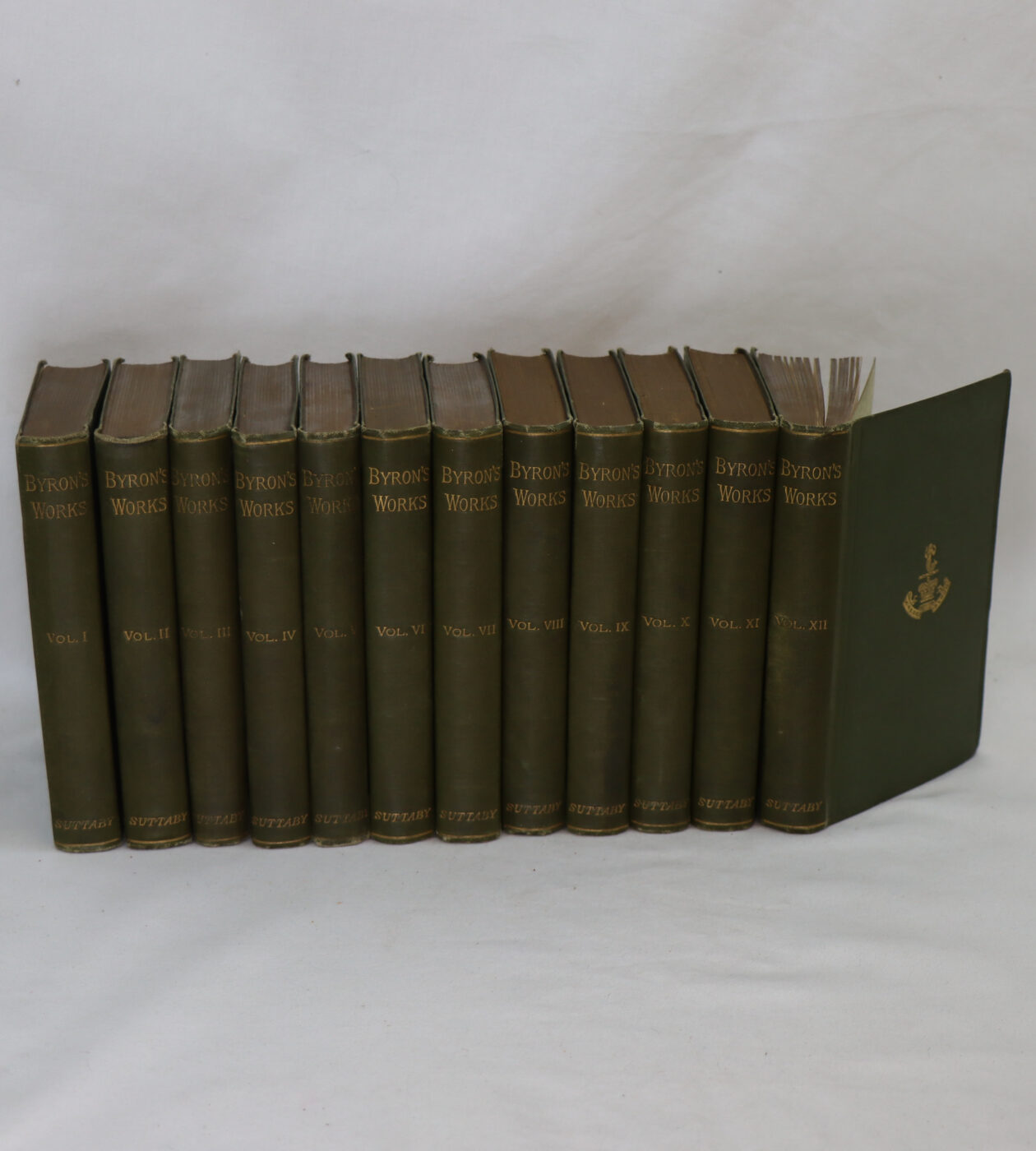
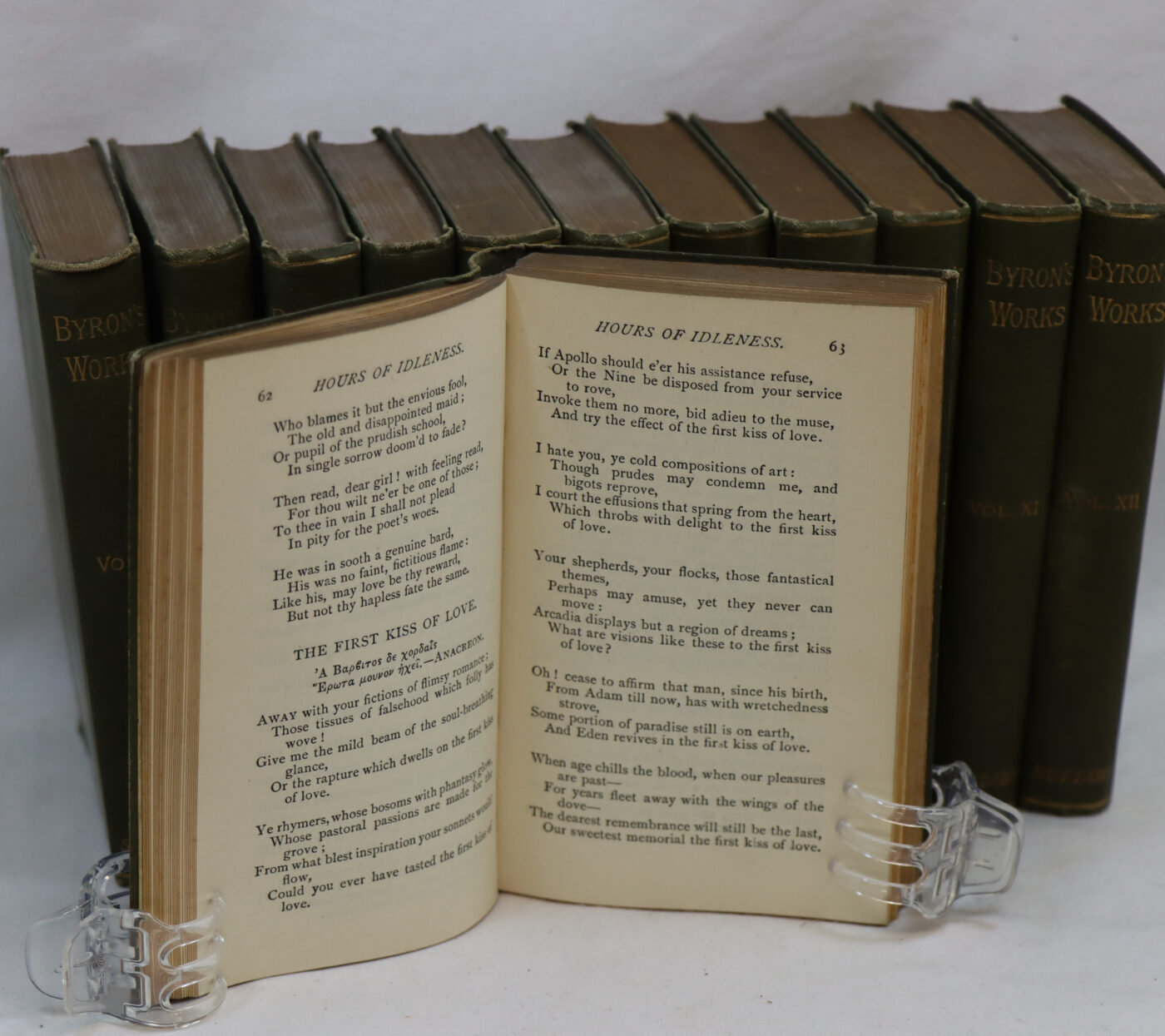
Byron's Works. 12 Volume Miniature Set.
By Lord Byron
Printed: 1885
Publisher: Suttaby & Co. London
| Dimensions | 8 × 13 × 2 cm |
|---|---|
| Language |
Language: English
Size (cminches): 8 x 13 x 2
Condition: Good (See explanation of ratings)
£102.00
Buy Now

Item information
Description
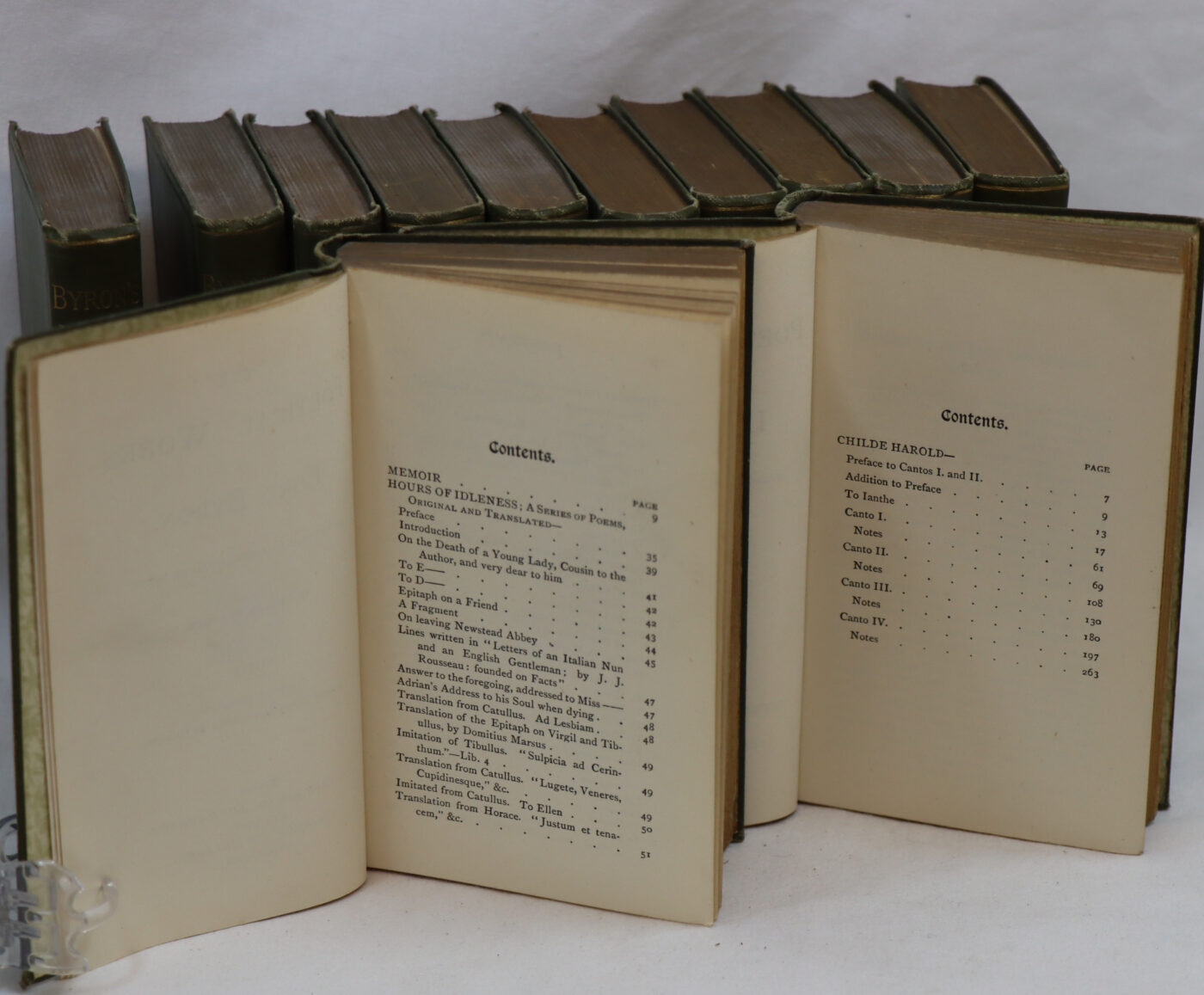
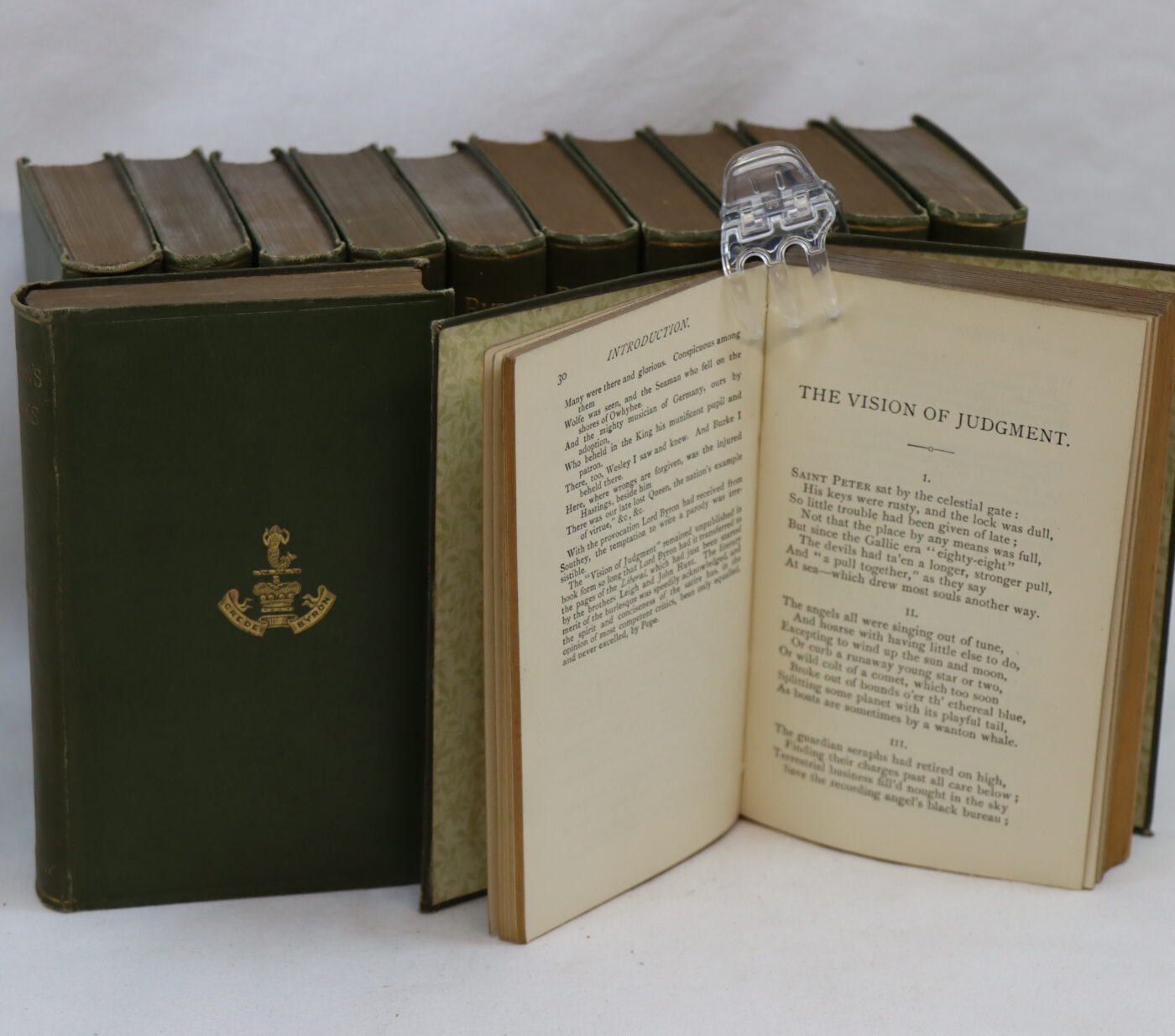
Green cloth binding with gilt title on the spine. Gilt crest on the front board. Dimensions are for one volume.
We provide an in-depth photographic presentation of this item to stimulate your feeling and touch. More traditional book descriptions are immediately available.
-
Note: These books carry a £5.00 discount to those that subscribe to the F.B.A. mailing list
Please view our photographs. “The Poetical Works of Lord Byron” published by Suttaby & Co. (London) in 1885 is a highly collectible late-Victorian miniature/pocket set.
Market Value & Assessment
For a complete 12-volume set in Good condition, the estimated market value generally ranges from £40 to £150. Because these were designed as delicate pocket or gift editions, their value heavily hinges on the state of the binding and whether they retain their original presentation box.
Characteristics of this Set which has NO presentation box.
-
The Format: At roughly 3.2 x 5.2 inches, these are considered small 12mo or “pocket” volumes. They were highly popular in the late 19th century for readers to travel with or display in compact home libraries.
-
The Publisher: Suttaby & Co. (based out of Amen Corner, London) was well-regarded for publishing high-quality, beautifully bound miniature editions of classic English poets. They frequently co-issued these sets with Scribner & Welford for the New York market.
Biography of Lord Byron
George Gordon Byron, 6th Baron Byron (22 January 1788 – 19 April 1824), known simply as Lord Byron, was a towering figure of the British Romantic movement. Celebrated as one of history’s greatest poets, he was equally famous for his flamboyant lifestyle, extensive travels, numerous scandals, and his ultimate sacrifice in the Greek War of Independence. He immortalised the “Byronic hero”—a melancholic, rebellious, and fiercely intelligent outcast.
1. Early Life and Insecurities (1788–1808)
-
Humble Beginnings: Born in London to Catherine Gordon and Captain John “Mad Jack” Byron. His father squandered the family fortune and abandoned them, leaving Byron to spend his early years in relative poverty in Aberdeen, Scotland.
-
The Clubfoot: Born with a deformed right foot, he suffered lifelong physical pain and deep insecurity. He overcompensated by becoming an exceptionally strong athlete, excelling in swimming, boxing, and cricket.
-
Inheriting the Title: At just 10 years old, the unexpected death of his great-uncle made him the 6th Baron Byron, inheriting the title and the ancestral estate of Newstead Abbey.
-
Education and Rebellion: Educated at Harrow School and Trinity College, Cambridge. At Cambridge, he became known for eccentric rebellion—even keeping a pet bear in his dorm room to mock a rule banning dogs.
2. Meteoric Rise to Fame (1809–1814)
-
The Grand Tour: Restless and buried in debt, Byron embarked on a grand tour of Europe and the Mediterranean between 1809 and 1811, traveling through Portugal, Spain, Albania, Greece, and Turkey. During this trip, he famously swam across the Hellespont strait.
-
“Famous Overnight”: His travels inspired his first major success, Childe Harold’s Pilgrimage (1812). The semi-autobiographical poem sold out in days, prompting his famous quote: “I awoke one morning and found myself famous.”
-
High Society Sensation: He became the darling of London high society. The aristocratic author Lady Caroline Lamb famously described Byron as “mad, bad, and dangerous to know” during their tumultuous affair.
3. Scandal and Exile (1815–1822)
-
A Failed Marriage: In 1815, attempting to settle down and escape mounting debts, he married the mathematical intellectual Annabella Milbanke.
-
Ada Lovelace: The couple had one daughter, Ada Lovelace, who would later become a brilliant mathematician and the world’s first computer programmer.
-
Exile from England: The marriage imploded within a year due to Byron’s volatile behaviour and heavy drinking. Amid terrifying rumours of incestuous relations with his half-sister, Augusta Leigh, and facing social ruin, Byron fled England in April 1816, never to return.
-
The Italian Years: He settled in Italy for several years, living a nomadic, highly creative life. He befriended poet Percy Bysshe Shelley and wrote his ultimate satirical masterpiece, Don Juan, a sweeping, witty epic left unfinished at his death.
4. The Last Crusade and Death (1823–1824)
Driven by a passion for liberty, Byron poured his own money into the Greek War of Independence against the Ottoman Empire. In 1823, he sailed to Missolonghi to personally command a rebel army unit.
He never saw battle; he contracted a severe, violent fever and died on 19 April 1824 at the age of 36. Greece deeply mourned his loss and still honours him today as a national hero. His body was returned to England, where he was buried near his ancestral home in Nottinghamshire.
Want to know more about this item?
We are happy to answer any questions you may have about this item. In addition, it is also possible to request more photographs if there is something specific you want illustrated.
Ask a question
Related products
Share this Page with a friend
