
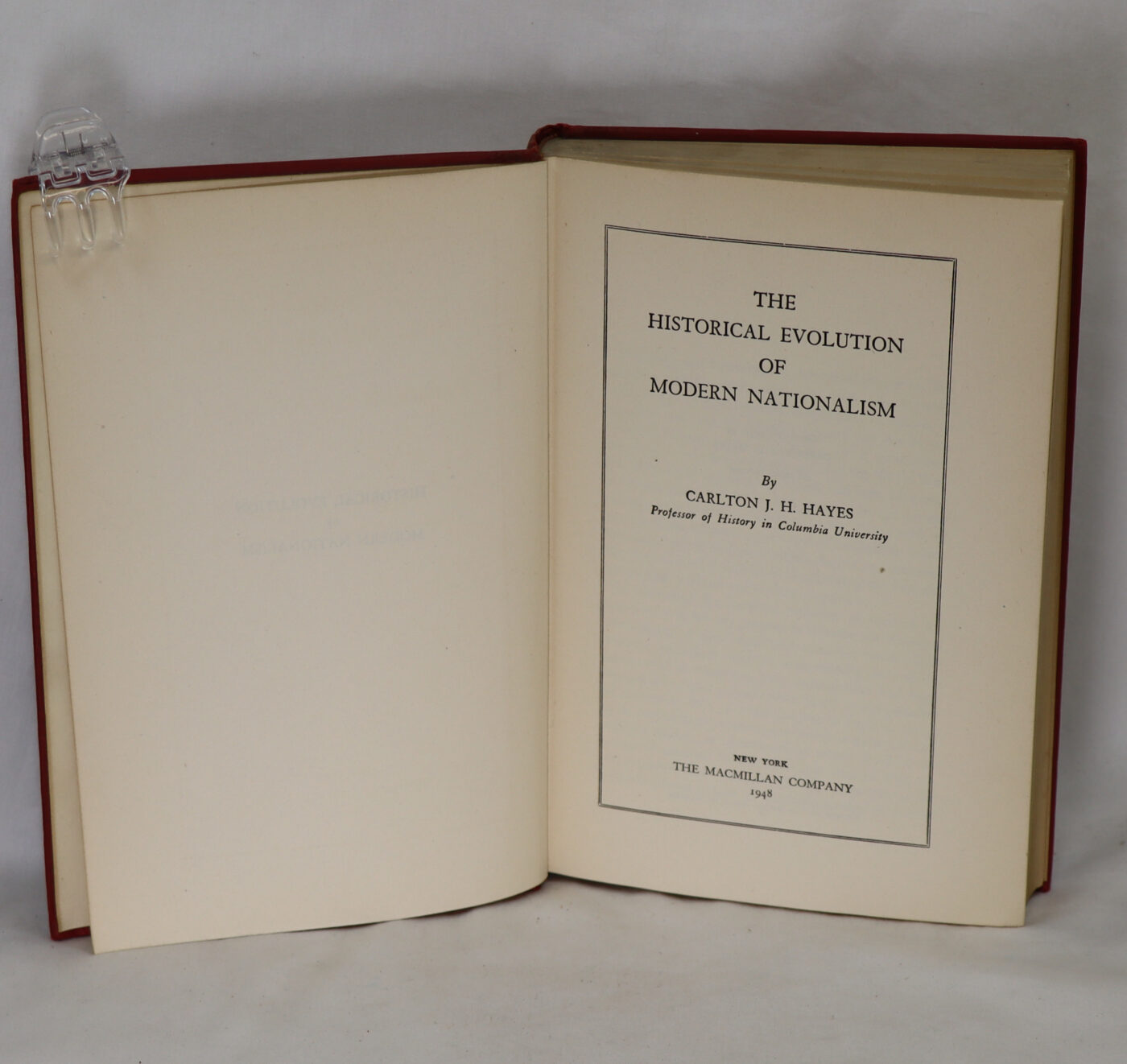
The Historical Evolution of Modern Nationalism.
By Carlton J H Hayes
Printed: 1948
Publisher: Macmillan & Co. New York
| Dimensions | 14 × 21 × 3 cm |
|---|---|
| Language |
Language: English
Size (cminches): 14 x 21 x 3
Condition: Good (See explanation of ratings)
£26.00
Buy Now


Item information
Description
Red cloth binding with gilt title on the spine.
We provide an in-depth photographic presentation of this item to stimulate your feeling and touch. More traditional book descriptions are immediately available.
- Note: This book carries a £5.00 discount to those that subscribe to the F.B.A. mailing list
Please view our photograhs. The Historical Evolution of Modern Nationalism. By Carlton J H Hayes Printed: 1948 Publisher: Macmillan & Co. New York Language: English Size (inches): 5.6 x 8.4 x 1.2 Condition: Good. The estimated market value for a 1948 reprint of Carlton J.H. Hayes’s The Historical Evolution of Modern Nationalism in “Good” condition generally ranges from £12 to £38. Because it is a 1948 printing and not the 1931 first edition, its value rests primarily on its utility as a foundational academic text and its appeal to collectors of mid-century political history rather than premium antiquarian value.
Valuation Breakdown
- Condition Factors: A “Good” grading in the used book trade means the book shows completely intact pages and a clean spine, but will exhibit clear signs of wear. This can include light fraying at the spine ends, minor bumping on the corners, sun-fading on the cloth cover, or neat previous owner signatures.
Chapter structure of Carlton J. H. Hayes’s The Historical Evolution of Modern Nationalism is organised directly around his famous typology of nationalism. Rather than taking a purely chronological approach, Hayes structures the book to trace how the core philosophy of nationalism transformed through different political ideological phases from the 18th century onward.
The book contains eight major chapters:
Chapter I: Introduction
Defines nationalism and distinguishes it from older concepts like tribalism or mere patriotism. It sets up the central thesis: modern nationalism is a complex historical doctrine that evolved through distinct stages.
Chapter II: Humanitarian Nationalism
Examines the 18th-century roots of nationalism rooted in Enlightenment thought, natural law, and the pursuit of progress. It features key thinkers like Bolingbroke, Rousseau, and Herder.
Chapter III: Jacobin Nationalism
Explores the radical, aggressive manifestation of nationalism that emerged during the French Revolution. This chapter details how the state began to demand absolute loyalty, standardising language, education, and building a citizen-soldier army.
Chapter IV: Traditional Nationalism
Focuses on the conservative backlash to Jacobinism, spearheaded by thinkers like Edmund Burke. It examines nationalism through the lens of historical continuity, aristocratic traditions, and evolutionary social growth.
Chapter V: Liberal Nationalism
Outlines the mid-19th-century variant championed by the rising middle class, which attempted to marry national self-determination with individual liberties, free trade, and constitutional governance.
Chapter VI: Integral Nationalism
Traces the 20th-century shift toward a highly exclusive, aggressive, and militaristic form of nationalism. In this phase, individual rights are entirely subordinated to the power and expansion of the state.
Chapter VII: Economic Nationalism
Analyzes how modern nations weaponised tariffs, imperial expansion, and domestic trade protections to ensure national self-sufficiency and geopolitical dominance over rivals.
Chapter VIII: Conclusion: Contemporary Nationalism
Offers Hayes’s final reflections on the dual nature of nationalism as a unifying force that simultaneously threatens global stability and peace, synthesising the trajectory of the previous chapters.
Want to know more about this item?
We are happy to answer any questions you may have about this item. In addition, it is also possible to request more photographs if there is something specific you want illustrated.
Ask a question
Related products







Share this Page with a friend
