
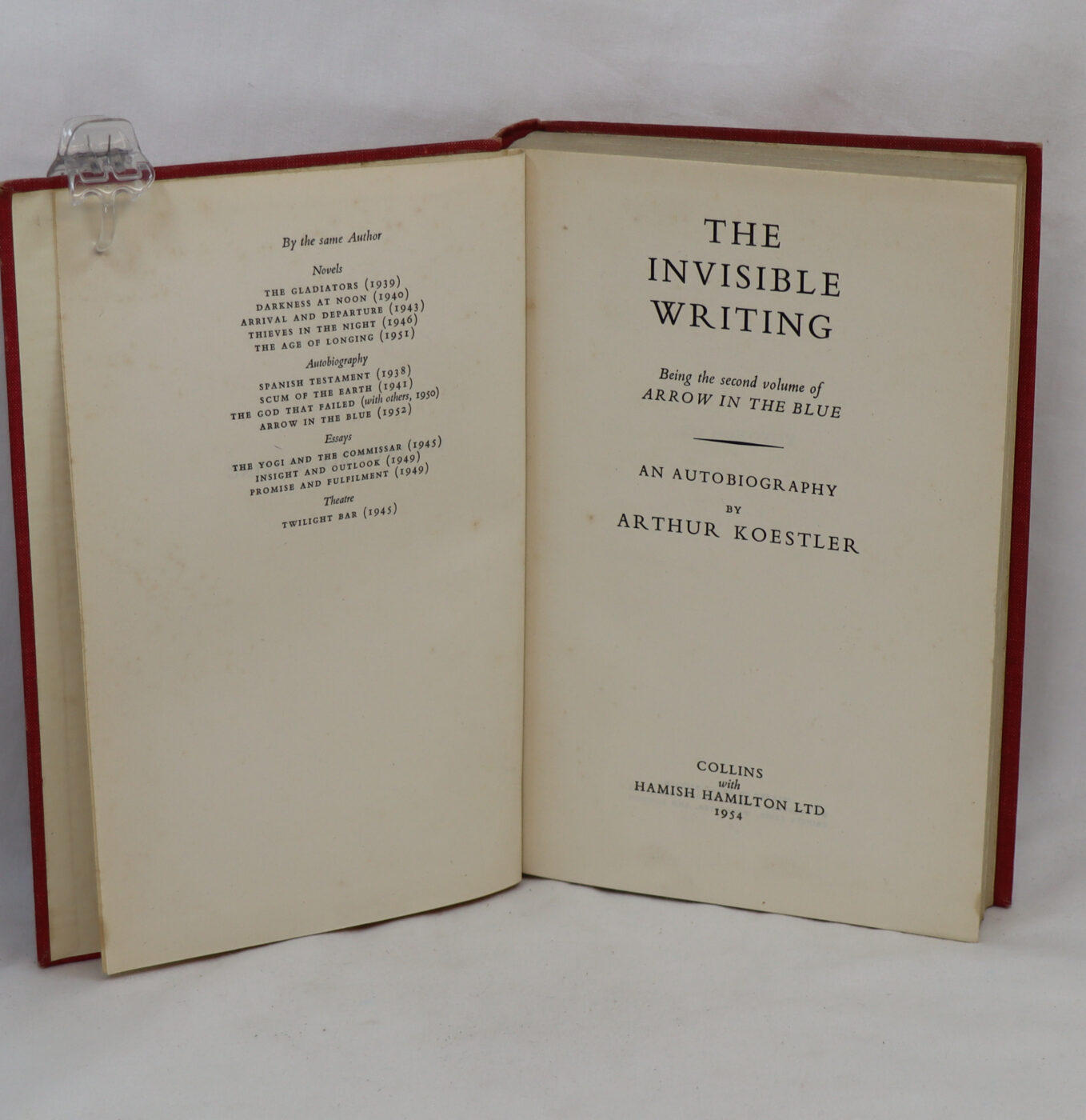
The Invisible Writing (2nd vol. of Arrow in the Blue).
By Authur Koestler
Printed: 1952
Publisher: Collins. London
| Dimensions | 15 × 22 × 3 cm |
|---|---|
| Language |
Language: English
Size (cminches): 15 x 22 x 3
Condition: Good (See explanation of ratings)
£18.00
Buy Now

Item information
Description
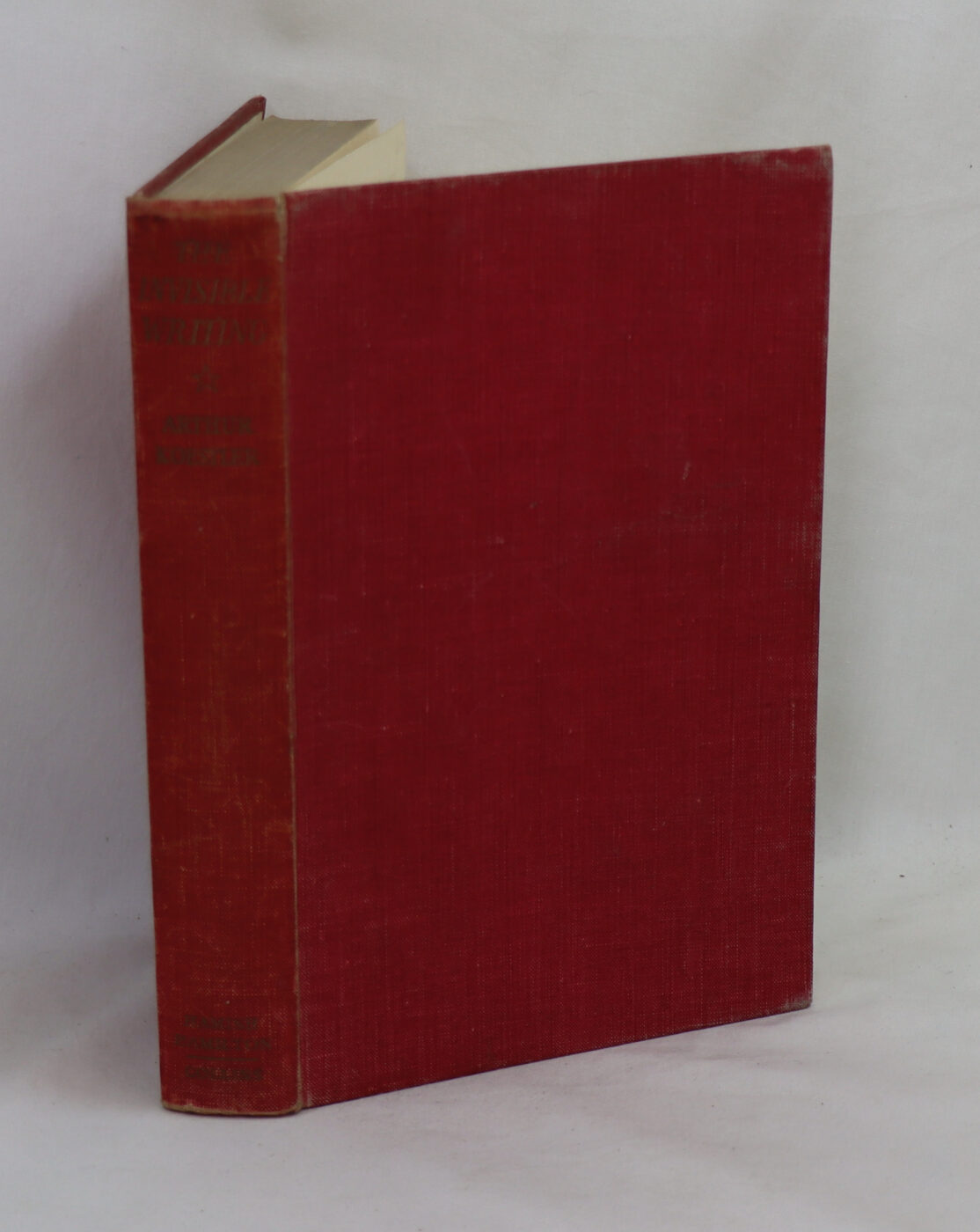
Red cloth binding with gilt title on the spine.
We provide an in-depth photographic presentation of this item to stimulate your feeling and touch. More traditional book descriptions are immediately available.
- Note: This book carries a £5.00 discount to those that subscribe to the F.B.A. mailing list
Please view our photographs. This is a copy of “The Invisible Writing” by Arthur Koestler, which serves as the second volume of his autobiography, Arrow in the Blue. Please note a minor historical correction regarding the dates: while the first volume (Arrow in the Blue) was printed in 1952, this second volume, The Invisible Writing, was officially published by Collins (in association with Hamish Hamilton) in 1954.
Market Value & Assessment
The Invisible Writing is the second volume of Arthur Koestler’s autobiography (following Arrow in the Blue), primarily tracking his life from 1932 to 1940. A first edition of this book in “Good” condition usually commands a market value of £15 to £30 ($20 to $40 USD) on antiquarian platforms like AbeBooks. (Note: While the text was completed earlier, the actual first UK edition was co-published by Collins and Hamish Hamilton in 1954. If your copy states 1952, it may be referencing the copyright date of the first volume or a specific printing note).
Book Content & Themes
The book provides a vivid, psychological, and historical account of Europe’s darkest decade. Key focal points include:
- The Communist Illusion: Picking up exactly where the first volume ends, it details Koestler’s entry into the Communist Party, his travels through Soviet Russia and Central Asia, and his subsequent disillusionment and alienation from the movement by 1938.
- Surviving Fascism: It chronicles his harrowing capture by Franco’s forces during the Spanish Civil War, where he spent months under a death sentence.
- Escape to England: It details his time in French concentration camps (such as Camp Vernet) at the outbreak of World War II, culminating in his dramatic escape to England in 1940.
- The “Invisible Writing”: The title functions as a metaphor for the higher, unseen spiritual or philosophical meaning in life that Koestler began to seek after abandoning political totalitarianism.
Want to know more about this item?
We are happy to answer any questions you may have about this item. In addition, it is also possible to request more photographs if there is something specific you want illustrated.
Ask a question
Share this Page with a friend
