
Jeremy at Crale.
By Hugh Walpole
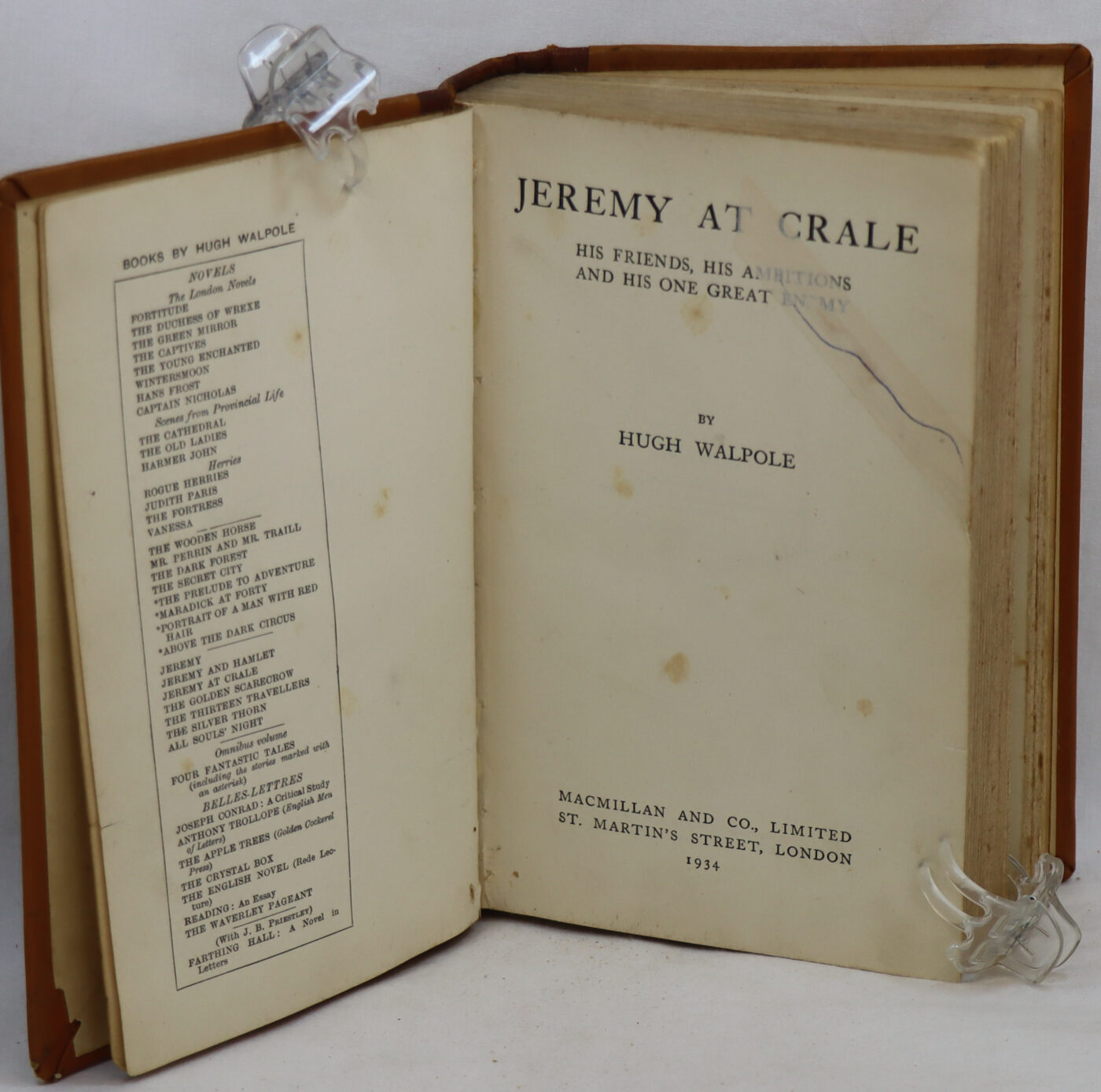
Printed: 1934
Publisher: Macmillan & Co. London
| Dimensions | 13 × 19 × 3 cm |
|---|---|
| Language |
Language: English
Size (cminches): 13 x 19 x 3
Condition: Fair (See explanation of ratings)
£24.00
Buy Now

Item information
Description
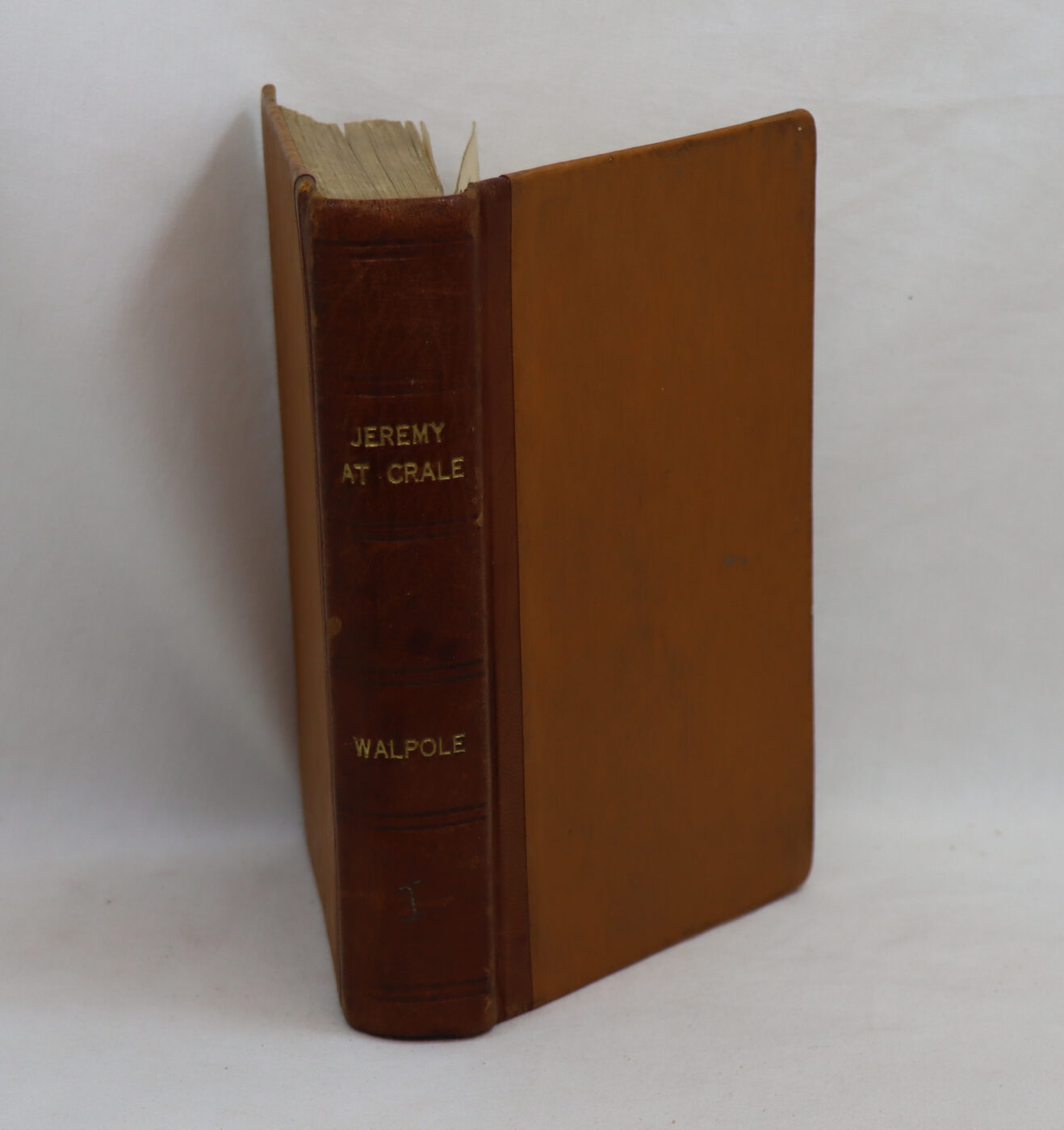
Brown leather spine with gilt title. Tan cloth boards.
We provide an in-depth photographic presentation of this item to stimulate your feeling and touch. More traditional book descriptions are immediately available.
- Note: This book carries a £5.00 discount to those that subscribe to the F.B.A. mailing list
Please view our photographs. This is an ex library book.
That matches the specifications of a 1934 printing of Jeremy at Crale by Sir Hugh Walpole, published in London by Macmillan & Co.. This particular edition is frequently noted by collectors as part of the Cumberland Edition.
Book Summary & Context
- The Story: Originally published in 1927, Jeremy at Crale is the third and final installment in Walpole’s acclaimed semi-autobiographical Jeremy trilogy. It is a classic English coming-of-age story that follows a young protagonist, Jeremy Cole, through the complexities, camaraderie, and intense rivalries of life at a traditional British boarding school.
- The Trilogy: The preceding books are Jeremy (1919) and Jeremy and Hamlet (1923).
- The Author: Sir Hugh Walpole was one of the most popular and prolific British novelists of the 1920s and 1930s, known for his vivid characterizations and authentic depictions of English boyhood.
For Collectors and Sellers
If you are assessing this copy for cataloging, buying, or selling, keep these factors in mind:
- The Binding: Depending on the exact release of the 1934 print run, these books were typically bound either in a distinctive crimson cloth or a pocket-sized limp leather format.
- Condition is Key: Because it is a 1934 reprint rather than the 1927 first edition, its value depends heavily on its condition. Look out for sunning on the spine, foxing (brown spots) on the page edges, and whether the original dust jacket is present.
NOTE 1: Sir Hugh Seymour Walpole, CBE (13 March 1884 – 1 June 1941) was an English novelist. He was the son of an Anglican clergyman, intended for a career in the church but drawn instead to writing. Among those who encouraged him were the authors Henry James and Arnold Bennett. His skill at scene-setting and vivid plots, as well as his high profile as a lecturer, brought him a large readership in the United Kingdom and North America. He was a best-selling author in the 1920s and 1930s but has been largely neglected since his death.
After his debut novel, The Wooden Horse, was published in 1909, Walpole wrote prolifically, producing at least one book every year. He was a spontaneous story-teller, writing quickly to get all his ideas on paper, seldom revising. His first novel to achieve major success was his third, Mr Perrin and Mr Traill, a tragicomic story of a fatal clash between two schoolmasters. During the First World War he served in the Red Cross on the Russian-Austrian front, and worked in British propaganda in Petrograd and London. In the 1920s and 1930s Walpole was much in demand not only as a novelist but also as a lecturer on literature, making four exceptionally well-paid tours of North America.
As a gay man at a time when sex between men was illegal in Britain, Walpole conducted a succession of intense but discreet relationships with other men, and was for much of his life in search of what he saw as “the perfect friend”. He eventually found one, a married policeman, with whom he settled in the English Lake District. Having as a young man eagerly sought the support of established authors, he was in his later years a generous sponsor of many younger writers. He was a patron of the visual arts and bequeathed a substantial legacy of paintings to the Tate Gallery and other British institutions.
Walpole’s output was large and varied. Between 1909 and 1941 he wrote thirty-six novels, five volumes of short stories, two original plays and three volumes of memoirs. His range included disturbing studies of the macabre, children’s stories and historical fiction, most notably his Herries Chronicle series, set in the Lake District. He worked in Hollywood writing scenarios for two Metro-Goldwyn-Mayer films in the 1930s, and had a cameo in the 1935 film adaptation of David Copperfield.
Condition notes
ex library
Want to know more about this item?
We are happy to answer any questions you may have about this item. In addition, it is also possible to request more photographs if there is something specific you want illustrated.
Ask a question
Related products


Share this Page with a friend
