
The Man Who Saved London.
By George Martelli
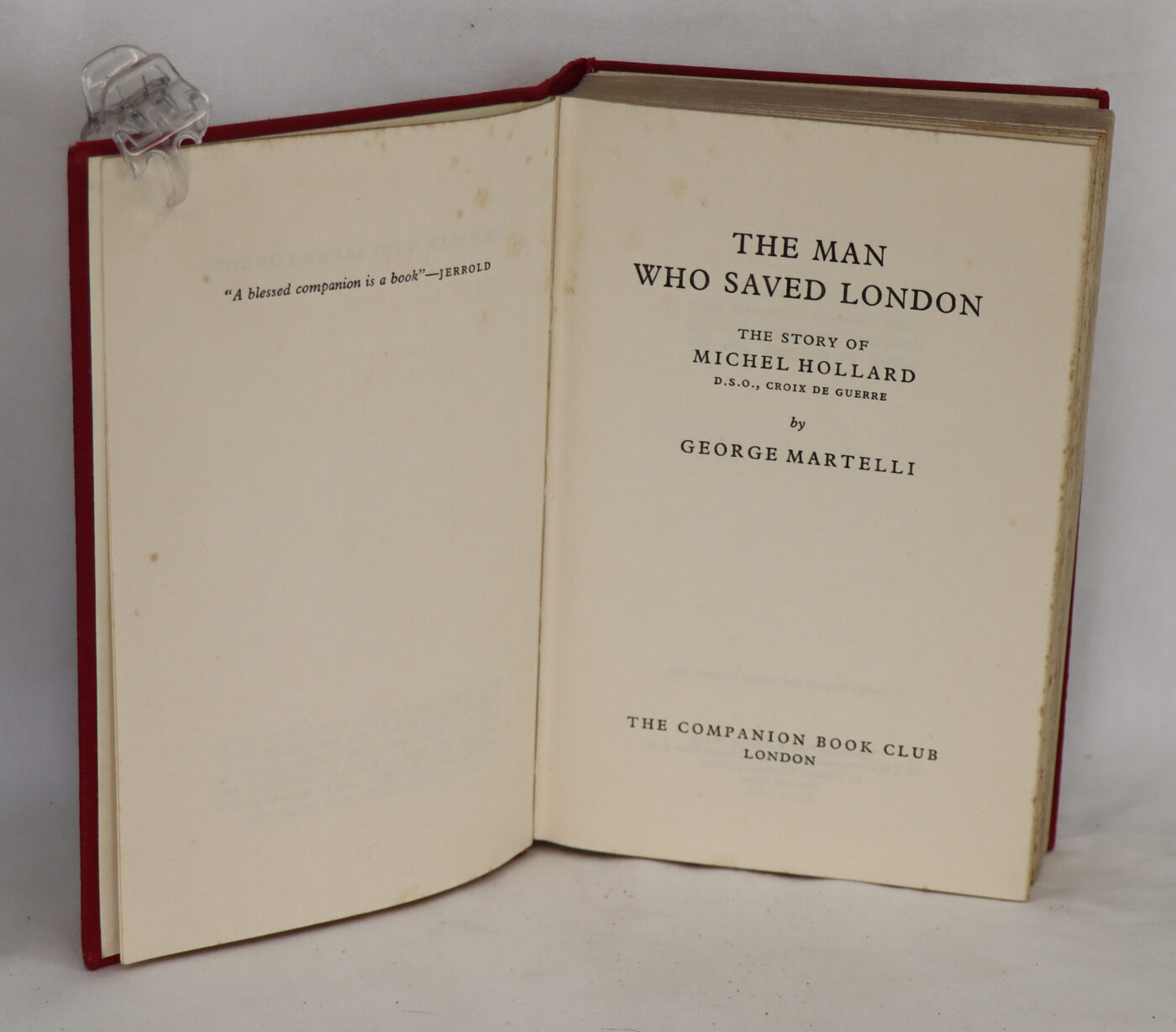
Printed: 1960
Publisher: The Companion Book Club. London
| Dimensions | 13 × 19 × 3 cm |
|---|---|
| Language |
Language: English
Size (cminches): 13 x 19 x 3
Condition: Fair (See explanation of ratings)
£17.00
Buy Now

Item information
Description
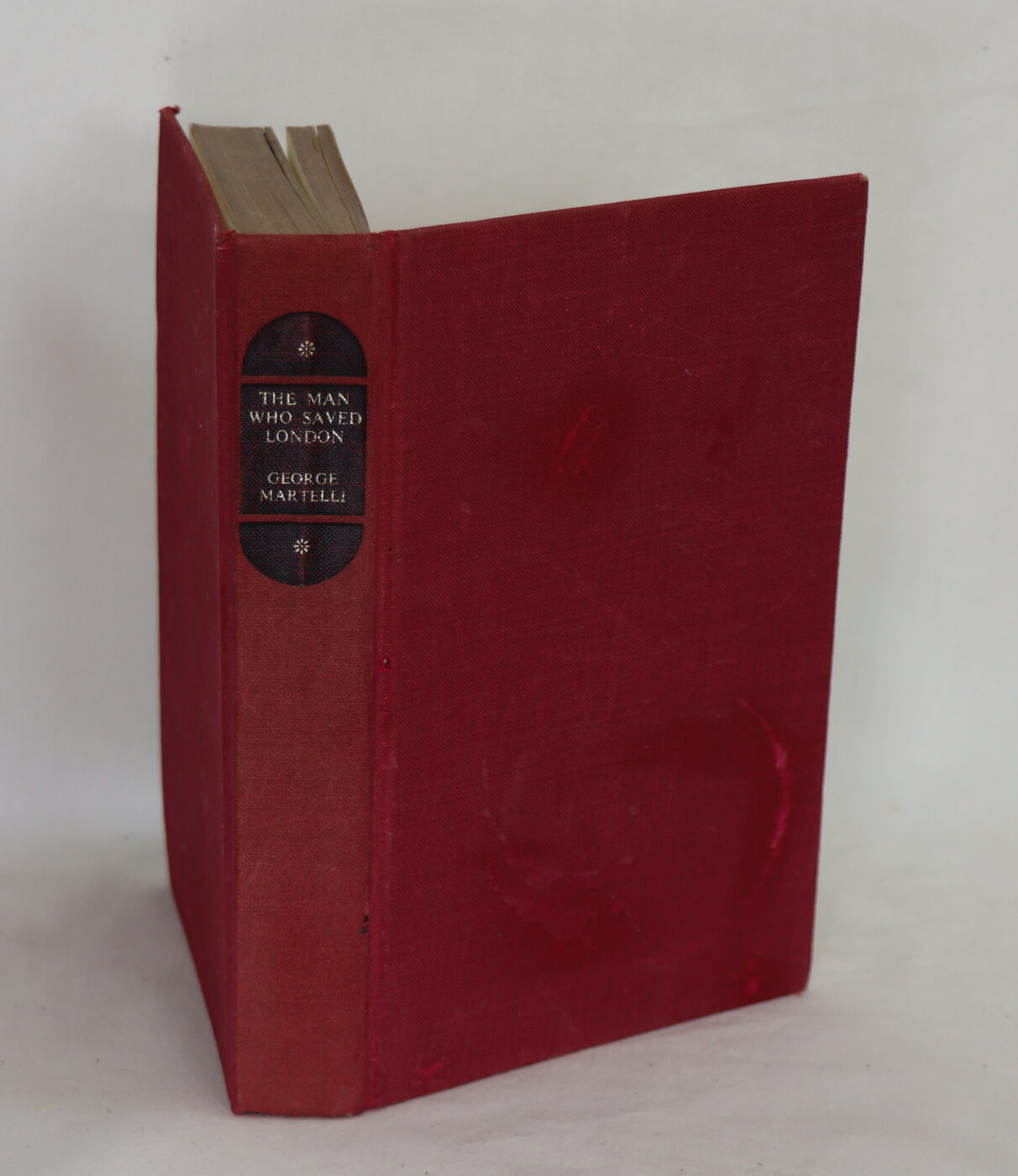
Maroon cloth binding with brown title plate and gilt title on the spine.
We provide an in-depth photographic presentation of this item to stimulate your feeling and touch. More traditional book descriptions are immediately available.
-
Note: This book carries a £5.00 discount to those that subscribe to the F.B.A. mailing list
Please view our photographs. Michel Hollard is a remarkable hero of World War II, and ought to be better known, or have this book reprinted!
-
Hollard had been a brave young soldier in the French army during World War I. Later he trained as an engineer. When World War Ii began he was too old to enlist. After the fall of France in 1940, on his own initiative, he dared to cross the Swiss border, and offer his services as intelligence-gatherer to the British Military Attache in Berne. Initially he was asked to collect information about German units, leaders, locations, and troop movements in France.
-
He recruited assistants who worked in the French railways or were able to covertly bicycle around the countryside. Again and again he took his information to the British in Switzerland. Some of his agents were betrayed, and executed or imprisoned. One of these broke his back escaping, and Hollard found a safe doctor and a safe place to recover from this almost-crippling injury. When this became too dangerous, Hollard helped the man across the Swiss border, carrying him on his back, crawling on all fours, for the last agonising steps to safety. By happy coincidence, in 1943, one of his far-roaming agents reported a strange construction near the French coast, close to England. Hollard personally investigated, exploring the site, disguised as a French worker. He recognised that a long concrete strip was pointing directly at London! Later his agents were able to locate up to 100 similar strange building sites, each with a long concrete strip aimed at London.Meanwhile, separately from Hollard’s intelligence ring, other agents had reported that the Germans were experimenting with a pilot-less plane. Shortly after this, Hollard recruited a young engineer who was hired to oversee the on-site designing of one of these sites. This engineer was able to make a secret copy of the master-plan for all these sites. When Hollard and the engineer examined the complete plan it became clear that these mysterious sites were the launching grounds for the un-manned planes — V-1 “buzz-bombs” — the first of Hitler’s “revenge weapons”. Hollard was able to examine a crated V-1 on its way to one of these launch-sites.
-
The result was that the Allies’ air forces were able to bomb the identified sites, and seriously upset Hitler’s plans to launch 5000 V-1s a month, for at least 10 months, during what was actually the military build-up, in Britain, preparing for the D-Day invasion at Normandy.
-
It is unquestionable that if Hollard and others had not discovered the preparations for this V-1 assault, the D-Day preparations would have been severely upset, and the actual invasion would have almost certainly been delayed. Although London did suffer the psychological stress of a greatly curtailed Buzz-Bomb “blitz”, up until the V-1 launch-sites were over-run by Allied ground troops, the actual loss of life, and damage to the city was far less than it might have been. The damage to military installations and industry was minimal.
-
This is hardly surprising. The British populace did not beg for surrender as a result of the 1940-41 German “Blitz”. Nor did the German population overthrow the Nazi regime in response to the far more devastating area bombing of German cities during 1942-43-44.
-
The actual damage to German military power and industry caused by the massive bombing campaigns of RAF Bomber Command and the USAAF Bomber groups was far less than the air force leaders hoped for. The much smaller V-1 campaign that was waged, could only have much less impact. In hindsight, important though Hollard’s and others’ intelligence work was in discovering and disrupting the V-1 menace, it must be asked whether (in the vein of historian Kenneth Macksey’s “Military Errors of World War II” — a stimulating survey of blunders of many kinds) Hitler’s focus on REVENGE weapons, such as the V-1 and V-2 rocket, was not a “military error”, and typical of the Nazis’ lack of plan for how to WIN the war. All the V-1 could do was terrorise. The cost of the massive V-1 campaign, as planned (100+ sites, plus 50,000 V-1s, plus explosive, plus personnel, plus research and development), might have been used to better tactical, or strategic effect, IF the Nazis had a guiding strategy.Hollard was eventually betrayed, captured, tortured by the Gestapo, and sent to a German concentration camp, pending execution. He never broke under torture. His intelligence ring was not compromised.
-
Eventually he survived the war, and returned to civilian life.
-
Is it too late to hope that a statue of him might be erected somewhere in London, so he is not forgotten?
Want to know more about this item?
We are happy to answer any questions you may have about this item. In addition, it is also possible to request more photographs if there is something specific you want illustrated.
Ask a question
Share this Page with a friend
