
A Treatise on the Meaning of the Holy Sacrament.
By John Kettlewell
Printed: 1686
Publisher: Robert Kettlewell. London
| Dimensions | 10 × 16 × 3 cm |
|---|---|
| Language |
Language: English
Size (cminches): 10 x 16 x 3
Condition: Fair (See explanation of ratings)
£140.00
Buy Now

Item information
Description
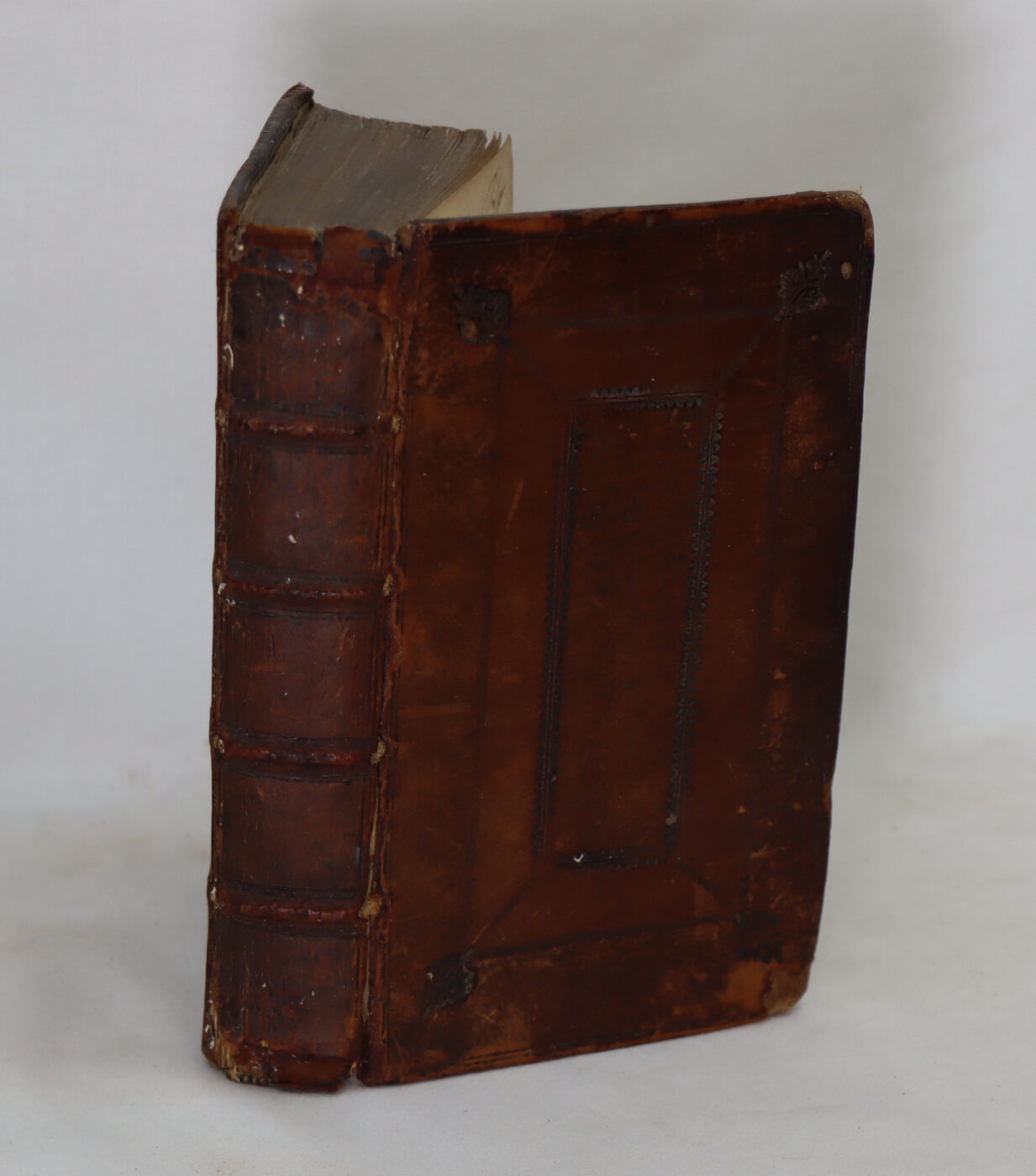
Brown leather binding with raised banding. Cambridge panel embossed on the boards. Original (worn) binding.
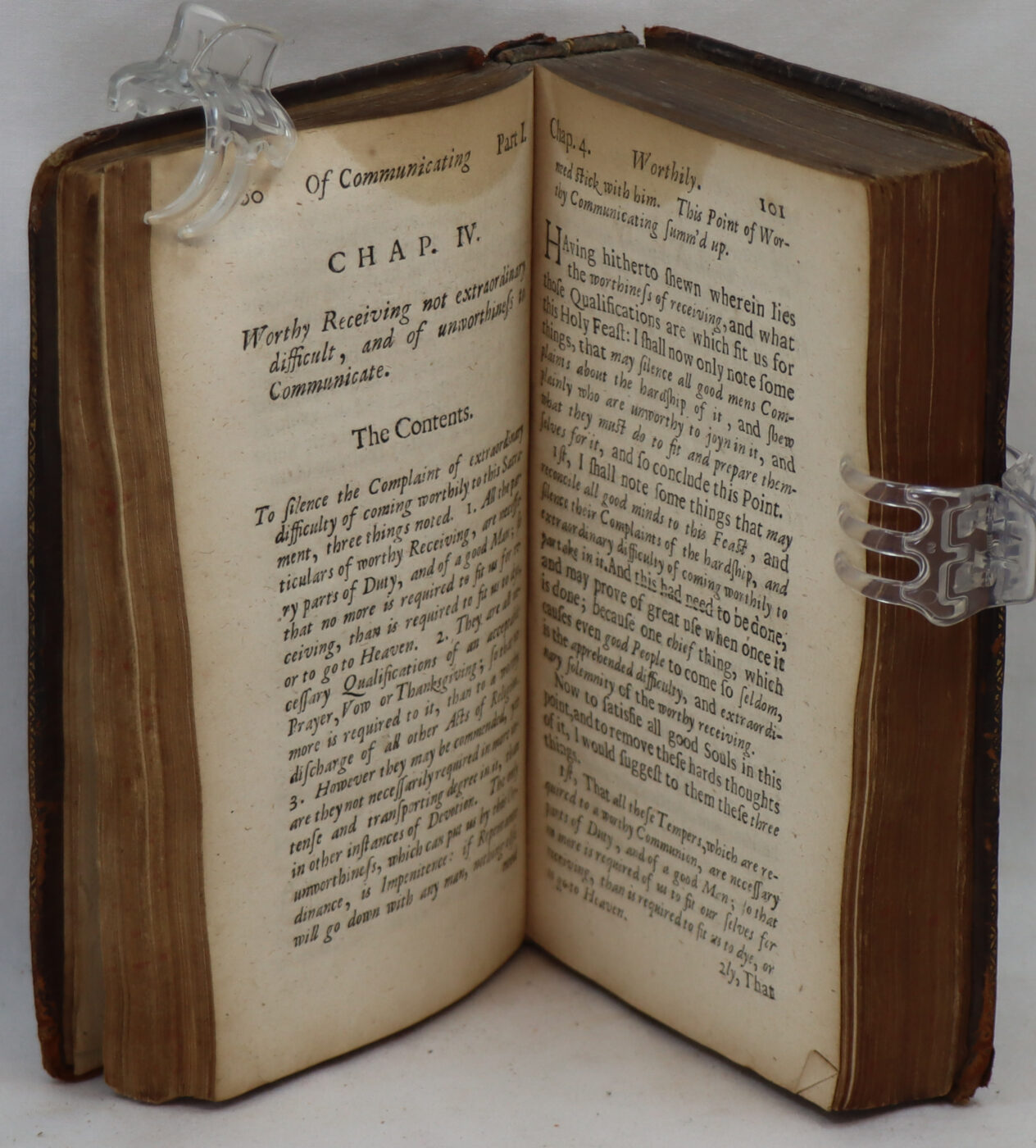
We provide an in-depth photographic presentation of this item to stimulate your feeling and touch. More traditional book descriptions are immediately available.
-
Note: This book carries a £5.00 discount to those that subscribe to the F.B.A. mailing list
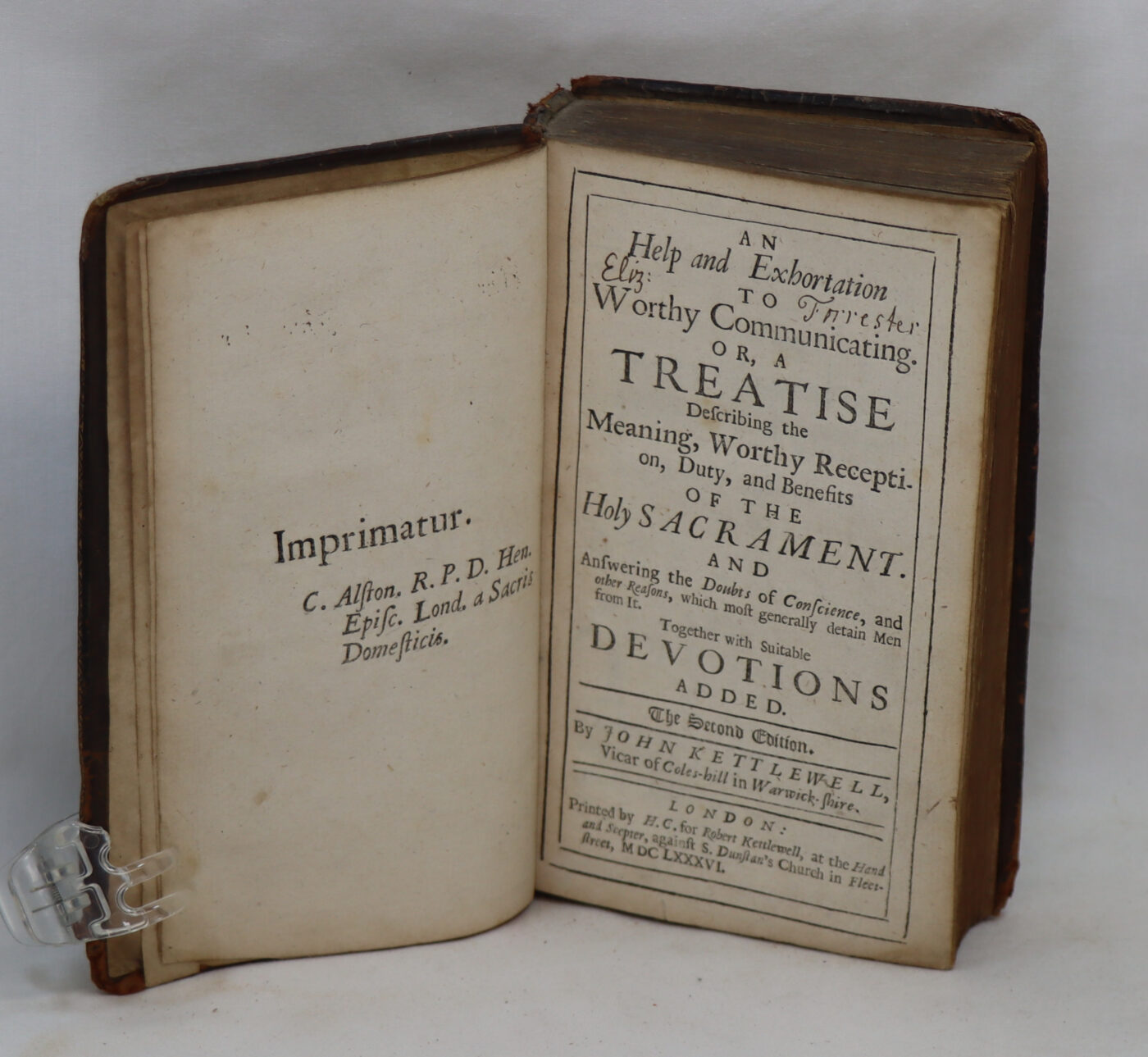
A help and exhortation to worthy communicating. Or, a treatise describing the Meaning, Worthy Reception, Duty and Benefits of the holy sacrament.
Full contemporary panelled calf blanks. Imprimatur, title in two-line border. Dedication. Please view our photographs for conditions
The 1686 edition of John Kettlewell’s work—formally titled An Help and Exhortation to Worthy Communicating. Or, A Treatise Describing the Meaning, Worthy Reception, Duty, and Benefits of the Holy Sacrament (2nd edition, printed for Robert Kettlewell)—was printed in octavo (8vo) format, which typically measures approximately 7 to 8 inches tall by 4.5 to 5 inches wide (around 18–20 cm × 11–13 cm).
Because 17th-century books were bound individually by hand and trimmed to the buyer’s preference, exact exterior dimensions vary slightly from copy to copy.
Bibliographic & Physical Details
- Full Title. An Help and Exhortation to Worthy Communicating. Or, A Treatise Describing the Meaning, Worthy Reception, Duty, and Benefits of the Holy Sacrament.
- Edition & Imprint. Second edition, printed in London in 1686 by H.C. for Robert Kettlewell.
- Format. Octavo (8vo), meaning each large sheet of paper was folded three times to create eight leaves (16 pages) per gathering.
- Page Count. Approximately 538 pages total ([34] preliminary pages, 502 numbered pages, and [2] final unnumbered pages).
- Typical Exterior Dimensions. Roughly 7.25″ – 8″ × 4.5″ – 5″ (height × width), with a spine thickness of around 1.25″ – 1.5″ depending on the leather binding.
John Kettlewell (1653–1695) was a prominent English clergyman, theological writer, and leading figure in the Nonjuror schism within the Church of England. He was widely respected during the late 17th century for his influential devotional manuals and his steadfast refusal to swear allegiance to King William III and Queen Mary II.
Early Life and Ministry
- Yorkshire Roots. Born on 10 March 1653 in Brompton, near Northallerton in Yorkshire, Kettlewell was the son of a local merchant. He was educated at Northallerton Grammar School under a staunch royalist schoolmaster.
- Oxford Career. He entered St Edmund Hall, Oxford, in 1670 and was elected a fellow of Lincoln College in 1675.
- Vicar of Coleshill. After gaining fame for his early religious writings, Kettlewell was appointed vicar of Coleshill in Warwickshire in 1682 by Lord Digby. He remained there for eight years, establishing a reputation for strict piety and pastoral care.
The Nonjuror Crisis
- Refusal of the Oaths. Following the Glorious Revolution of 1688–1689, which deposed King James II, Parliament required all clergy to swear new oaths of allegiance to William and Mary. Because Kettlewell believed his earlier oath to James II was binding before God, his conscience forbade him from taking the new oath.
- Deprivation and Exile. Along with roughly 400 other clergy—known as Nonjurors—Kettlewell was stripped of his parish and income in 1690. He moved to London, where he spent his final years writing and organising a charitable relief fund for impoverished Nonjuring clergy and their families.
- Political Controversy. His relief fund was viewed with suspicion by the government as a potentially seditious Jacobite network, leading to brief questioning by authorities. He also published sharp theological tracts opposing clergy like William Sherlock, who argued in favour of switching allegiance to the new monarchs.
Legacy and Major Works
- Devotional Influence. Despite political divisions, Kettlewell was admired across religious lines for his gentle character and clear, practical spiritual guidance. His works remained popular in Anglican households well into the 18th century.
- Key Publications. Alongside An Help and Exhortation to Worthy Communicating (1683, reprinted 1686), his best-known works include The Measures of Christian Obedience (1681) and The Practical Believer (1688).
- Death. Kettlewell died of tuberculosis in London on 12 April 1695 at the age of 42. You can read more about his life and writings in his entry on Wikipedia.
Robert Kettlewell’s brother and the publisher of this 1686 edition).
A comparative price of this book
Antiquarian copies of John Kettlewell’s An Help and Exhortation to Worthy Communicating typically sell for £110 to £150 (around $140 to $207 USD) depending on the edition, binding, and physical condition.
Because the book went through eight editions between 1683 and the mid-18th century, early printings appear on the rare book market fairly regularly.
Comparable Market Listings
- 1686 Second Edition (Frost Books & Artifacts). Listed at £140.00 (or $186.79 USD) in full contemporary panelled calf leather binding.
- 1706 Fifth Edition (Antiquates Ltd). Listed at £150.00 (or $206.95 USD on AbeBooks) as an octavo hardcover with slight spotting to the text.
- 1737 Later Edition (Humber Books Ltd). Listed at roughly £110 GBP on AbeBooks as a disbound text block without covers.
Key Factors Affecting Value
- Edition Date. 17th-century printings published during Kettlewell’s lifetime (such as the 1683 first edition and 1686 second edition) are generally more desirable to collectors than 18th-century reprints.
- Binding Integrity. Contemporary leather bindings (like Cambridge panelled calf) retain higher value when the boards are still firmly attached, even if the leather shows expected shelf wear.
- Completeness. Collectors check that the frontispiece portrait (if issued with that printing), imprimatur leaf, and title page are intact and free from heavy dampstaining or missing text.
Condition notes
Hinges cracked
Want to know more about this item?
We are happy to answer any questions you may have about this item. In addition, it is also possible to request more photographs if there is something specific you want illustrated.
Ask a question
Related products

Share this Page with a friend
