
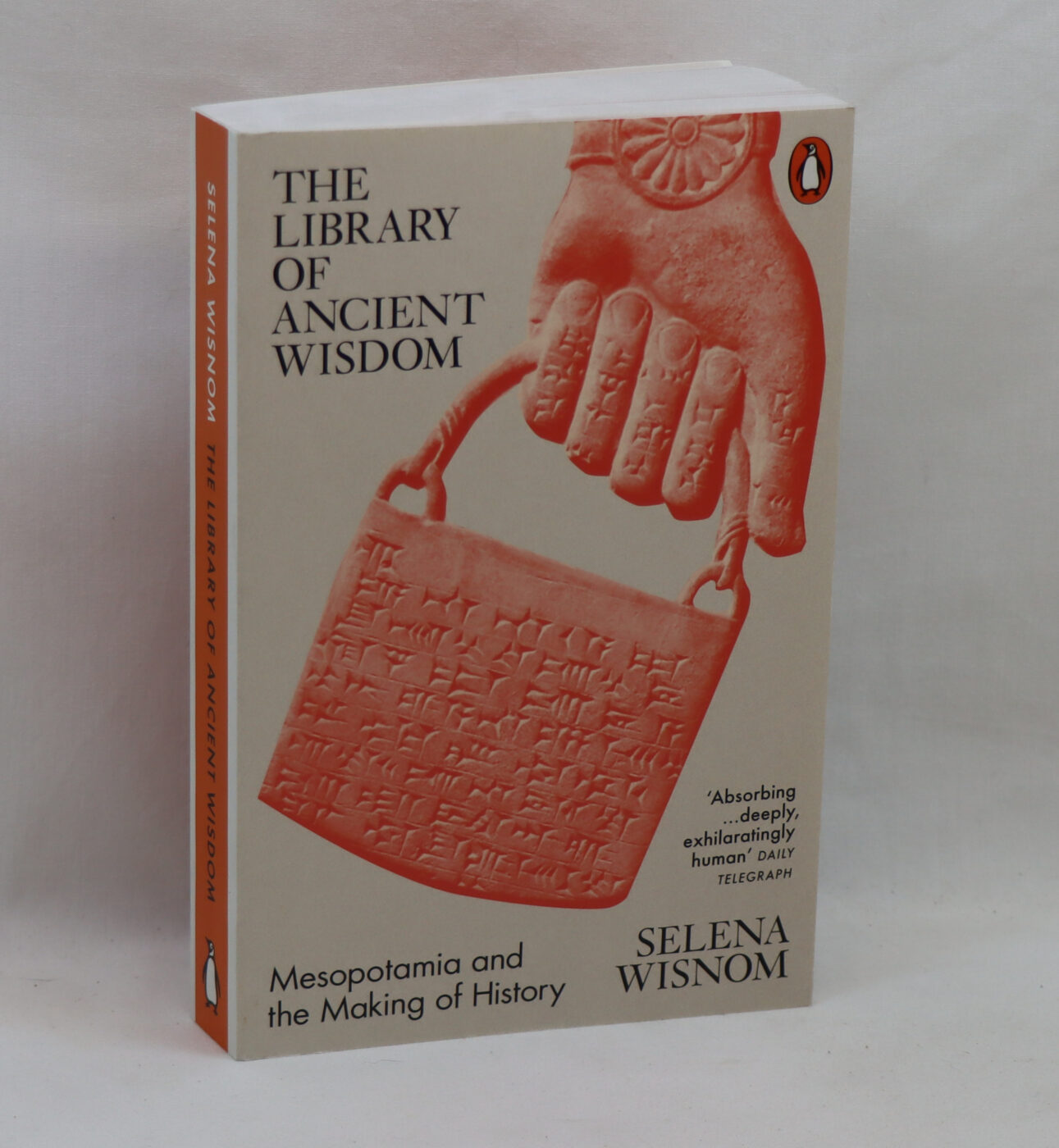
The Library of Ancient History.
By Selena Wisnom
ISBN: 9780226826226
Printed: 2026
Publisher: Penguin Books.
| Dimensions | 13 × 20 × 2.5 cm |
|---|---|
| Language |
Language: English
Size (cminches): 13 x 20 x 2.5
Condition: As new (See explanation of ratings)
£13.00
Buy Now

Item information
Description
Paperback. Orange cover with a black title.
We provide an in-depth photographic presentation of this item to stimulate your feeling and touch. More traditional book descriptions are immediately available.
- A £2 reduction when collected from FBA shop
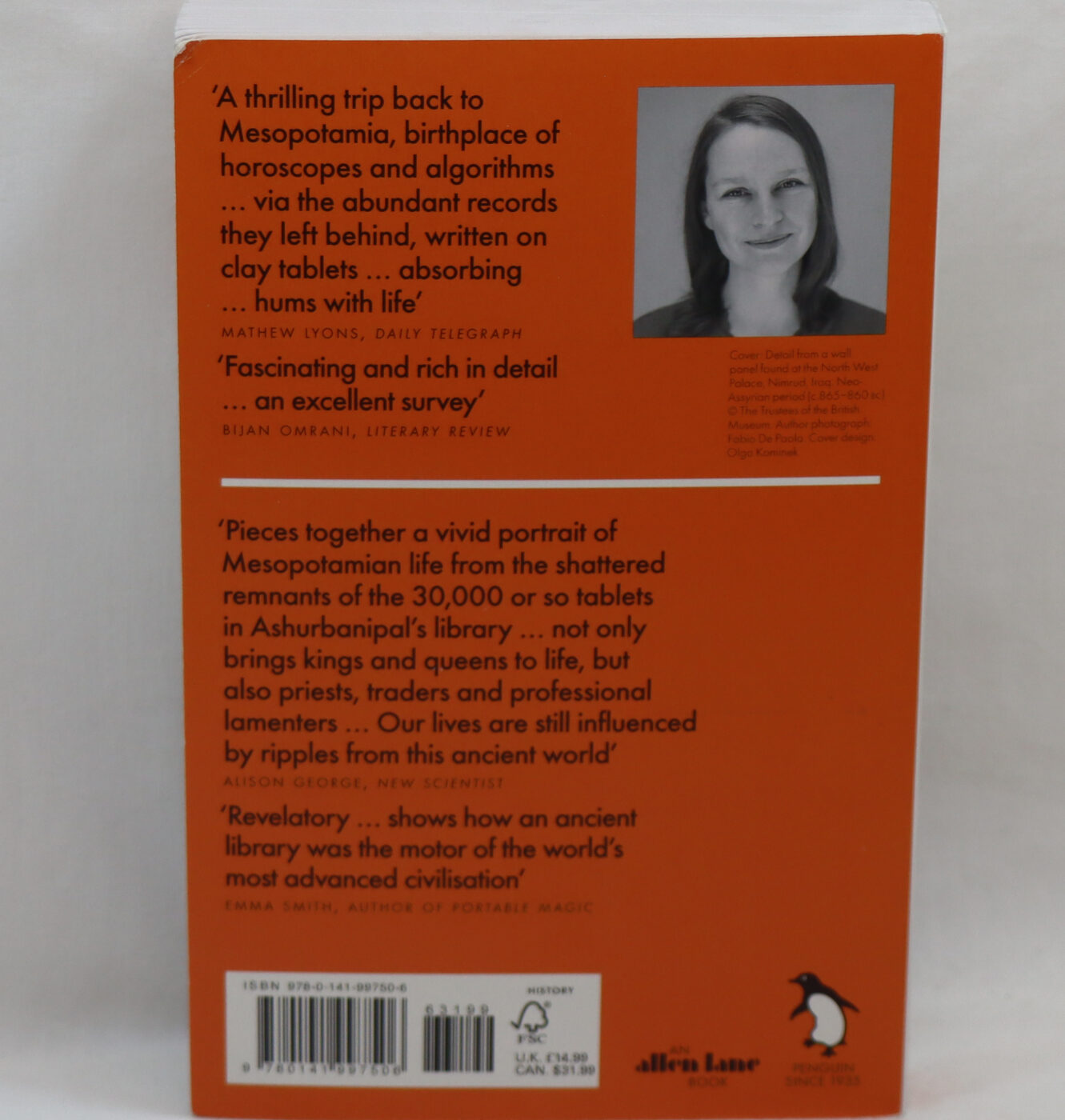
‘A thrilling trip back to Mesopotamia, birthplace of horoscopes and algorithms … via the abundant records they left behind, written on clay tablets… absorbing… hums with life’ – Mathew Lyons, Daily Telegraph
- ‘Fascinating and rich in detail… provides an excellent survey of Mesopotamian literary classics.. and offers snippets of daily life’ – Literary Review
When a team of Victorian archaeologists dug into a grassy hill in Iraq, they chanced upon one of the oldest and greatest stores of knowledge ever seen: the library of the Assyrian king Ashurbanipal, seventh century BCE ruler of a huge swathe of the ancient Middle East known as Mesopotamia. After his death, vengeful rivals burned Ashurbanipal’s library to the ground – yet the texts, carved on clay tablets, were baked and preserved by the heat. Buried for millennia, the tablets were written in cuneiform: the first written language in the world.
More than half of human history is written in cuneiform, but only a few hundred people on earth can read it. In this captivating new book, Assyriologist Selena Wisnom takes us on an immersive tour of this extraordinary library, bringing ancient Mesopotamia and its people to life. Through it, we encounter a world of astonishing richness, complexity and sophistication. Mesopotamia, she shows, was home to advanced mathematics, astronomy and banking, law and literature. This was a culture absorbed and developed by the ancient Greeks, and whose myths were precursors to Bible stories – in short, a culture without which our lives today would be unrecognizable.
The Library of Ancient Wisdom unearths a civilization at once strange and strangely familiar: a land of capricious gods, exorcisms and professional lamenters, whose citizens wrote of jealous rivalries, profound friendships and petty grievances. Through these pages we come face to face with humanity’s first civilization: their startling achievements, their daily life, and their struggle to understand our place in the universe.
Reviews:
-
- Fascinating and rich in detail… provides an excellent survey of Mesopotamian literary classics, including the Epic of Gilgamesh, and the ways in which they influenced later cultures and texts, such as the Iliad and the Odyssey… she also offers snippets of daily life, including an account of Ashurbanipal’s father, Esarhaddon, getting into a panic because a mongoose had run under his chariot (was it a fatal omen?) and the actual agenda of a meeting — Bijan Omrani ― Literary Review
- A thrilling trip back to Mesopotamia, birthplace of horoscopes and algorithms … via the abundant records they left behind, written on clay tablets… absorbing… hums with life — Mathew Lyons ― Daily Telegraph
- Wisnom’s strength lies in taking a walk along the shelves of the library and discovering what the books tell us about the ideas circulating in the court of Nineveh — Richard Ovenden ― The FT
- The Library of Ancient Wisdom pieces together a vivid portrait of Mesopotamian life from the shattered remnants of the 30,000 or so tablets in Ashurbanipal’s library… which not only bring kings and queens to life, but also priests, traders and professional lamenters — Alison George ― New Scientist
- A fascinating book about the contents of the library of the Assyrian king Ashurbanipal… An excellent bibliographical essay, useful timelines, maps, and illustrations, and a helpful list of the historical figures who people this story enhance Wisnom’s tour of an astounding collection — Ellen Gilbert ― Library Journal
- A fascinating account of the daily lives lived by people thousands of years ago — Terry Freedman ― Teach Secondary Magazine
- Selena Wisnom shows how an ancient library was the motor of the world’s most advanced civilization. Her book is a great work of revelatory history, but I was also unexpectedly moved by its measured optimism about the future – for the preservation of the heritage of Mesopotamia, for the ways history rhymes across millennia, and for the library as the heart of any culture worth remembering — Emma Smith, author of Portable Magic: A History of Books and their Reader
- Selena Wisnom illuminates an extraordinary survival – one of the greatest libraries of the ancient world, but one that was forgotten until the middle of the 19th century, when it began to emerge from the earth of central Iraq. Ashurbanipal’s library preserved by accident a wealth of knowledge from the ancient civilisations of Mesopotamia – texts which still speak to us today — Richard Ovenden, author of Burning the Books and Librarian at the Bodleian Library, Oxford
-
- In this remarkable book, Wisnom takes her readers on a spell-binding tour through one of antiquity’s great monuments to knowledge: the Library at Nineveh. As she surveys the clay tablets that were buried in a blaze millennia ago, a lost world of learning and literature comes back to life — Sophus Helle, author of Gilgamesh: A New Translation of the Ancient Epic
- Wisnom makes the past come alive with descriptions of powerful personalities, daily life, and the hopes, fears, and rivalries of Assyrian elites. Her humanizing account takes us on an exciting journey, with stops at the invention of writing, the Mesopotamian school curriculum, the gods and their complicated relationships and powers, the practice and purpose of magic, the causes and treatments of diseases, and the interpretations of omens. We learn about the grand concepts of evil, suffering and justice, as well as precise details about marks on sheep livers and their implications for the outcome of battles — Augusta McMahon, author of Once There Was a Place: Settlement Archaeology at Chagar Bazar 1999–2002
- When a team of Victorian archaeologists dug into a grassy hill in Iraq, they chanced upon one of the oldest and greatest stores of knowledge ever seen: the library of the Assyrian king Ashurbanipal, seventh century BCE ruler of a huge swathe of the ancient Middle East known as Mesopotamia. After his death, vengeful rivals burned Ashurbanipal’s library to the ground – yet the texts, carved on clay tablets, were baked and preserved by the heat. Buried for millennia, the tablets were written in cuneiform: the
Selena Wisnom is Lecturer in the Heritage of the Middle East at the University of Leicester. A specialist in the interpretation of Mesopotamian cultural sources, Selena’s previous works include Weapons of Words: Intertextual Competition in Babylonian Poetry. She has also written three plays set in ancient Assyria; the most recent, Ashurbanipal: The Last Great King of Assyria was staged at London’s Crypt Gallery in 2019.
Want to know more about this item?
We are happy to answer any questions you may have about this item. In addition, it is also possible to request more photographs if there is something specific you want illustrated.
Ask a question


Share this Page with a friend
