
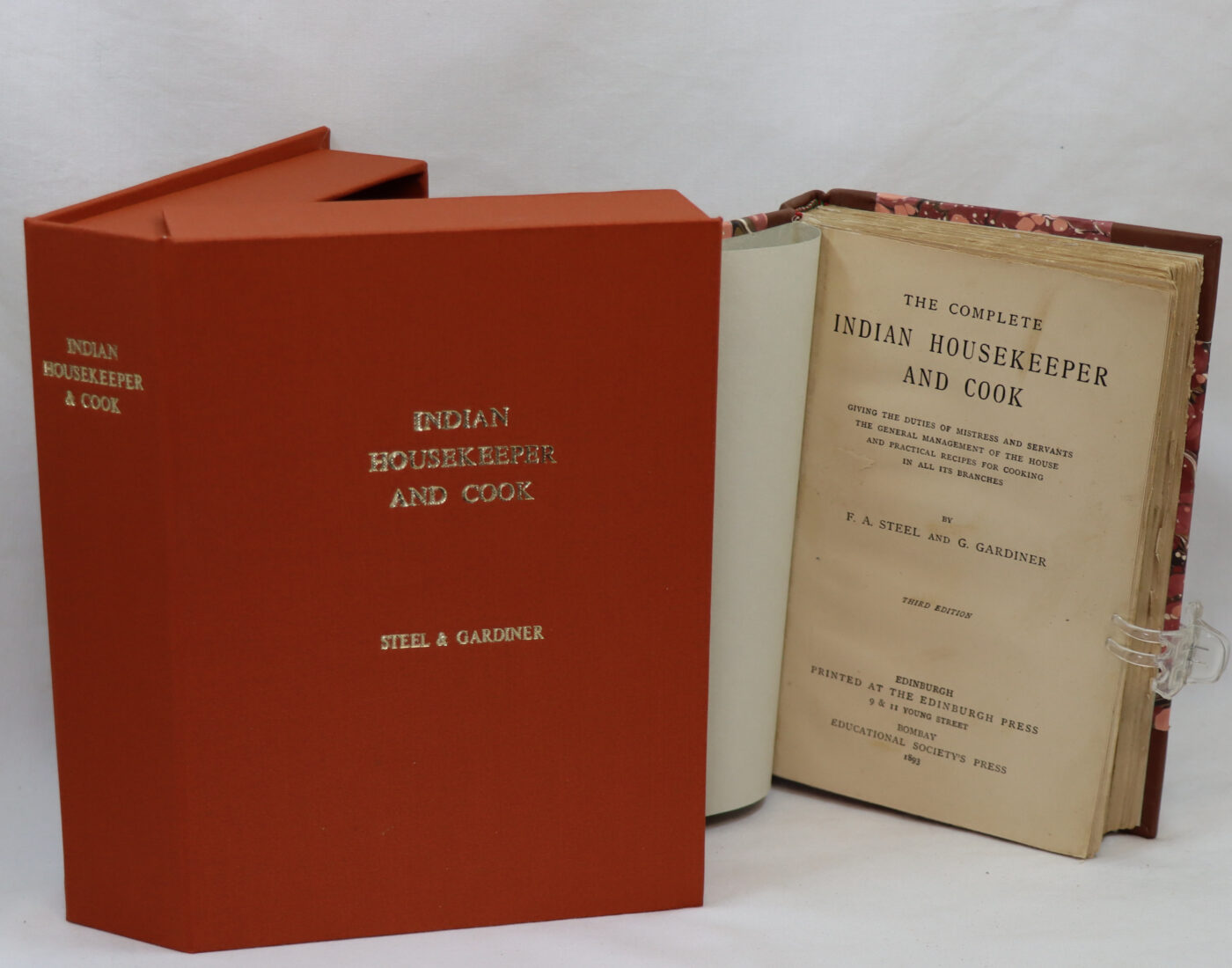
The Complete Indian Housekeeper and Cook.
By F A Steel & G Gardiner
Printed: 1893
Publisher: Edinburgh Press. Edinburgh
| Dimensions | 15 × 20 × 4 cm |
|---|---|
| Language |
Language: English
Size (cminches): 15 x 20 x 4
Condition: Very good (See explanation of ratings)
THIS ITEM WILL BE AVAILABLE SOON
SORRY, THIS ITEM HAS SOLD

Item information
Description
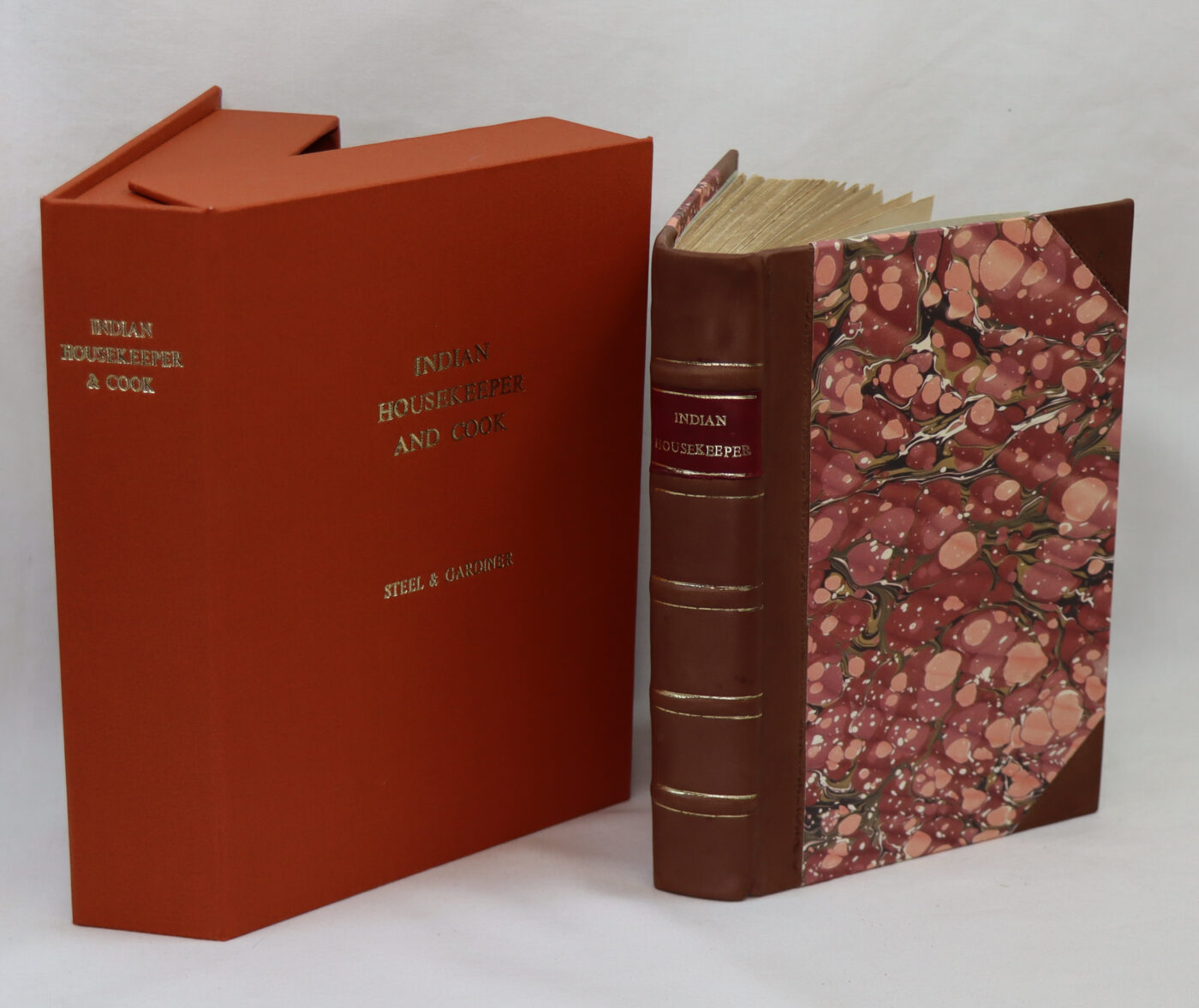
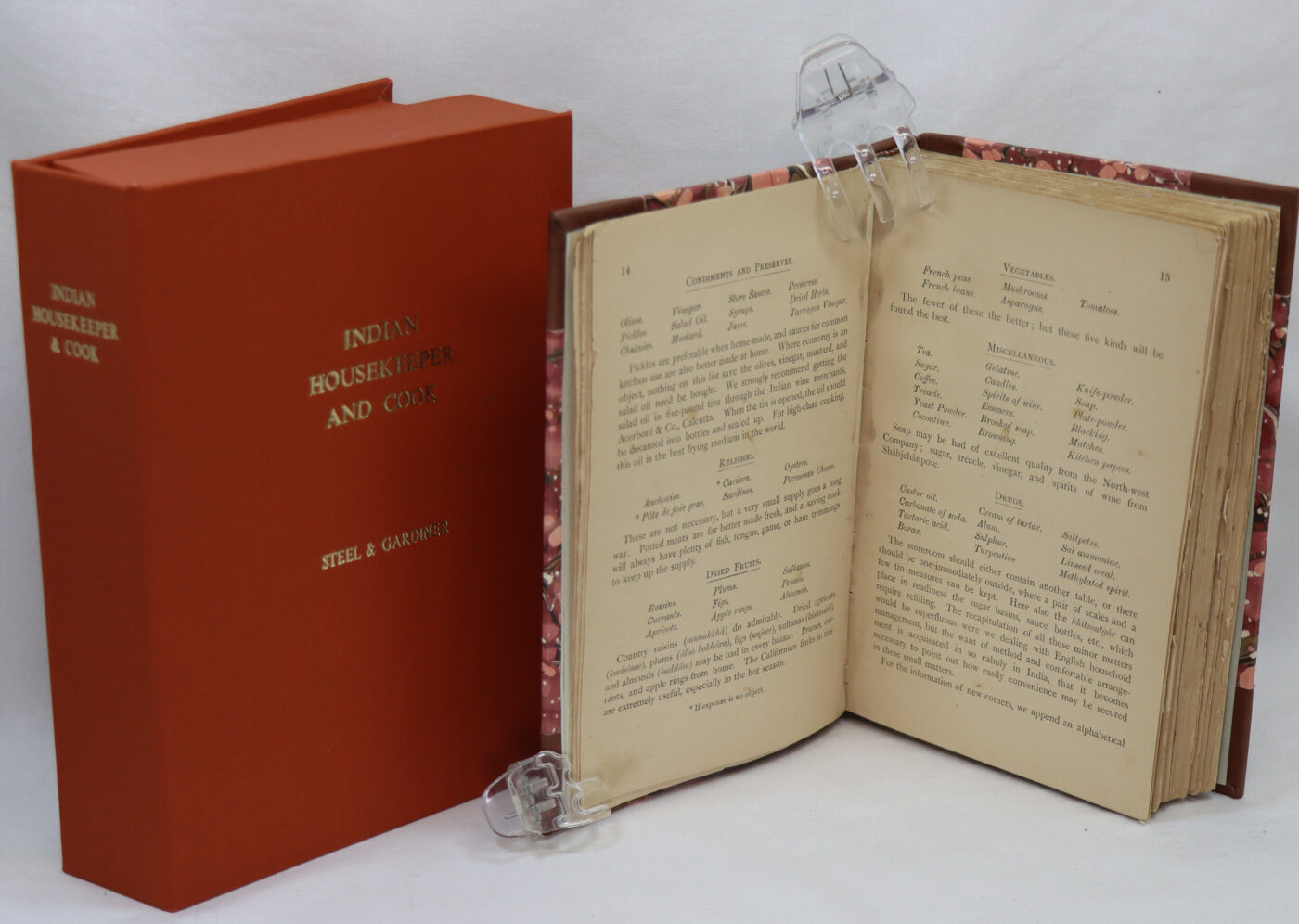
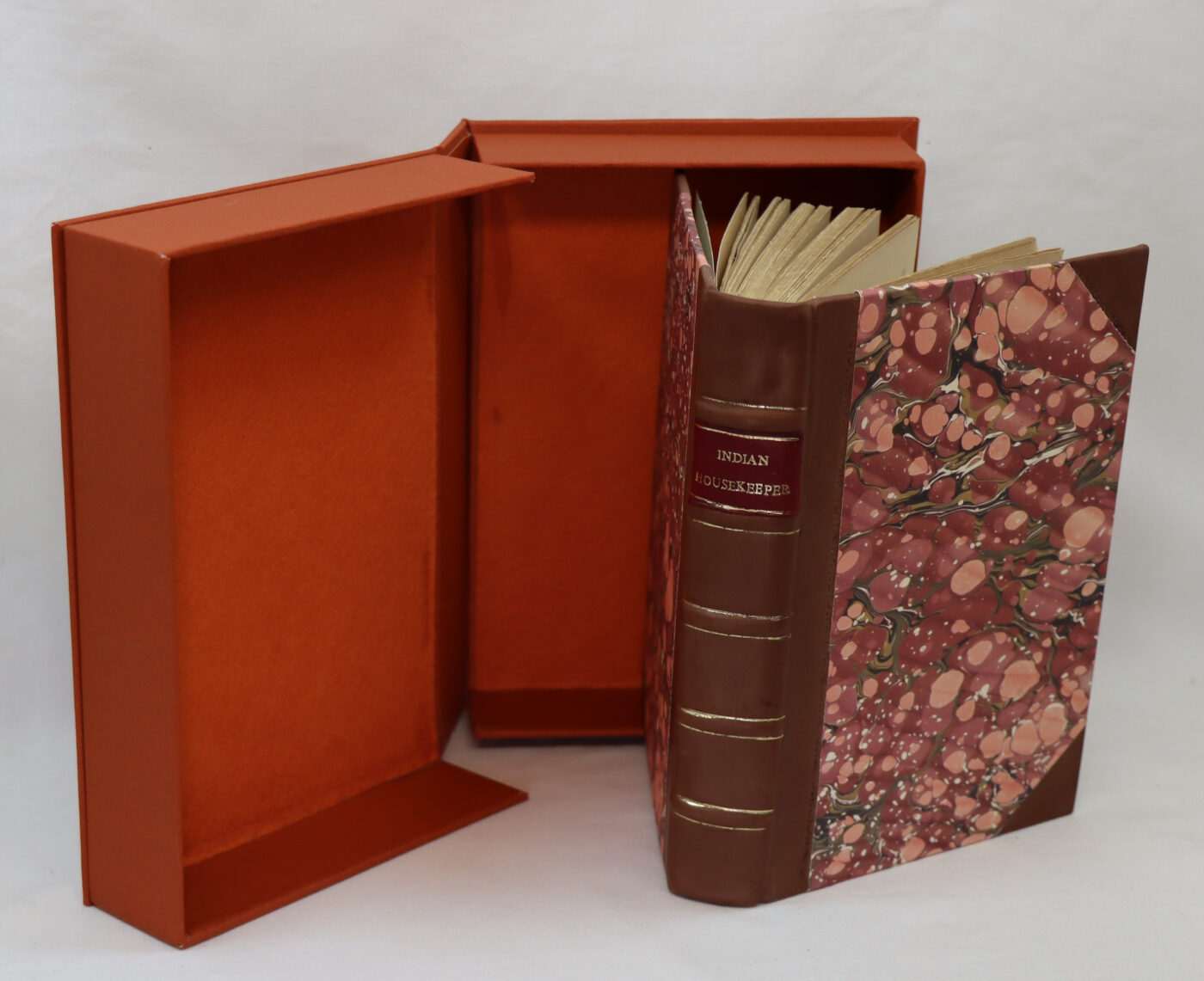
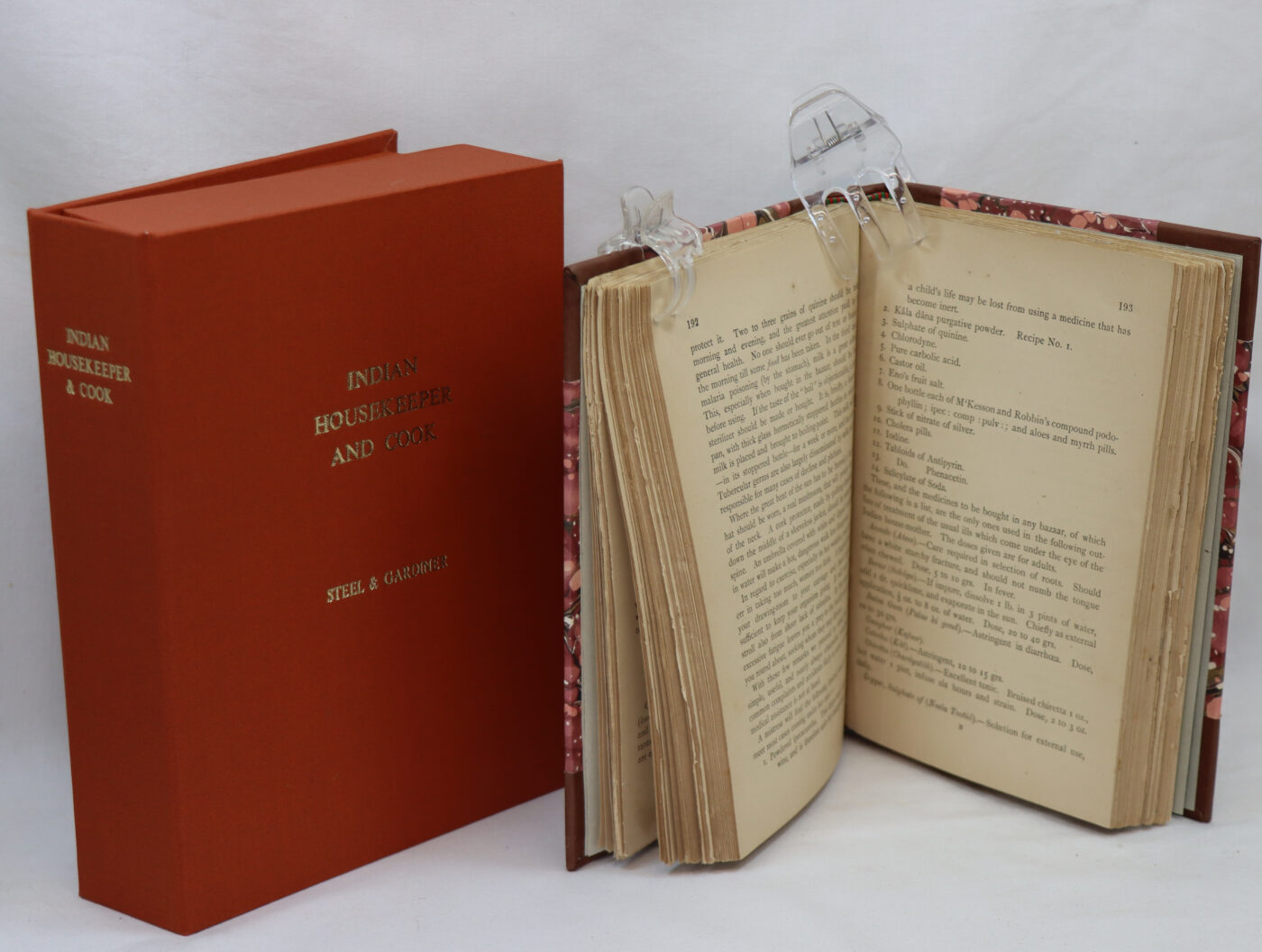
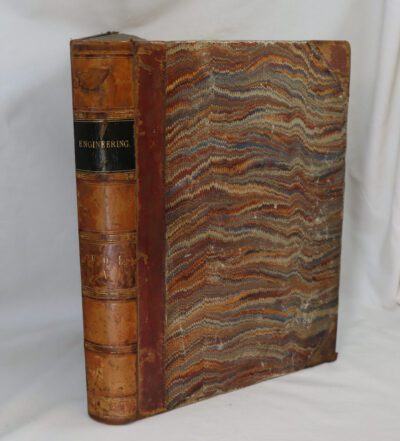
Presented in a newly made clam-shell box. Rebound with brown calf spine.red title plate, raised banding and gilte title. Red and brown marbled boards. Measurements are for the box.
-
We provide an in-depth photographic presentation of this item to stimulate your feeling and touch. More traditional book descriptions are immediately available.
-
Note: This book carries a £5.00 discount to those that subscribe to the F.B.A. mailing list
This third edition’s, most rare copy, has a solid pedigree being by tradition the copy that Rudyard Kipling passed onto Colonel Arthur Cory, who was the father of Annie Sophie Cory, the famous writer of the Victoria Cross novels. From the Cory family the book then passed into the hands of the Cambridge Lang family from whom Frost Books acquired it in 2025. The Frost family in 1993 bought the Edinburgh Press imprint from the estate of Sir Robert Maxwell along with that of Oliver and Boyd. Because of its great sentimental value this book is painstakingly restored and expertly boxed by the craftsman Brian Cole.
Flora Annie Steel and Grace Gardiner’s classic work of Anglo-Indian household life was first published in 1888 and went through ten editions thanks to its great utility. Tailored specifically for the British community in India, the book covers household hints, domestic finances and house management, a glossary of common domestic terms, and a variety of recipes. For readers today, it provides a valuable insight into life in British India, as well as revealing contemporary attitudes to the native Indian people. Steel and Gardiner were witty and well-travelled women of lively intelligence, and the book makes entertaining and accessible, if highly opinionated, reading. Topics covered include the care of domestic and farm animals, clothing and dressmaking, practical cooking tips, camp and missionary life, and how to cope with the idiosyncrasies of the Indian servant.
The Complete Indian Housekeeper and Cook is a book on housekeeping during the British Raj. Flora Annie Steel and Grace Gardiner, each the wife of a British civil servant in India, published the first edition of the book in 1888 after having lived in India for some years. They revised and reprinted the book several times.
The book is significant in modern times as a historical record of daily home living among the British in India. Though it focuses on domestic tasks, it reveals much about British attitudes to India in the late nineteenth century. Steel and Gardiner’s mission was to uphold Victorian standards in Indian kitchens, and in their advice for memsahibs explain how to “make hold” over their Indian servants.
Editions: There are no known extant copies of the 1888 original first edition.The earliest version identified is the 1890 version which bears an introductory note that it was published after a previous first edition. Heinemann Publishing published the fourth edition in 1898 and kept that edition in print until 1921.
-
One reviewer considered how the authors of the text were representatives of women in memsaab roles.
-
One reviewer noted that the book describes British authority in the way that they ruled.
-
Another reviewer described how the book gives insight to British national identity.
NOTE: This is an original book from the library gathered by the famous Cambridge Don, computer scientist, food and wine connoisseur, Jack Arnold LANG. Note: Jack founded the Michelin Guide ‘Midsummer House’- Cambridge’s paramount restaurant. This dining experience is hidden amongst the grassy pastures and grazing cattle of Midsummer Common and perched on the banks of the River Cam. The Midsummer House experience is imaginatively curated to delight and amaze, so the surprise set menu changes regularly and is ‘Midsummer’s’ playground to showcase.
In 2008, Jack was one of the co-founders of the Raspberry Pi Foundation, alongside other members of the Department, and acted as the Foundation’s Chair. The project’s original goals were modest: to build and distribute low-cost computers for prospective applicants to our Computer Science degree. Initially the project was a “success disaster”, as Jack would say, as demand far outstripped the low-scale manufacturing plans. Ultimately the Raspberry Pi became the UK’s most successful computer with more than 60 million sold to date. Jack was drawn to the educational possibilities of the Raspberry Pi, its potential uses in emerging economies and the way it could support self-directed learning.
Flora Annie Steel (2 April 1847 – 12 April 1929) was a writer who lived in British India for 22 years. She was noted especially for books set in the Indian subcontinent or connected with it. Her novel On the Face of the Waters (1896) describes incidents in the Indian Mutiny. She was born Flora Annie Webster at Sudbury Priory, Sudbury, Middlesex, the third child of George Webster. Her mother, Isabella MacCallum, was an heiress. In 1867 she married Henry William Steel, a member of the Indian Civil Service, and they lived in India until 1889, chiefly in the Punjab, with which most of her books are connected. She grew deeply interested in native Indian life and began to urge educational reforms on the government of India. Mrs Steel herself became an Inspectress of Government and Aided Schools in the Punjab and also worked with John Lockwood Kipling, Rudyard Kipling’s father, fostering Indian cooking. When her husband’s health was weak, Flora Annie Steel took over some of his responsibilities.
She died at her daughter’s house in Minchinhampton, Gloucestershire on 12 April 1929. Her biographers include Violet Powell and Daya Patwardhan.
Writing: Flora was interested in relating to all classes of Indian society. The birth of her daughter gave her a chance to interact with local women and learn their language. She encouraged the production of local handicrafts and collected folk-tales, a collection of which she published in 1894.
Her interest in schools and the education of women gave her insight into native life and character. A year before leaving India, she co-authored and published The Complete Indian Housekeeper and Cook, which gave detailed directions to European women on all aspects of household management in India.
In 1889 the family moved back to Britain, and she continued her writing there. Some of her best work, according to the 1911 Encyclopædia Britannica, is contained in two collections of her short stories, From the Five Rivers and Tales of the Punjab.
She also wrote a popular history of India. John F. Riddick describes Steel’s The Hosts of the Lord as one of the “three significant works” produced by Anglo-Indian writers on Indian missionaries, along with The Old Missionary (1895) by William Wilson Hunter and Idolatry (1909) by Alice Perrin. Among her other literary associates in India was Bithia Mary Croker
Condition notes
Rebound
Want to know more about this item?
We are happy to answer any questions you may have about this item. In addition, it is also possible to request more photographs if there is something specific you want illustrated.
Ask a question
Related products
Share this Page with a friend
