
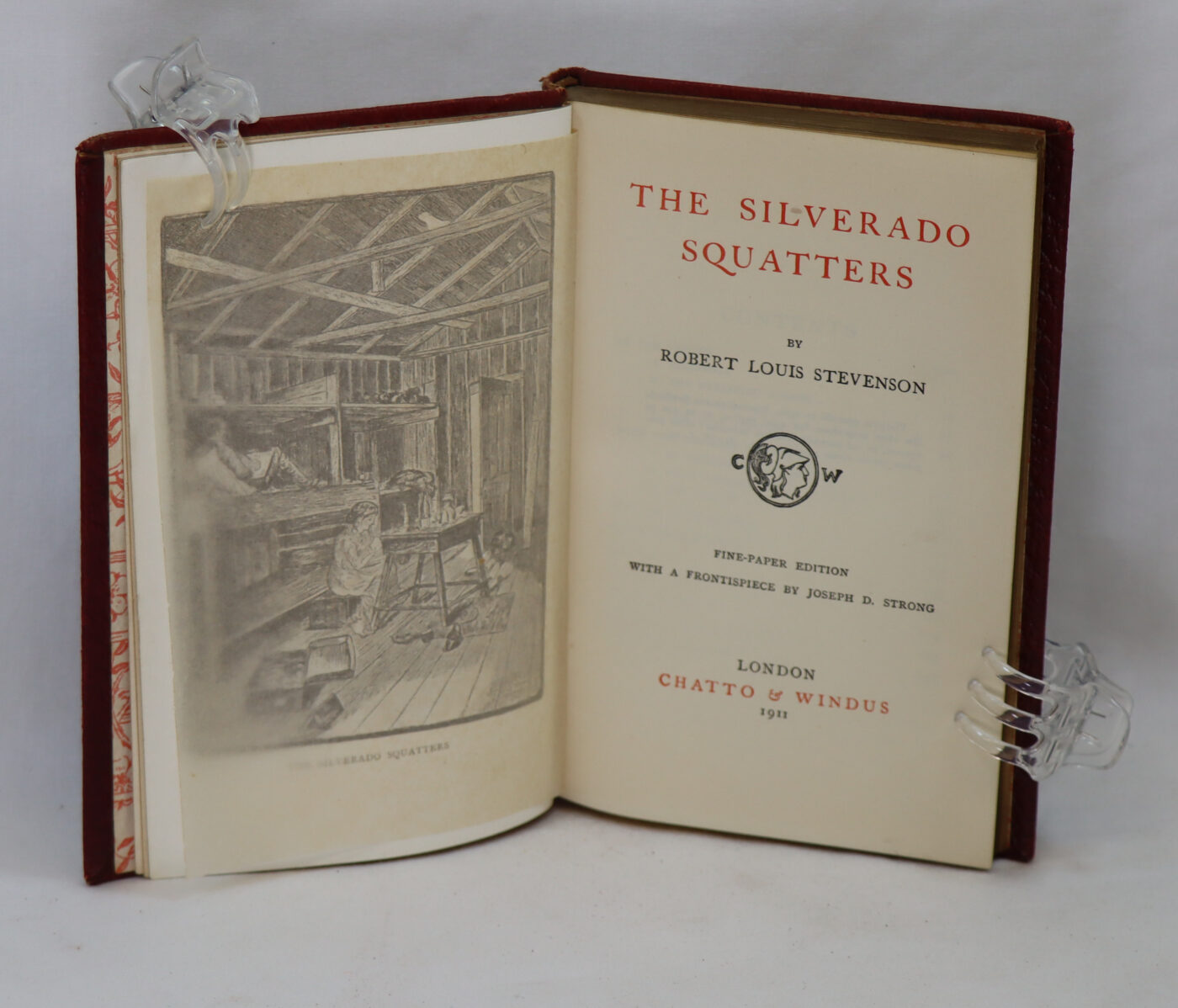
The Silverado Squatters.
By Robert Louis Stevenson
Printed: 1911
Publisher: Cassell & Co. London
Edition: First edition
| Dimensions | 13 × 16 × 2 cm |
|---|---|
| Language |
Language: English
Size (cminches): 13 x 16 x 2
Condition: Good (See explanation of ratings)
£112.00
Buy Now

Item information
Description
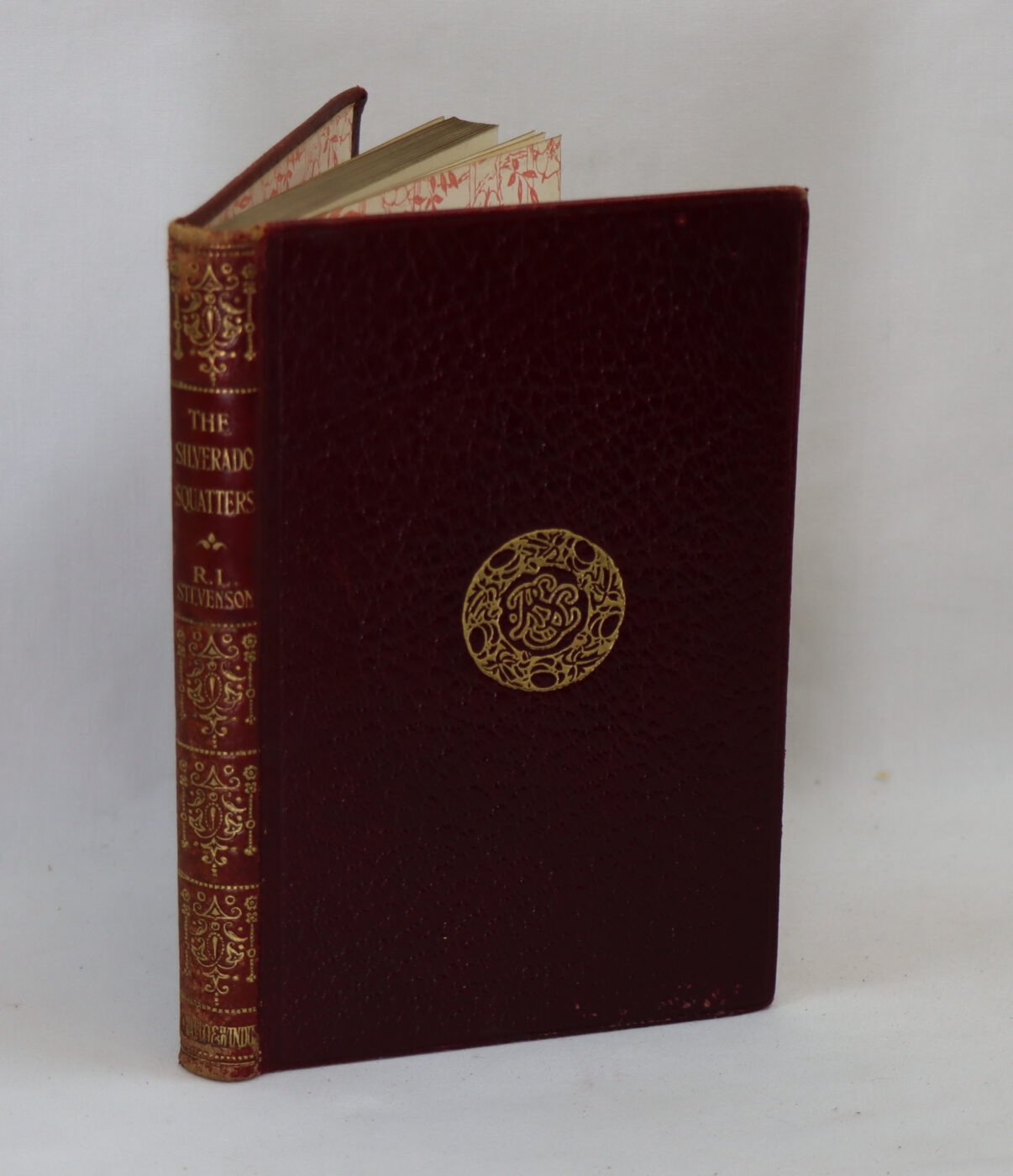
Softback. Red leather binding with gilt title and decoration on the spine.
We provide an in-depth photographic presentation of this item to stimulate your feeling and touch. More traditional book descriptions are immediately available.
- Note: This book carries a £5.00 discount to those that subscribe to the F.B.A. mailing list
It is a pleasure to touch and feel this lovely book. A book which has been treasured throughout its life.
This is a First Edition from Cassell & Co. London
The Silverado Squatters is a travel memoir by Scottish author Robert Louis Stevenson. Printed in 1911—and originally published in 1883—the book details his two-month honeymoon trip to the rugged Napa Valley in California in the summer of 1880. To recover from lifelong respiratory illness and save money, the couple “squatted” in an abandoned mining bunkhouse on Mount Saint Helena.
Key details and background:
- The Plot: The memoir describes Stevenson, his new wife Fanny Vandegrift, and her son Lloyd Osbourne living a makeshift, simple life in the remote mountains.
- The Setting: It offers a vivid portrait of 19th-century California, recounting encounters with eccentric locals, gold rush remains, and local wine growers.
- Literary Significance: The notes and scenery Stevenson observed around him here later provided much of the descriptive detail for his masterpiece, Treasure Island.
Vintage editions and copies are frequently bought and sold among literary collectors. You can browse for this specific 1911 edition or other classic printings.
The Silverado Squatters provide some views of California during the late 19th century. Stevenson uses the first telephone of his life. He meets a number of wine growers in Napa Valley, an enterprise he deems “experimental”, with growers sometimes even mislabeling the bottles as originating from Spain in order to sell their product to skeptical Americans. He visits the oldest wine grower in the valley, Jacob Schram, who had been experimenting for 18 years at his Schramsberg Winery, and had recently expanded the wine cellar in his backyard. Stevenson also visits a petrified forest owned by an old Swedish ex-sailor who had stumbled upon it while clearing farmland—the precise nature of the petrified forest remained for everyone a source of curiosity. Stevenson also details his encounters with a local Jewish merchant, whom he compares to a character in a Charles Dickens novel (probably Fagin from Oliver Twist), and portrays as happy-go-lucky but always scheming to earn a dollar. Like Dickens in American Notes (1842), Stevenson found the American habit of spitting on the floor hard to get used to. His experiences at Silverado were recorded in a journal he called “Silverado Sketches”, parts of which he incorporated into Silverado Squatters in 1883 while living in Bournemouth, England, with other tales appearing in “Essays of Travel” and “Across the Plains”. Many of his notes on the scenery around him later provided much of the descriptive detail for Treasure Island (1883).
Robert Louis Stevenson (born Robert Lewis Balfour Stevenson; 13 November 1850 – 3 December 1894) was a Scottish novelist, essayist, poet and travel writer. He is best known for the novels Treasure Island (1883), Strange Case of Dr Jekyll and Mr Hyde (1886), and Kidnapped (1886) and for the poetry collection A Child’s Garden of Verses (1885).
Born and educated in Edinburgh, Stevenson suffered from serious bronchial trouble for much of his life but managed to write prolifically and travel widely despite his poor health. As a young man, he mixed in London literary circles, receiving encouragement from Sidney Colvin, Andrew Lang, Edmund Gosse, Leslie Stephen and W. E. Henley, the last of whom may have provided the model for Long John Silver in Treasure Island. In 1890 he settled in Samoa, where, alarmed at increasing European and American influence in the South Sea islands, his writing turned from romance and adventure fiction toward a darker realism. He died of a stroke in his island home in 1894 at age 44.
A celebrity in his lifetime, Stevenson’s critical reputation has fluctuated since his death, although today his works are held in general acclaim. In 2018 he was ranked just behind Charles Dickens as the 26th-most-translated author in the world.
Want to know more about this item?
We are happy to answer any questions you may have about this item. In addition, it is also possible to request more photographs if there is something specific you want illustrated.
Ask a question
Related products




Share this Page with a friend
