
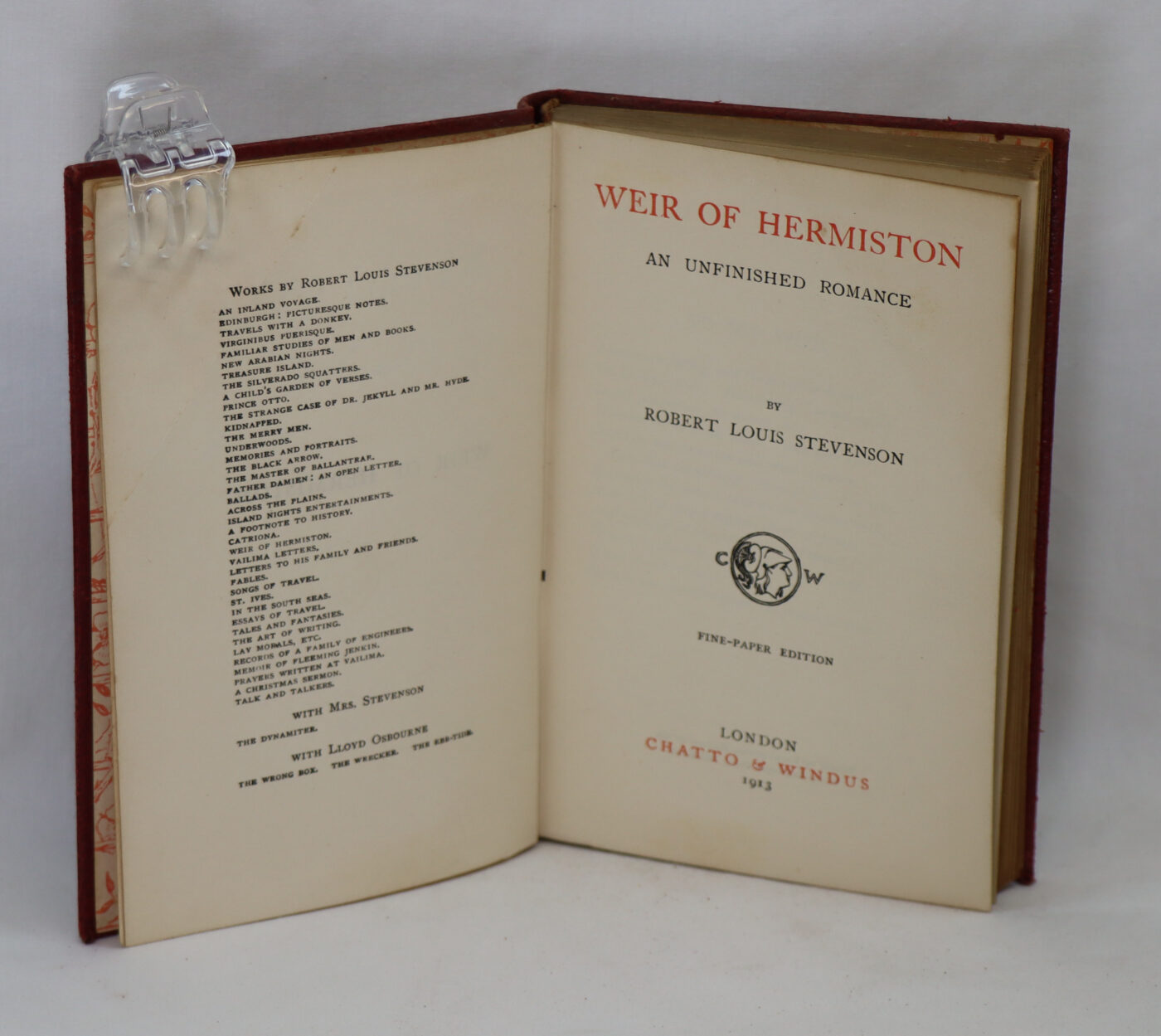
Weir of Hermiston.
By Robert Louis Stevenson
Printed: 1913
Publisher: Cassell & Co. London
| Dimensions | 13 × 16 × 2 cm |
|---|---|
| Language |
Language: English
Size (cminches): 13 x 16 x 2
Condition: Good (See explanation of ratings)
£34.00
Buy Now

Item information
Description
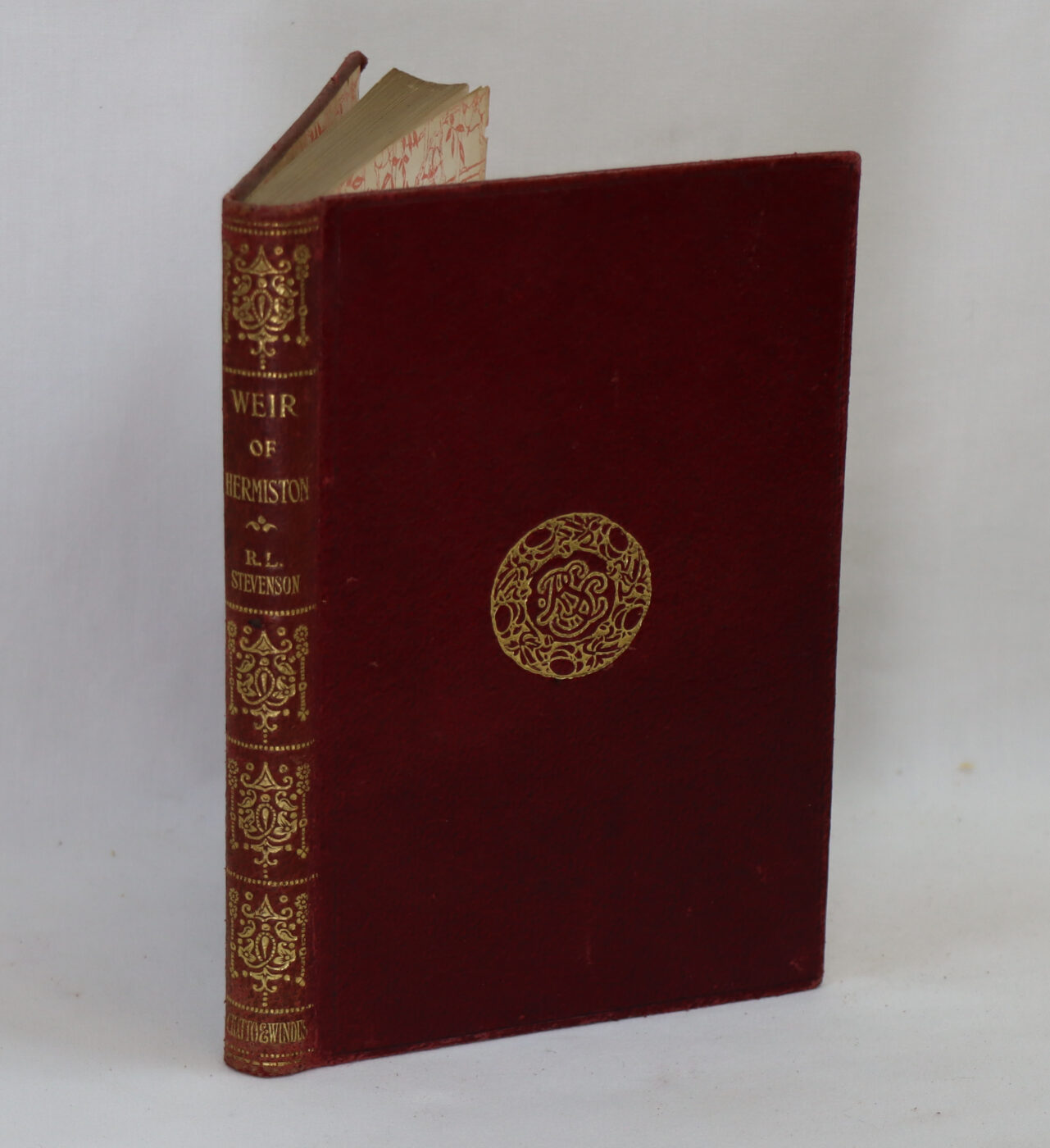
Softback. Red leather binding with gilt title and decoration on the spine.
We provide an in-depth photographic presentation of this item to stimulate your feeling and touch. More traditional book descriptions are immediately available.
Note: This book carries a £5.00 discount to those that subscribe to the F.B.A. mailing list
It is a pleasure to touch and feel this lovely book. A book which has been treasured throughout its life.
Weir of Hermiston is an 1896 unfinished novel by Robert Louis Stevenson. It is markedly different from his previous works in style and has often been praised as a potential masterpiece. It was cut short by Stevenson’s sudden death in 1894 from a cerebral haemorrhage. The novel is set at the time of the Napoleonic Wars. The novel tells the story of Archibald “Archie” Weir, a young man born into an upper-class Edinburgh family. Because of his Romantic sensibilities and sensitivity, Archie is estranged from his father, who is depicted as the coarse and cruel judge of a criminal court. By mutual consent, Archie is banished from his family of origin and sent to live as the local laird on a family property in the vicinity of the Borders hamlet Hermiston. While serving as the laird, Archie meets and falls in love with Kirstie (Christina). As the two are deepening their relationship, the book breaks off. Confusingly, there are two characters in the novel called Christina, the younger of whom is Archie’s sweetheart.
According to Sir Sidney Colvin, quoting Stevenson’s stepdaughter, Stevenson intended the story to continue with the seduction of (young) Kirstie by Archie’s dissolute friend Frank Innes. Kirstie’s four brothers believe that Archie is the culprit and vow revenge on him. However, Archie has meanwhile confronted Frank and killed him, and is arrested for murder. He is tried for his life before his father (this is legally implausible, as Weir Snr. should have recused himself from presiding) and condemned to death. But the older Kirstie discovers the truth and tells the brothers, who break the jail and release Archie. Archie and his beloved Kirstie flee to America, presumably to live happily ever after.
This summary has much in common with the plot of Bulwer-Lytton’s novel Paul Clifford (1830).
Robert Louis Stevenson (born Robert Lewis Balfour Stevenson; 13 November 1850 – 3 December 1894) was a Scottish novelist, essayist, poet and travel writer. He is best known for the novels Treasure Island (1883), Strange Case of Dr Jekyll and Mr Hyde (1886), and Kidnapped (1886) and for the poetry collection A Child’s Garden of Verses (1885).
Born and educated in Edinburgh, Stevenson suffered from serious bronchial trouble for much of his life but managed to write prolifically and travel widely despite his poor health. As a young man, he mixed in London literary circles, receiving encouragement from Sidney Colvin, Andrew Lang, Edmund Gosse, Leslie Stephen and W. E. Henley, the last of whom may have provided the model for Long John Silver in Treasure Island. In 1890 he settled in Samoa, where, alarmed at increasing European and American influence in the South Sea islands, his writing turned from romance and adventure fiction toward a darker realism. He died of a stroke in his island home in 1894 at age 44.
A celebrity in his lifetime, Stevenson’s critical reputation has fluctuated since his death, although today his works are held in general acclaim. In 2018 he was ranked just behind Charles Dickens as the 26th-most-translated author in the world.
Want to know more about this item?
We are happy to answer any questions you may have about this item. In addition, it is also possible to request more photographs if there is something specific you want illustrated.
Ask a question
Related products



Share this Page with a friend
