
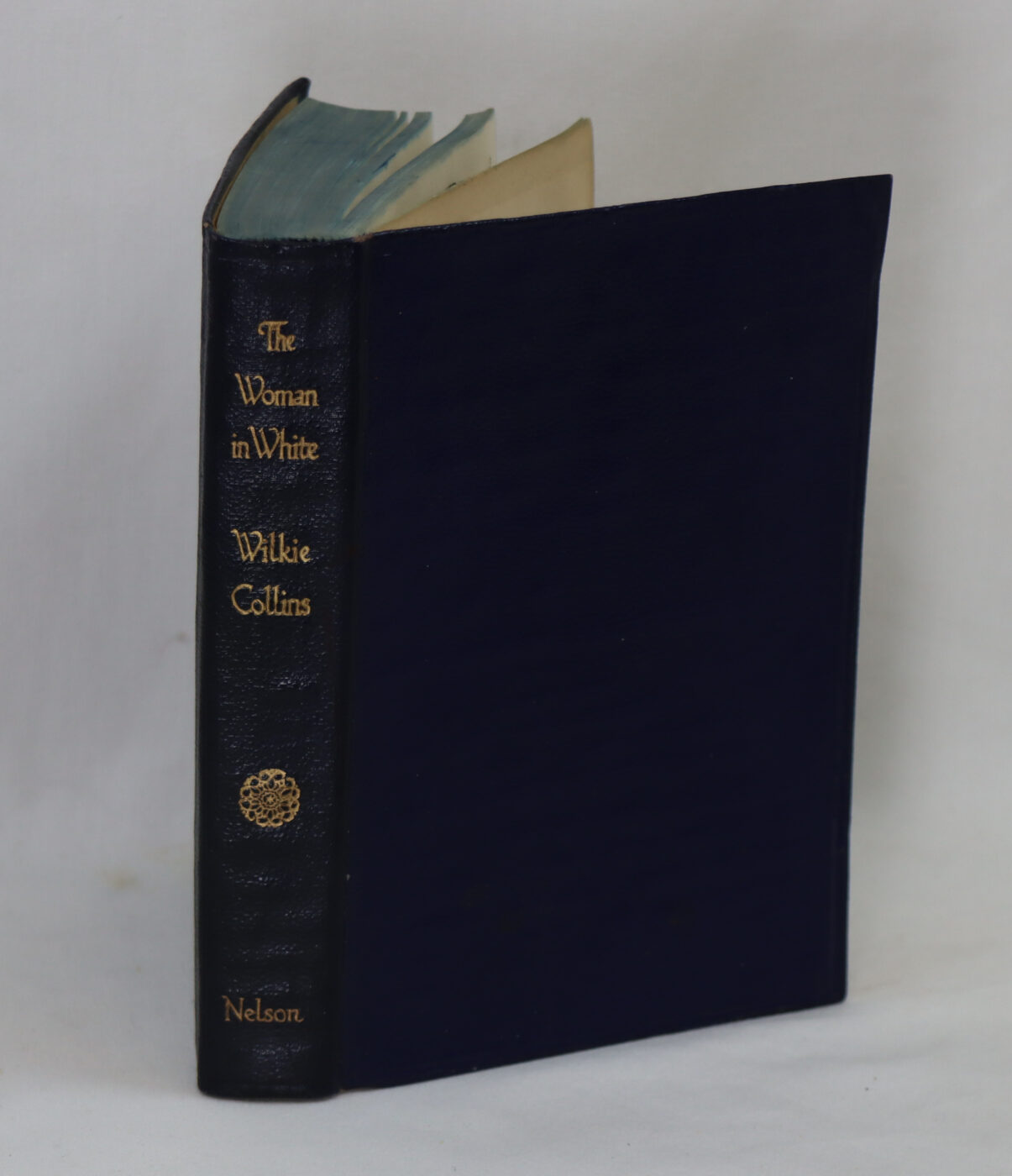
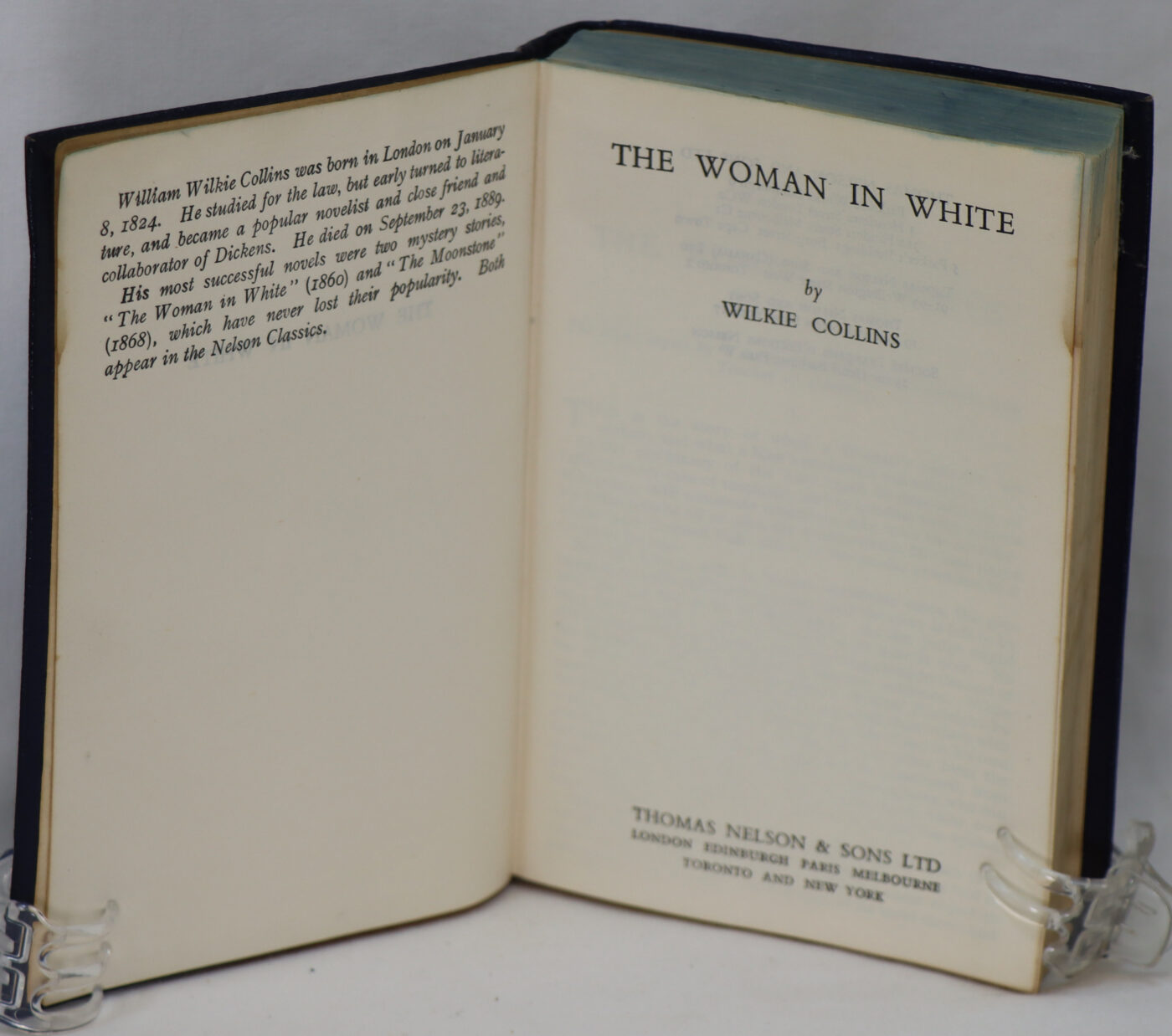
The Woman in White.
By Wilkie Collins
Printed: Circa 1940
Publisher: Thomas Nelson & Sons. London
| Dimensions | 13 × 16 × 3 cm |
|---|---|
| Language |
Language: English
Size (cminches): 13 x 16 x 3
Condition: Good (See explanation of ratings)
£17.00
Buy Now

Item information
Description
Softback. Navy leatherette cloth binding with gilt title on the spine.
We provide an in-depth photographic presentation of this item to stimulate your feeling and touch. More traditional book descriptions are immediately available.
- Note: This book carries a £5.00 discount to those that subscribe to the F.B.A. mailing list
It is a pleasure to touch and feel this lovely book. A book which has been treasured throughout its life.
The Woman in White is Wilkie Collins’s fifth published novel, written in 1860 and set from 1849 to 1850. It started its publication on 26 November 1859 and its publication was completed on 25 August 1860. It is a mystery novel and falls under the genre of “sensation novels”.
The story can be seen as an early example of detective fiction with many of the sleuthing techniques of protagonist Walter Hartright being employed by later private detectives. The use of multiple narrators (including nearly all the principal characters) draws on Collins’s legal training, and as he points out in his preamble: “the story here presented will be told by more than one pen, as the story of an offence against the laws is told in Court by more than one witness”. Collins also drew on memories of his father, the artist William Collins, in the creation of drawing master Walter Hartright, and populates his story with a number of Italian characters, likely inspired by two years spent in Italy during childhood.
In 2003, Robert McCrum writing for The Observer listed The Woman in White number 23 in “the top 100 greatest novels of all time”, and the novel was listed at number 77 on the BBC’s survey The Big Read.
This is part of the esteemed Nelson Classics series published by Thomas Nelson & Sons, which was widely distributed in the UK during the 1930s and 1940s.
William Wilkie Collins (8 January 1824 – 23 September 1889) was an English novelist and playwright known especially for The Woman in White (1860), a mystery novel and early sensation novel, and for The Moonstone (1868), which established many of the ground rules of the modern detective novel and is also perhaps the earliest clear example of the police procedural genre.
Born to the London painter William Collins and his wife, Harriet Geddes, he moved with them to Italy when he was twelve, living there and in France for two years, learning both Italian and French. He worked initially as a tea merchant. After Antonina, his first novel, was published in 1850, Collins met Charles Dickens, who became his friend and mentor. Some of Collins’ work appeared in Dickens’ journals Household Words and All the Year Round. They also collaborated on drama and fiction. Collins gained financial stability and an international following by the 1860s. In the 1870s and 1880s, after becoming addicted to the opium which he took for his gout, the quality of his health declined and, in turn, the reception of his artistic output.
Collins criticised the institution of marriage. He had relationships with two women: widow Caroline Graves – living with her for most of his life, treating her daughter as his – and the younger Martha Rudd, with whom he had three children.
Want to know more about this item?
We are happy to answer any questions you may have about this item. In addition, it is also possible to request more photographs if there is something specific you want illustrated.
Ask a question
Related products


Share this Page with a friend
