
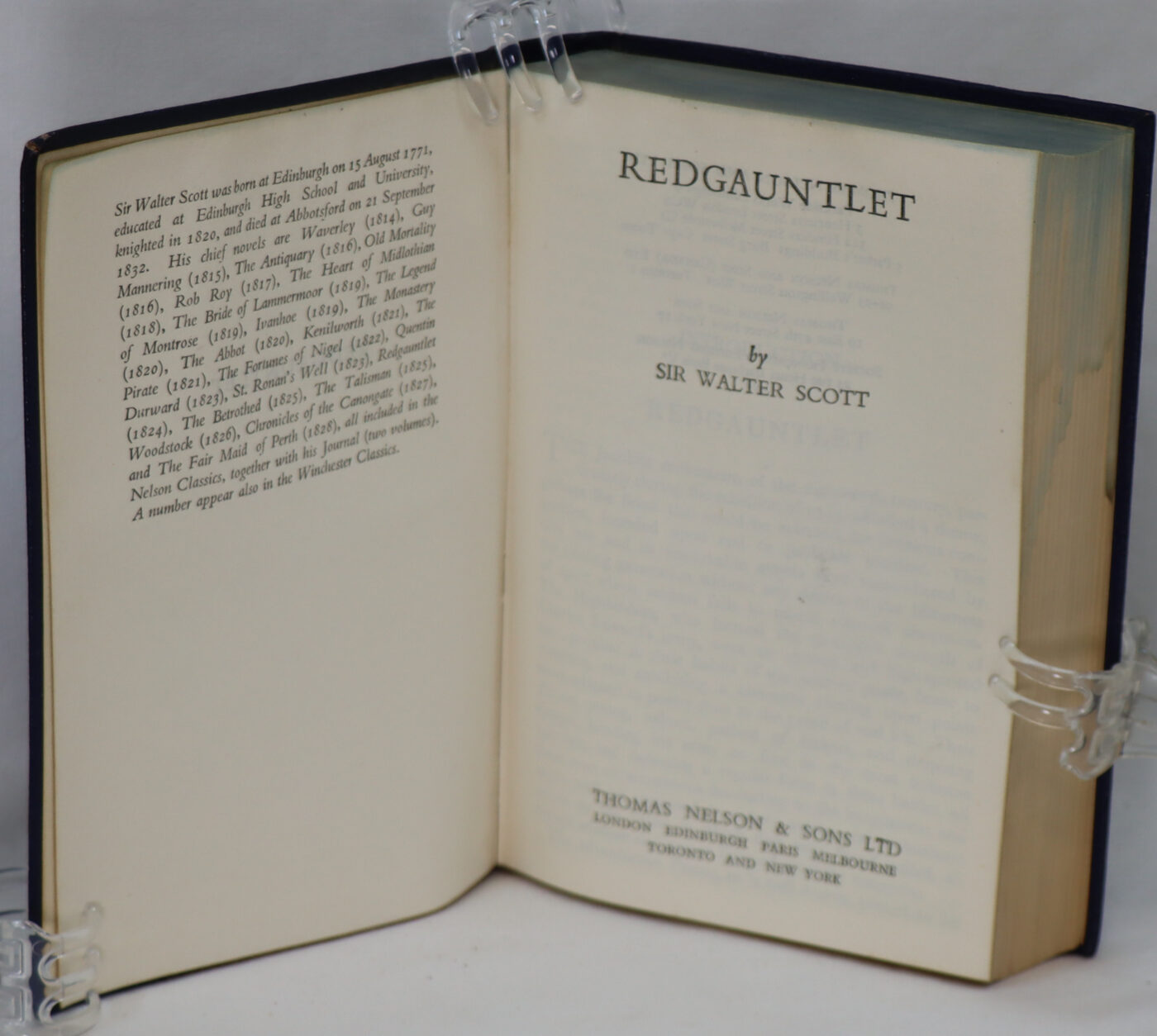
Red Gauntlet.
By Sir Walter Scott
Printed: Circa 1940
Publisher: Thomas Nelson & Sons. London
| Dimensions | 13 × 16 × 2 cm |
|---|---|
| Language |
Language: English
Size (cminches): 13 x 16 x 2
Condition: Good (See explanation of ratings)
£17.00
Buy Now

Item information
Description
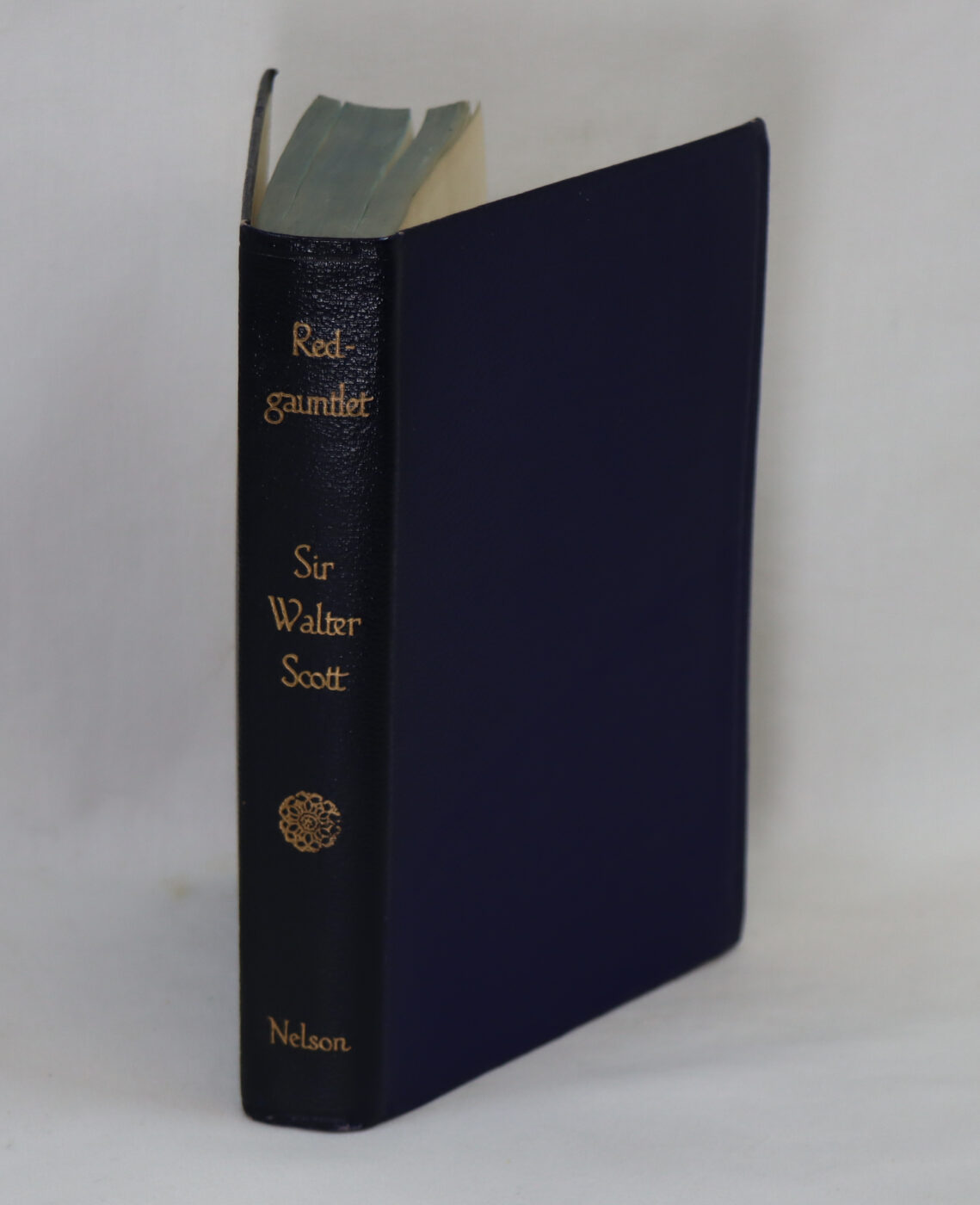
Softback. Navy leatherette cloth binding with gilt title on the spine.
We provide an in-depth photographic presentation of this item to stimulate your feeling and touch. More traditional book descriptions are immediately available.
- Note: This book carries a £5.00 discount to those that subscribe to the F.B.A. mailing list
It is a pleasure to touch and feel this lovely book. A book which has been treasured throughout its life.
Redgauntlet is an 1824 historical novel by Sir Walter Scott, one of the Waverley novels, set primarily in Dumfriesshire, southwest Scotland, in 1765, and described by Magnus Magnusson (a point first made by Andrew Lang) as “in a sense, the most autobiographical of Scott’s novels.” It describes a plot to start a fictional third Jacobite Rebellion, and includes “Wandering Willie’s Tale”, a famous short story which frequently appears in anthologies.
The composition of Redgauntlet was swift and steady. It began very shortly after the completion of Saint Ronan’s Well in early December 1823, and by early January 1824 proofs had reached the fourth letter. The first volume was in print before the end of March, the second was probably written in late March and April, and the third was certainly composed in May.
This is part of the esteemed Nelson Classics series published by Thomas Nelson & Sons, which was widely distributed in the UK during the 1930s and 1940s.
Sir Walter Scott, 1st Baronet (15 August 1771 – 21 September 1832), was a Scottish novelist, poet and historian. Many of his works remain classics of European and Scottish literature. He is known for his Waverley novels (1814–1831), which were, for nearly a century, among the most popular and widely read novels in Europe. He is also known for his narrative poems Marmion (1808) and The Lady of the Lake (1810). He greatly influenced European and American literature.
As an advocate and legal administrator by profession, he combined writing and editing with his daily work as Clerk of Session and Sheriff-Depute of Selkirkshire. He was prominent in Edinburgh’s Tory establishment, active in the Highland Society, a long time president of the Royal Society of Edinburgh (1820–1832), and a vice president of the Society of Antiquaries of Scotland (1827–1829). His knowledge of history and literary facility equipped him to establish the historical novel genre as an exemplar of European Romanticism. He became a baronet of Abbotsford in the County of Roxburgh on 22 April 1820; the title became extinct upon his son’s death in 1847.
Want to know more about this item?
We are happy to answer any questions you may have about this item. In addition, it is also possible to request more photographs if there is something specific you want illustrated.
Ask a question
Related products


Share this Page with a friend
