
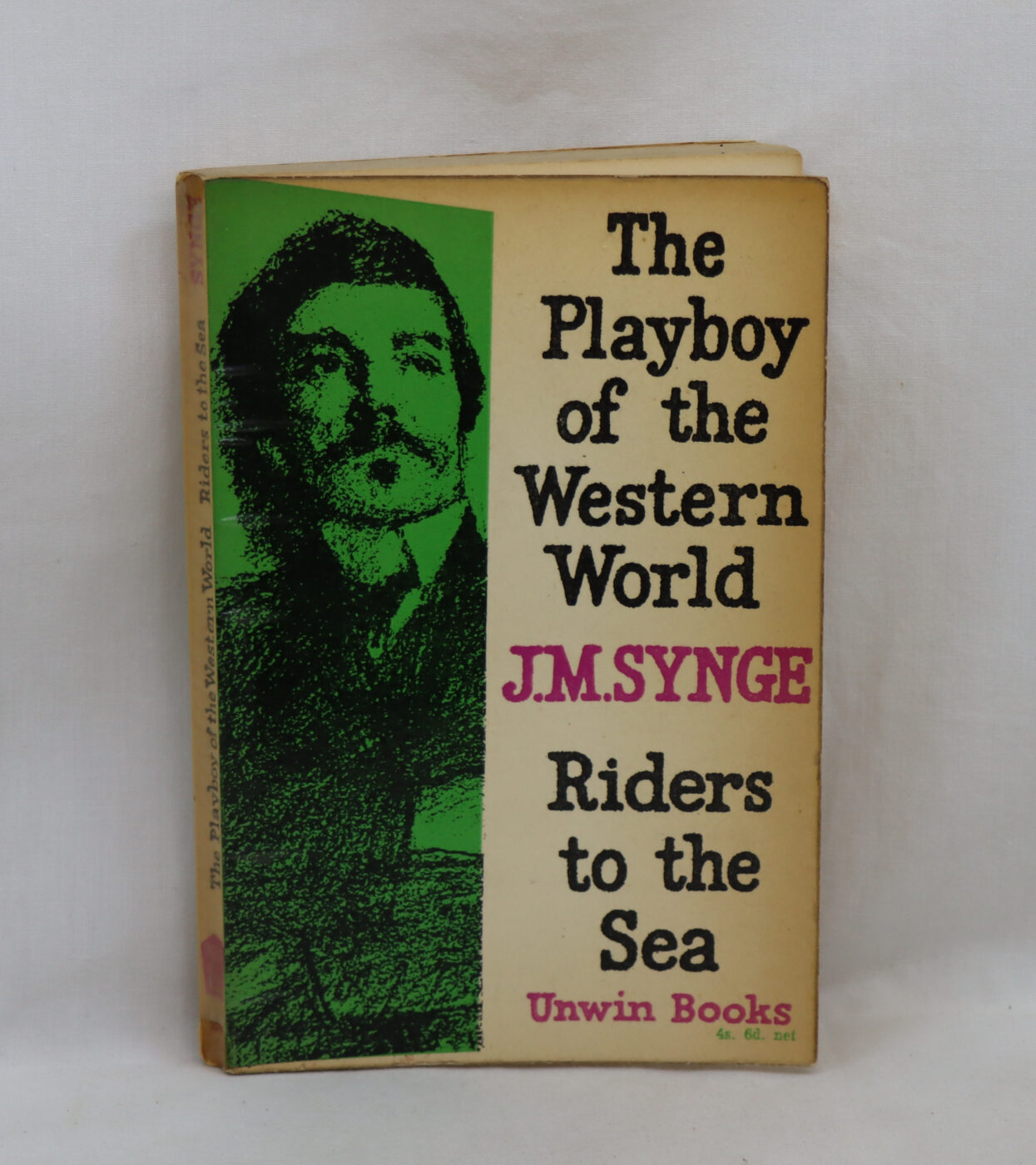
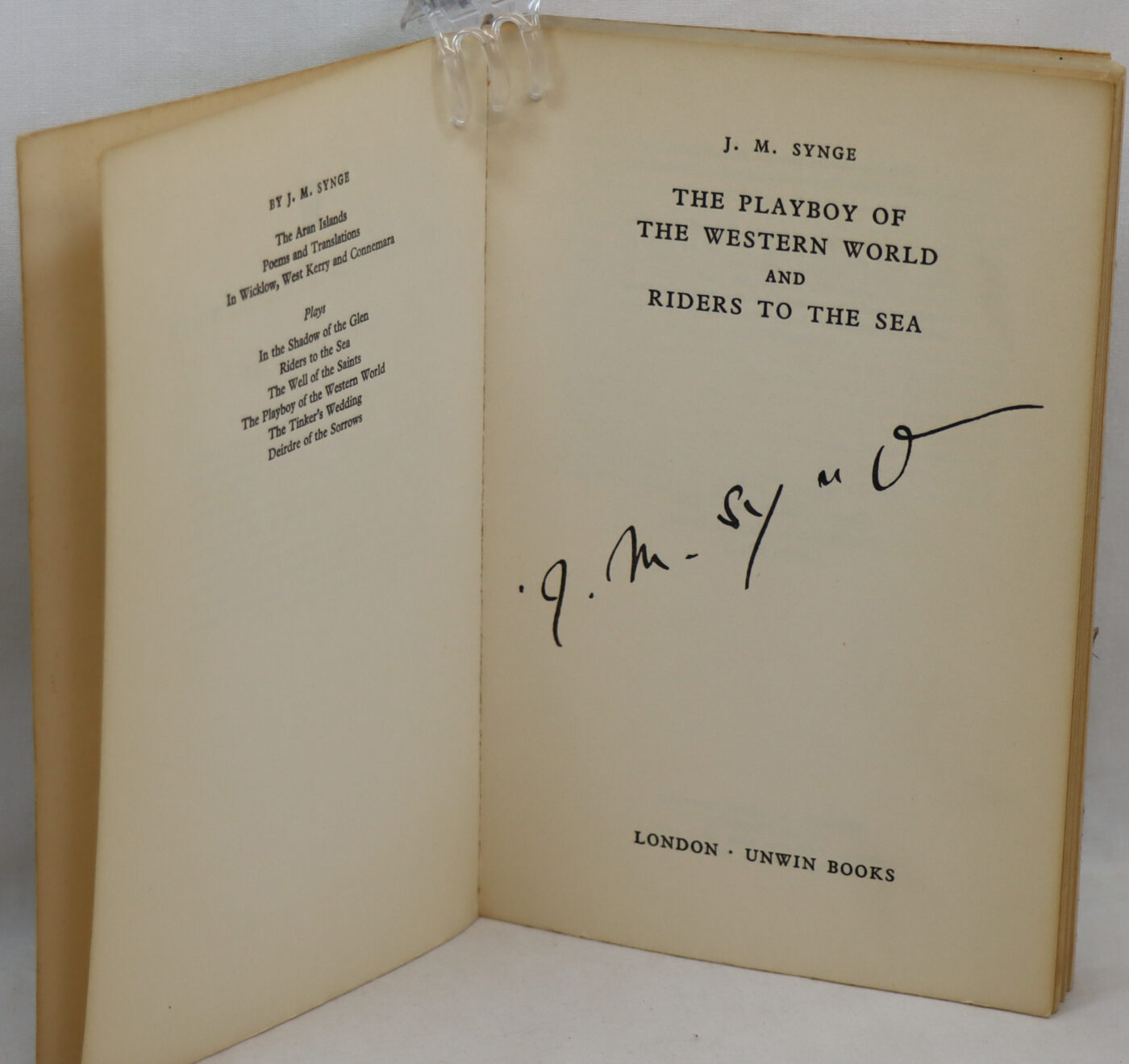
The Playboy of the Western World. Riders to the Sea.
By J M Singe
Printed: 1962
Publisher: Goerge Allen & Unwin. London
| Dimensions | 12 × 19 × 1 cm |
|---|---|
| Language |
Language: English
Size (cminches): 12 x 19 x 1
Condition: Fair (See explanation of ratings)
£17.00
Buy Now

Item information
Description
Paperback. Cream cover with black title.
We provide an in-depth photographic presentation of this item to stimulate your feeling and touch. More traditional book descriptions are immediately available
-
Note: This book carries a £5.00 discount to those that subscribe to the F.B.A. mailing list
Features three classic plays–In the Shadow ot the Glen, Riders to the Sea, and The Playboy of the Western World–by the cofounder of the Abbey Theater and one of Ireland’s greatest playwrights who captured the Irish spirit in his unforgettable characters and unique language.
Review: I brought this collecting of Synge plays a while back. It notably has some of the best plays and character writings I have ever come across. The dialogue and interacting are ahead of it time. Honestly, I prefer this play writer over Shakespeare (different times of course). He style is very unique..
Edmund John Millington Synge ( 16 April 1871 – 24 March 1909), popularly known as J. M. Synge was an Irish playwright, poet, writer and collector of folklores. As a key figure of the Irish Literary Revival during the early 20th century, he is widely regarded by critics and scholars as the most prolific playwright in Irish literature of the Edwardian era, and by several of his peers, among them William Butler Yeats,
His play The Playboy of the Western World (1907), one of his best-known works, was initially poorly received, due to its bleak ending, crude depiction of poor Irish peasants, and the idealisation of patricide, leading to hostile audience reactions and street riots in Dublin during its opening run at the Abbey Theatre, which he had co-founded with W. B. Yeats and Lady Gregory. His other major works include In the Shadow of the Glen (1903), Riders to the Sea (1904), The Well of the Saints (1905), and The Tinker’s Wedding (1909). Most of his plays were known for their highly realistic depictions of Irish society and culture, and included plots, themes, landscapes, and settings drawn from places he visited during his travels.
Synge came from a wealthy Anglo-Irish background, and mainly wrote about working-class Catholics in rural Ireland, and what he saw as their pagan worldview. Owing to his ill health, he was schooled at home. His early interest in music led to a scholarship and a degree at Trinity College Dublin, and he went to Germany in 1893 to study music. In 1894, he moved to Paris, where he took up poetry and literary criticism and met Yeats, and later returned to Ireland.
Synge had a relatively short career (c. 1903–1909), but his works continue to be held in high regard due to their cultural and literary significance. He was also one of the co-founders of the Abbey Theatre in Dublin, along with W. B. Yeats and Lady Gregory. He suffered from Hodgkin’s disease, and died aged 37 from Hodgkin’s-related cancer while writing what became Deirdre of the Sorrows (1910), considered by some as his masterpiece, though it was unfinished during his lifetime. Since his death, Synge has become one of Ireland’s most popular and significant playwrights, and his works continue to be studied and discussed in Irish literary circles. He had a direct influence on later writers such as Samuel Beckett and Brinsley MacNamara, and several of his plays are still occasionally performed in Dublin.
NOTE: This is an original book from the library gathered by the famous Cambridge Don, computer scientist, food and wine connoisseur, Jack Arnold LANG. Note: Jack founded the Michelin Guide ‘Midsummer House’- Cambridge’s paramount restaurant. This dining experience is hidden amongst the grassy pastures and grazing cattle of Midsummer Common and perched on the banks of the River Cam.
In 2008, Jack was one of the co-founders of the Raspberry Pi Foundation, alongside other members of the Department, and acted as the Foundation’s Chair. The project’s original goals were modest: to build and distribute low-cost computers for prospective applicants to our Computer Science degree. Initially the project was a “success disaster”, as Jack would say, as demand far outstripped the low-scale manufacturing plans. Ultimately the Raspberry Pi became the UK’s most successful computer with more than 60 million sold to date. Jack was drawn to the educational possibilities of the Raspberry Pi, its potential uses in emerging economies and the way it could support self-directed learning.
Want to know more about this item?
We are happy to answer any questions you may have about this item. In addition, it is also possible to request more photographs if there is something specific you want illustrated.
Ask a question
Related products




Share this Page with a friend
