
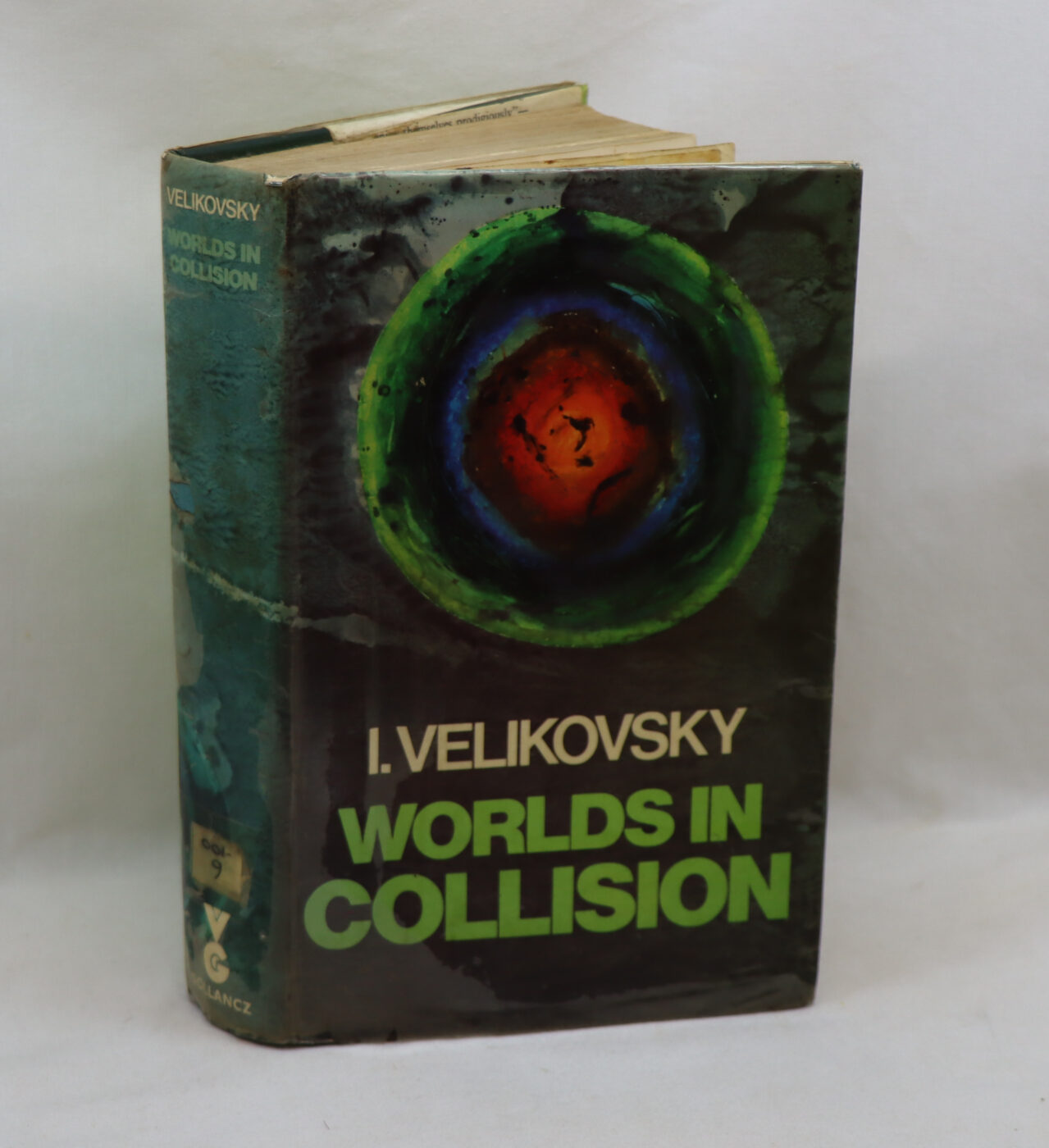
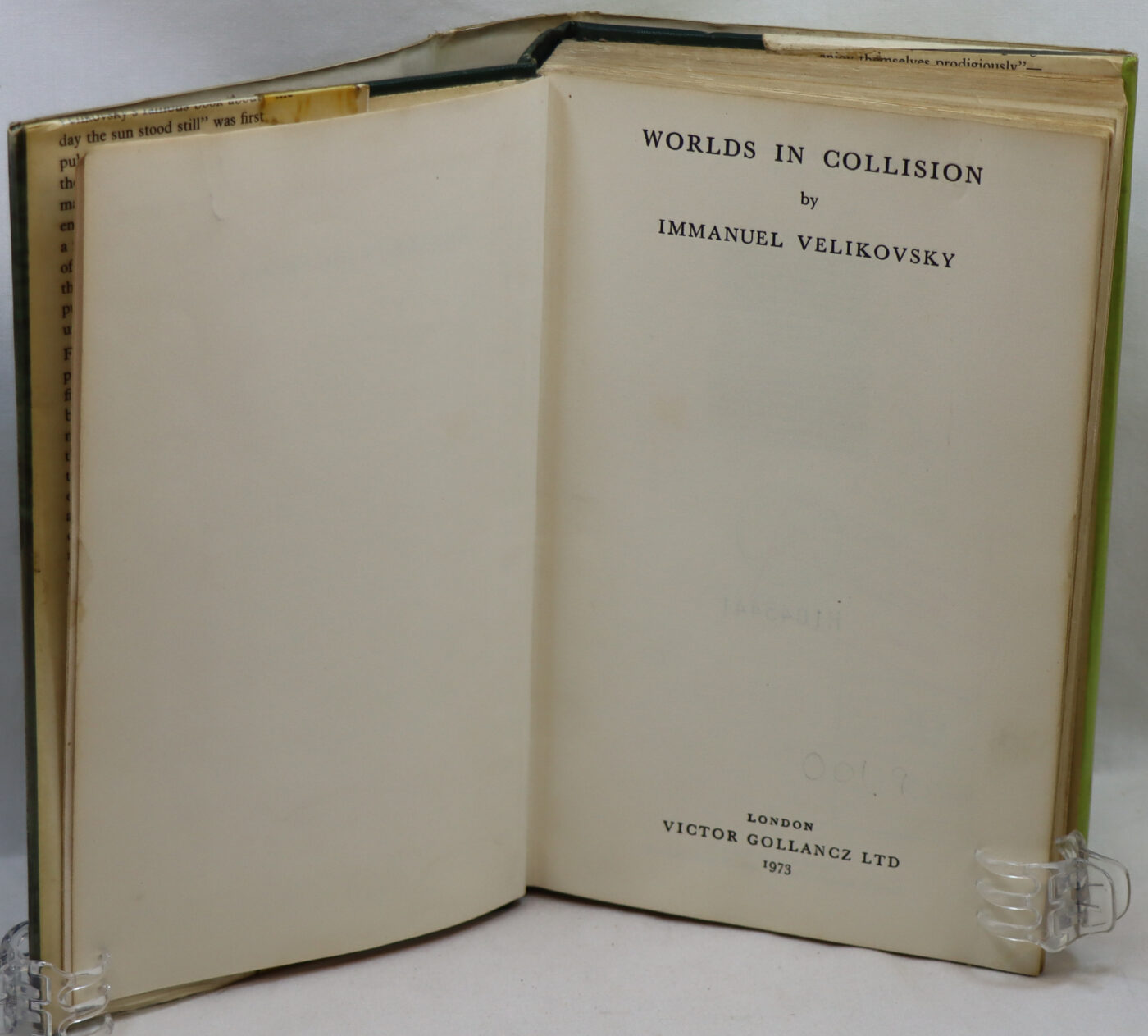
Worlds in Collision.
By Immanuel Velikovsky
Printed: 1973
Publisher: Victor Gollancz. London
| Dimensions | 15 × 22 × 4 cm |
|---|---|
| Language |
Language: English
Size (cminches): 15 x 22 x 4
Condition: Ex-library (See explanation of ratings)
£52.00
Buy Now

Item information
Description
In the original dust cover. Green cloth binding with gilt title on the spine. Ex Library.
We provide an in-depth photographic presentation of this item to stimulate your feeling and touch. More traditional book descriptions are immediately available
- Note: This book carries a £5.00 discount to those that subscribe to the F.B.A. mailing list
This author has been actively ignored by the mainstream Scientific community for no other reason than it does not fit comfortably with the ‘standard model’ .. I found the book both exciting and frightening. It seems that science took a wrong turn, preferring to withdraw into a mathematical fantasy world rather than hearing the stories told by our ancestors.
Reviews:
- EVERYBODY should read this! Velikovsky was definitely on to something here and explains a lot of possible lost histories in this book.
- This book closely examines the issues of climate change and polar shift. A thorough examination of ancient world writings to show that climate change and polar shift is not man made. After reading this I now understand that big money is behind this hoax.
Immanuel Velikovsky (10 June [O.S. 29 May] 1895 – 17 November 1979) was a Russian-American psychoanalyst, writer, and catastrophist. He is the author of several books offering pseudohistorical interpretations of ancient history, including the U.S. bestseller Worlds in Collision published in 1950. Velikovsky’s work is frequently cited as a canonical example of pseudoscience and has been used as an example of the demarcation problem.
His books use comparative mythology and ancient literary sources (including the Old Testament) to argue that Earth suffered catastrophic close contacts with other planets (principally Venus and Mars) in ancient history. In positioning Velikovsky among catastrophists including Hans Bellamy, Ignatius Donnelly, and Johann Gottlieb Radlof , the British astronomers Victor Clube and Bill Napier noted “… Velikovsky is not so much the first of the new catastrophists …; he is the last in a line of traditional catastrophists going back to mediaeval times and probably earlier.” Velikovsky argued that electromagnetic effects play an important role in celestial mechanics. He also proposed a revised chronology for ancient Egypt, Greece, Israel, and other cultures of the ancient Near East. The revised chronology aimed at explaining the so-called “dark age” of the eastern Mediterranean (c. 1100–750 BC) and reconciling biblical accounts with widely accepted archaeology and Egyptian chronology.
In general, Velikovsky’s ideas have been ignored or vigorously rejected by the academic community. Nonetheless, his books often sold well and gained enthusiastic support in lay circles, often fuelled by claims of unfair treatment of Velikovsky by orthodox academia. The controversy surrounding his work and its reception is often referred to as “the Velikovsky affair”.
NOTE: This is an original book from the library gathered by the famous Cambridge Don, computer scientist, food and wine connoisseur, Jack Arnold LANG. Note: Jack founded the Michelin Guide ‘Midsummer House’- Cambridge’s paramount restaurant. This dining experience is hidden amongst the grassy pastures and grazing cattle of Midsummer Common and perched on the banks of the River Cam.
In 2008, Jack was one of the co-founders of the Raspberry Pi Foundation, alongside other members of the Department, and acted as the Foundation’s Chair. The project’s original goals were modest: to build and distribute low-cost computers for prospective applicants to our Computer Science degree. Initially the project was a “success disaster”, as Jack would say, as demand far outstripped the low-scale manufacturing plans. Ultimately the Raspberry Pi became the UK’s most successful computer with more than 60 million sold to date. Jack was drawn to the educational possibilities of the Raspberry Pi, its potential uses in emerging economies and the way it could support self-directed learning.
Condition notes
Ex Library
Want to know more about this item?
We are happy to answer any questions you may have about this item. In addition, it is also possible to request more photographs if there is something specific you want illustrated.
Ask a question
Related products






Share this Page with a friend
