
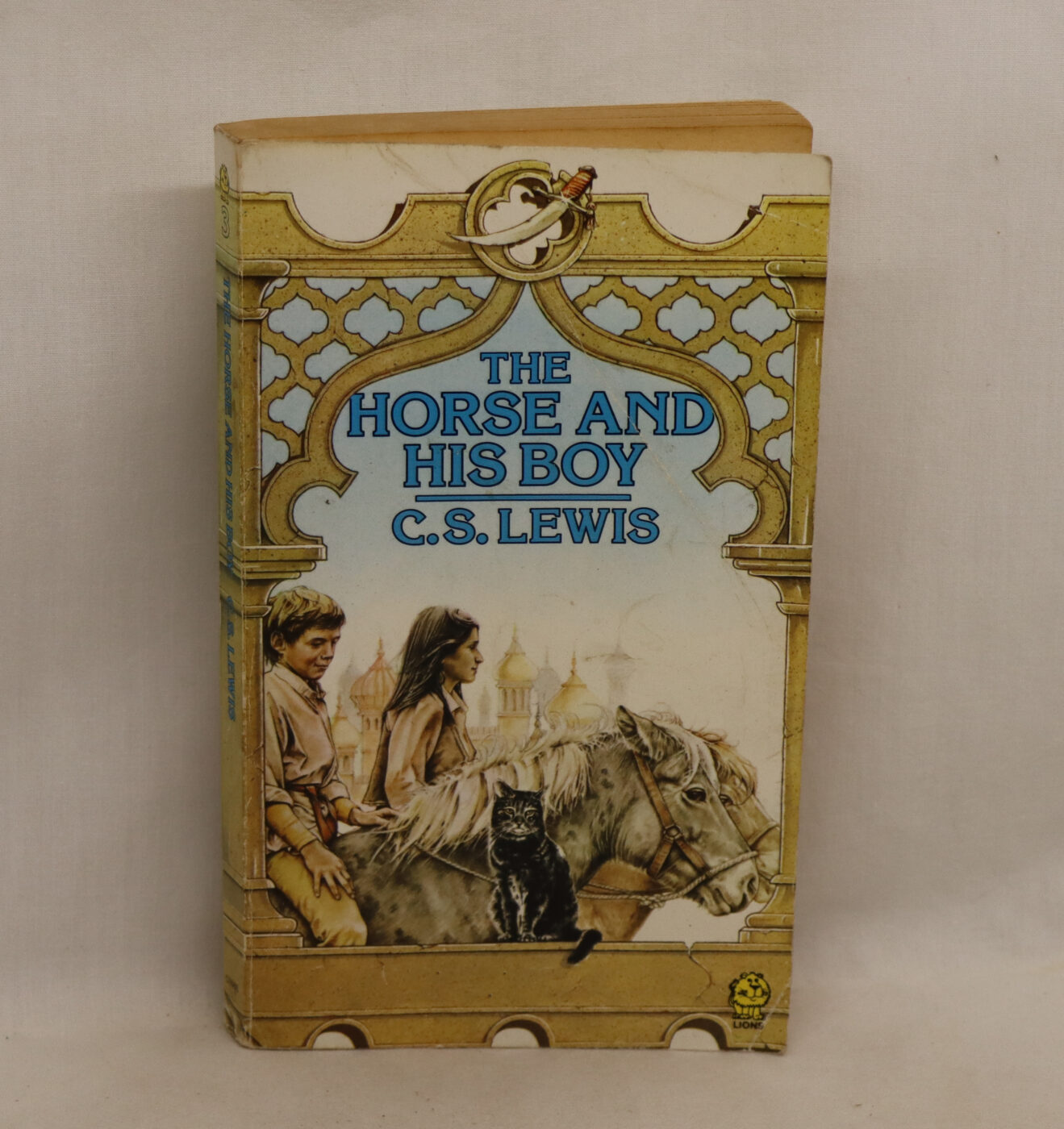
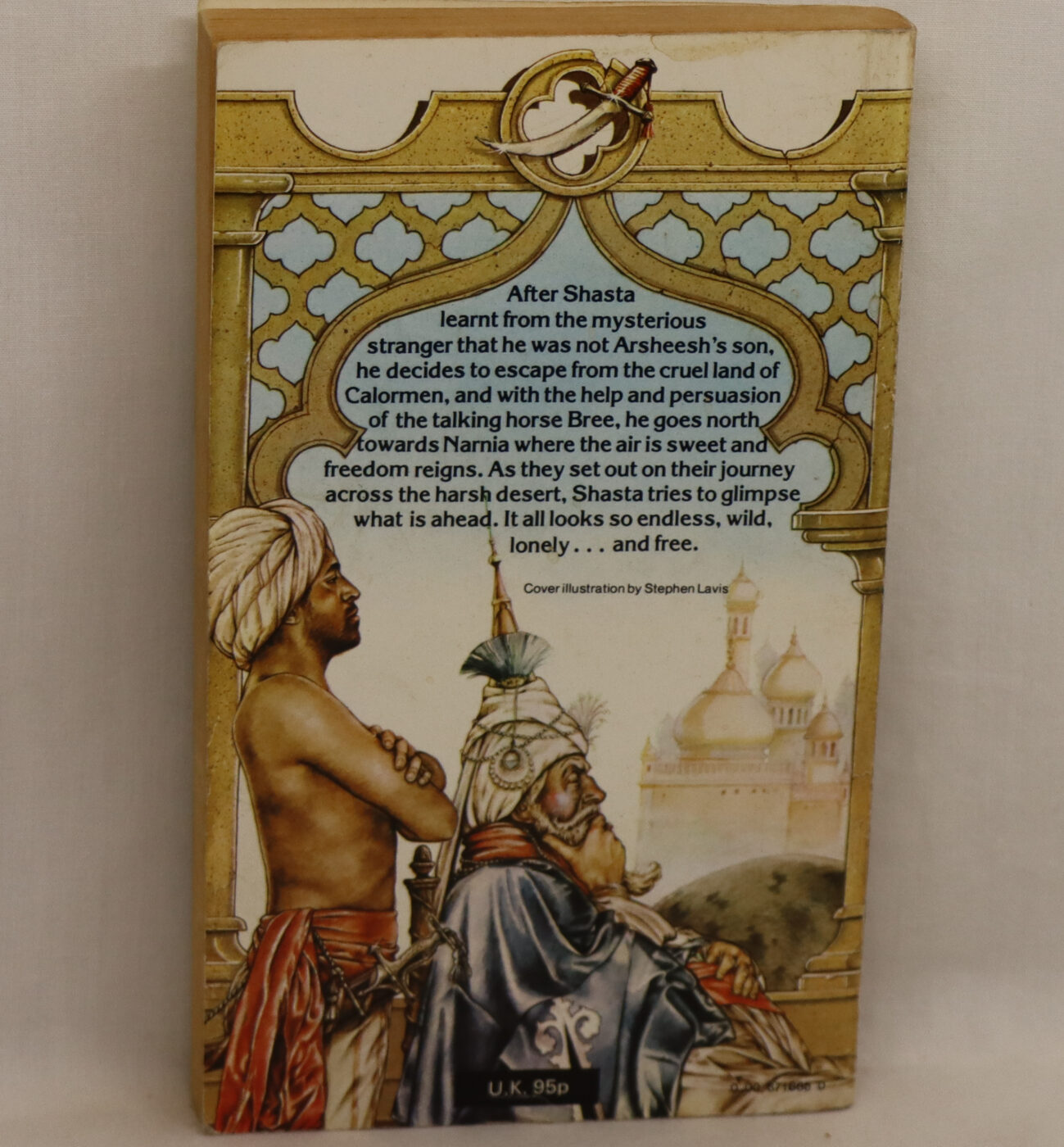
The Horse and His Boy.
By C S Lewis
ISBN: 9780007607150
Printed: 1981
Publisher: Fontana Lions. London
| Dimensions | 11 × 18 × 1 cm |
|---|---|
| Language |
Language: English
Size (cminches): 11 x 18 x 1
Condition: Fair (See explanation of ratings)
£8.00
Buy Now
Item information
Description
Paperback. White cover with blue title.
We provide an in-depth photographic presentation of this item to stimulate your feeling and touch. More traditional book descriptions are immediately available
- A £2 reduction when collected from FBA shop
Chronologically The Horse and his Boy comes third in the series, straight after The Lion, the Witch and the Wardrobe, but was actually written in 1954, after the core sequence of four Narnia books (Wardrobe, Caspian, Dawntreader and Silver Chair) were written. I first read the seven Narnia books when I was ten years old. My child’s mind found them awe-inspiring. The overall stories are forgotten, but certain images and characters have stayed vividly in my mind. I remember liking The Horse and his Boy the least out of all seven books. Now, after having reread it as an adult, I think the disappointment I experienced as a child was due to the fact that the main characters are quite separate from the focus of the other books, which is on the Earth children. I remembered a journey of a boy and a talking horse, their traversing a desert, and their paths crossing the stories of the Earth children only incidentally. Had I not had the expectations I had had as a child (I wanted to read more about Susan, Edmund, Lucy and Peter) I would have loved this book. It seems to be set in a completely different world to that of the other books, though it is supposed to be set in two neighbouring states, and the atmosphere is a ‘world’ apart. This change of tone and focus was quite jarring to me 20 years ago.
It is a child’s book. The narrator sometimes speaks to the reader in asides. The plot is very simple and the language simpler. But it is a wonderful child’s book, full of valuable moral lessons, clever (yet simple) details planted in the plot that make sense later and all loose ends neatly are tied up in a very satisfying way that I think would give a sense of achievement to the young and inexperienced reader in having understood how these things makes sense.
The story of Shatsa (the `boy’) and Bree (the `horse’) running away from `home’, and its themes of loyalty, friendship, home and birthright, play against a larger political theme of international relations (between Narnia and two bordering states, Archenland and Calormen). There is also the typically Narnian Biblical allegories, too, in which Shasta’s life vaguely mirrors that of Moses and Aslan resumes his God/Jesus-like role. Also, the author clearly favours the Narnian society, based on Western Europe, to the Calormen society, based on the Middle East – this is unwelcome and, I think, unhelpful to the modern young reader.
To get the most out of this book the reader (preferably a child) would do better to know some details from The Lion, but would do best not to read that book, or the preceding Magician’s Nephew, first, because it sets up expectations – of continuing their stories and of atmosphere- that are disappointed. For this reason, this book, though of a very high standard, doesn’t sit easily in the Chronicles of Narnia.
CLIVE STAPLES LEWIS (1898-1963) was one of the intellectual giants of the twentieth century and arguably one of the most influential writers of his day. He was a fellow and tutor in English Literature at Oxford University until 1954 when he was unanimously elected to the Chair of Medieval and Renaissance English at Cambridge University, a position he held until his retirement. He wrote more than thirty books, allowing him to reach a vast audience, and his works continue to attract thousands of new readers every year. His most distinguished and popular accomplishments include Mere Christianity, Out of the Silent Planet, The Great Divorce, The Screwtape Letters, and the universally acknowledged classics, the Chronicles of Narnia. To date, the Narnia books have sold over 100 million copies and been transformed into three major motion pictures.
NOTE: This is an original book from the library gathered by the famous Cambridge Don, computer scientist, food and wine connoisseur, Jack Arnold LANG. Note: Jack founded the Michelin Guide ‘Midsummer House’- Cambridge’s paramount restaurant. This dining experience is hidden amongst the grassy pastures and grazing cattle of Midsummer Common and perched on the banks of the River Cam.
In 2008, Jack was one of the co-founders of the Raspberry Pi Foundation, alongside other members of the Department, and acted as the Foundation’s Chair. The project’s original goals were modest: to build and distribute low-cost computers for prospective applicants to our Computer Science degree. Initially the project was a “success disaster”, as Jack would say, as demand far outstripped the low-scale manufacturing plans. Ultimately the Raspberry Pi became the UK’s most successful computer with more than 60 million sold to date. Jack was drawn to the educational possibilities of the Raspberry Pi, its potential uses in emerging economies and the way it could support self-directed learning.
Want to know more about this item?
We are happy to answer any questions you may have about this item. In addition, it is also possible to request more photographs if there is something specific you want illustrated.
Ask a question
Related products
Share this Page with a friend
