
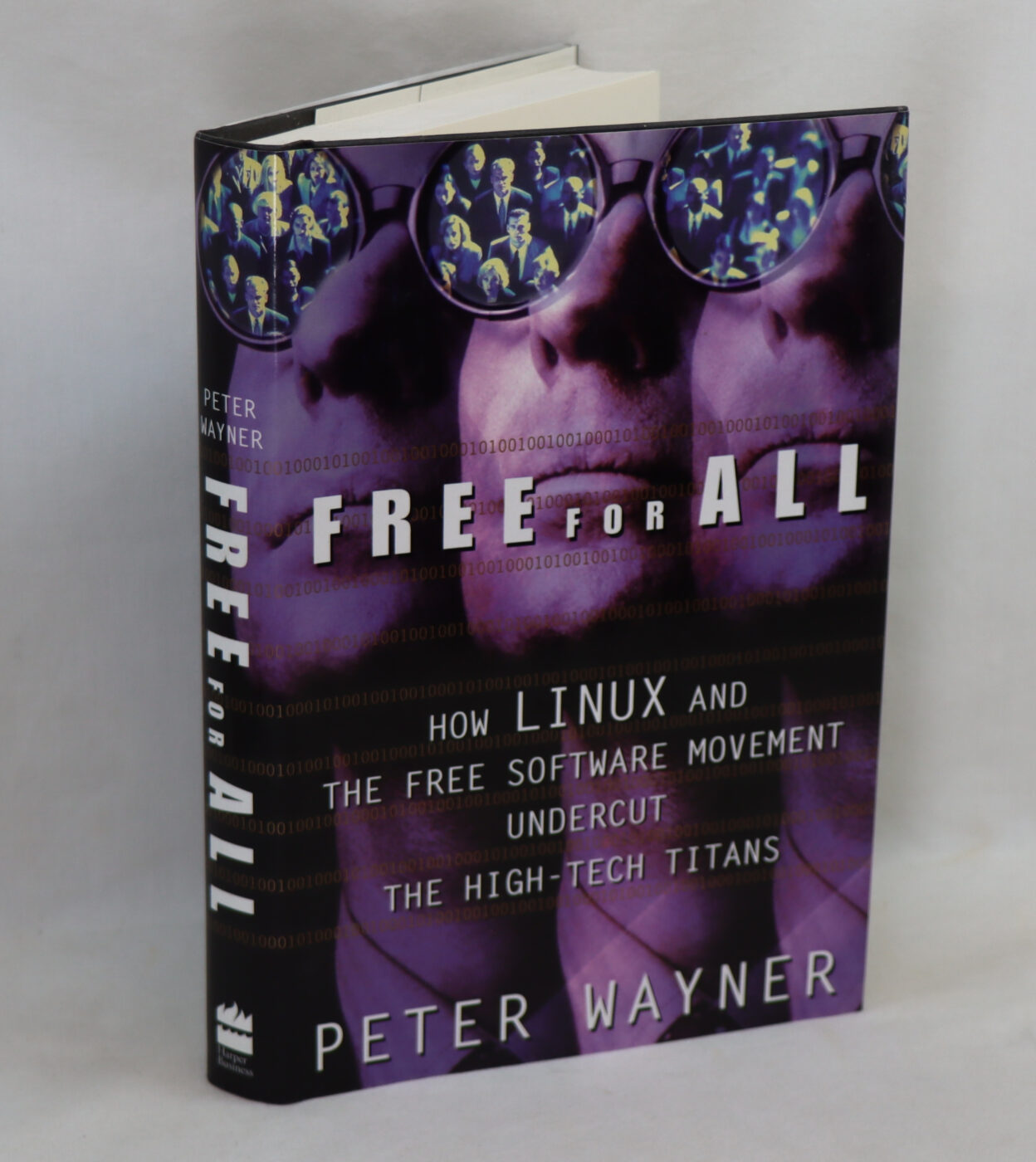
Free for All.
By Peter Wayner
ISBN: 9780756761844
Printed: 2000
Publisher: Harper Collins. London
| Dimensions | 17 × 24 × 3 cm |
|---|---|
| Language |
Language: English
Size (cminches): 17 x 24 x 3
Condition: Very good (See explanation of ratings)
£15.00
Buy Now

Item information
Description
In the original dust cover. Black binding with silver title on the spine.
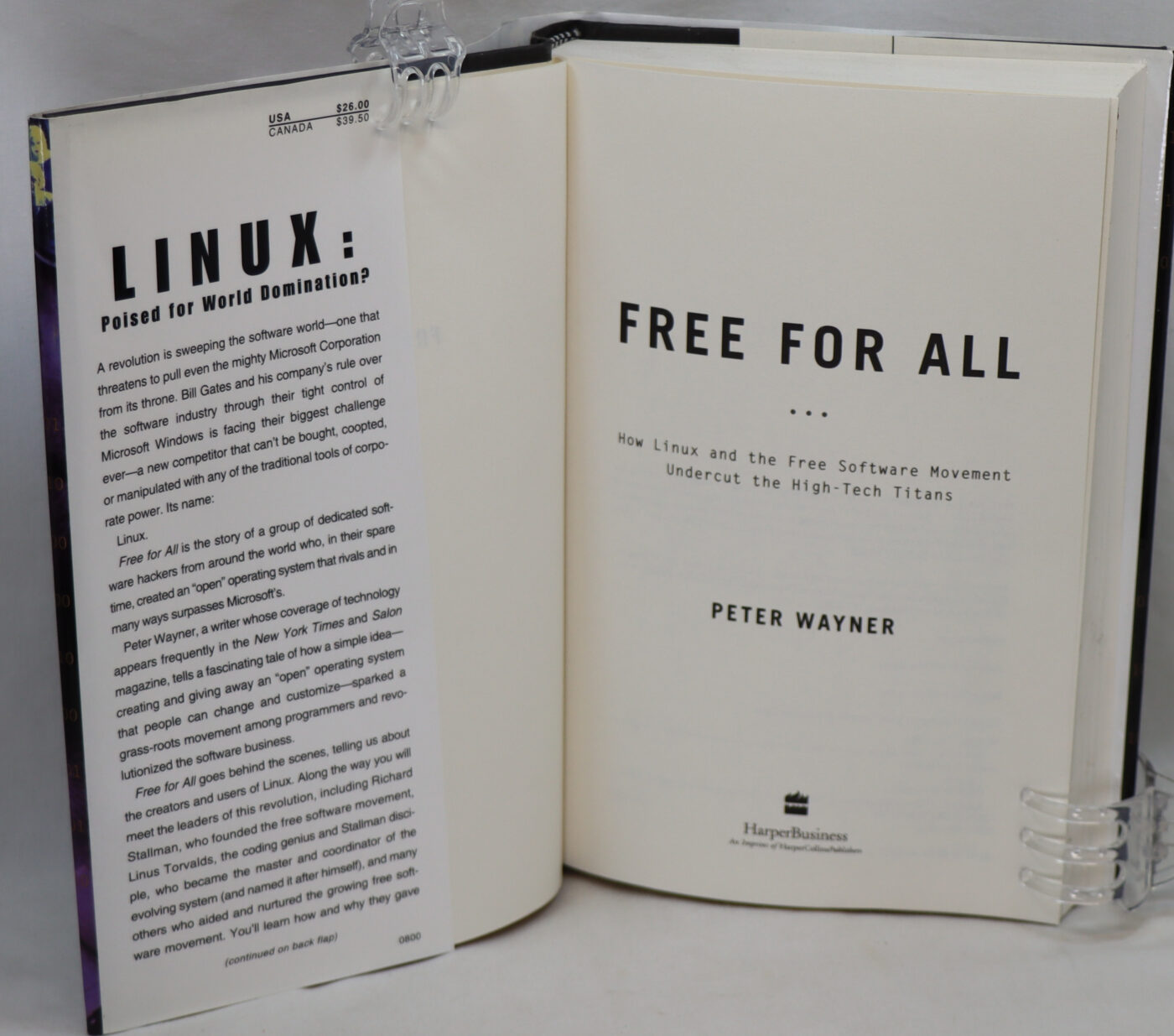
We provide an in-depth photographic presentation of this item to stimulate your feeling and touch. More traditional book descriptions are immediately available
- Note: This book carries a £5.00 discount to those that subscribe to the F.B.A. mailing list
A journalist who covers technology for The New York TImes takes a close-up look at the rise and popular acceptance of Linux and explains how free software is changing the nature of business and wealth.
Review: Peter Wayner does an outstanding job of looking at the history of the free software movement in this thoughtful, thorough book. Unlike other books about technology that refer to freeware (free software) as an example, Wayner looks directly at the phenomenon to evaluate its significance, the potential for the future, and why it works. I was especially impressed by the way he combined perspectives: historical, competitive, psychological, user needs, financial, resource, and wealth. Each one tells you something you need to know about this important area.
At first, my reaction was that this book would be only of interest to those who do not know much about freeware. Having read the whole book and thought more about it, I think the lessons here are probably just as pertinent for those who are active in the freeware movement. For Wayner is really addressing the long-term viability of what is needed to succeed. Many challenges are still ahead. For example, he notes that “the daily struggle for some form of income is one of the greatest challenges in the free source world today.” These are the Minutemen of the Knowledge Age, doing other work to keep a roof over their heads and fighting for better software in all of their free time.
I especially enjoyed the many profiles of people who are involved with freeware in humble, altruistic ways. In an age described by many as greedy and self-obsessed with momentary pleasures, many of these people are the sort of independent thinkers and doers who originally established the United States and made our modern lives of freedom possible. We should all salute them!
The basic argument is that openly-developed freeware is an effective model for accelerating the rate of technological and human development in using data processing and electronic communications. For example, over half the Web servers run on open source software because it works better. You can create a supercomputer for $3,000 using open source freeware. The freeware model works because users draw attention faster to glitches (and bugs), and talented, caring people who are interested in solutions are drawn to creating rapid fixes. There is fame, reputation, and notoriety available for doing this free software work — as well as tangible benefits in getting one’s own tasks done faster and better. It is basically an argument based on complexity science and chaos theory, but built on the actual experiences of the software built from the original UNIX base at Berkeley and the Linux operating system.
One of the intriguing contrasts that is drawn is between the Microsoft development and marketing approach and the one for freeware. This is also characterized as the suits against the nerds. Wayner also points out that many mixed models are also developing. Red Hat offers Linux for those who want some better documentation and some support for a price. Hardware makers are starting to support freeware development activities.
Wayner does a good job of overcoming labels that often seem to be misapplied. He explains that Linus Torvalds really focuses now on the kernel of Linux rather than all of its aspects, and the choices that Torvalds made which allowed Linux to become so powerful. He also shows the detailed views of important people in the development of freeware such as Richard Stallman (author of the GNU Manifesto). The history of disputes among those involved in freeware are fascinating, such as the way that the AT&T lawsuit against Berkeley slowed down the development of BSD (Berkeley Software Development) so that it lags behind Linux in numbers of people using its freeware.
From reading this book, I had the sense that something even more important is at stake here. I suspect that the freeware movement is actually creating a new and improved paradigm for acclerating human progress which can be applied in many other fields of knowledge. As Wayner points out, however, this is in some ways merely a reversion to the historical intellectual model of universities freely sharing knowledge for the benefit of all. That model has not usually been applied to creating commercial significant products and services directly. Perhaps the day has come for that to happen with the connectivity of the Internet to help us.
Overcome your disbelief, stall that existing methods of innovation will always dominate!
NOTE: This is an original book from the library gathered by the famous Cambridge Don, computer scientist, food and wine connoisseur, Jack Arnold LANG. Note: Jack founded the Michelin Guide ‘Midsummer House’- Cambridge’s paramount restaurant. This dining experience is hidden amongst the grassy pastures and grazing cattle of Midsummer Common and perched on the banks of the River Cam.
In 2008, Jack was one of the co-founders of the Raspberry Pi Foundation, alongside other members of the Department, and acted as the Foundation’s Chair. The project’s original goals were modest: to build and distribute low-cost computers for prospective applicants to our Computer Science degree. Initially the project was a “success disaster”, as Jack would say, as demand far outstripped the low-scale manufacturing plans. Ultimately the Raspberry Pi became the UK’s most successful computer with more than 60 million sold to date. Jack was drawn to the educational possibilities of the Raspberry Pi, its potential uses in emerging economies and the way it could support self-directed learning.
Want to know more about this item?
We are happy to answer any questions you may have about this item. In addition, it is also possible to request more photographs if there is something specific you want illustrated.
Ask a question
Related products







Share this Page with a friend
