
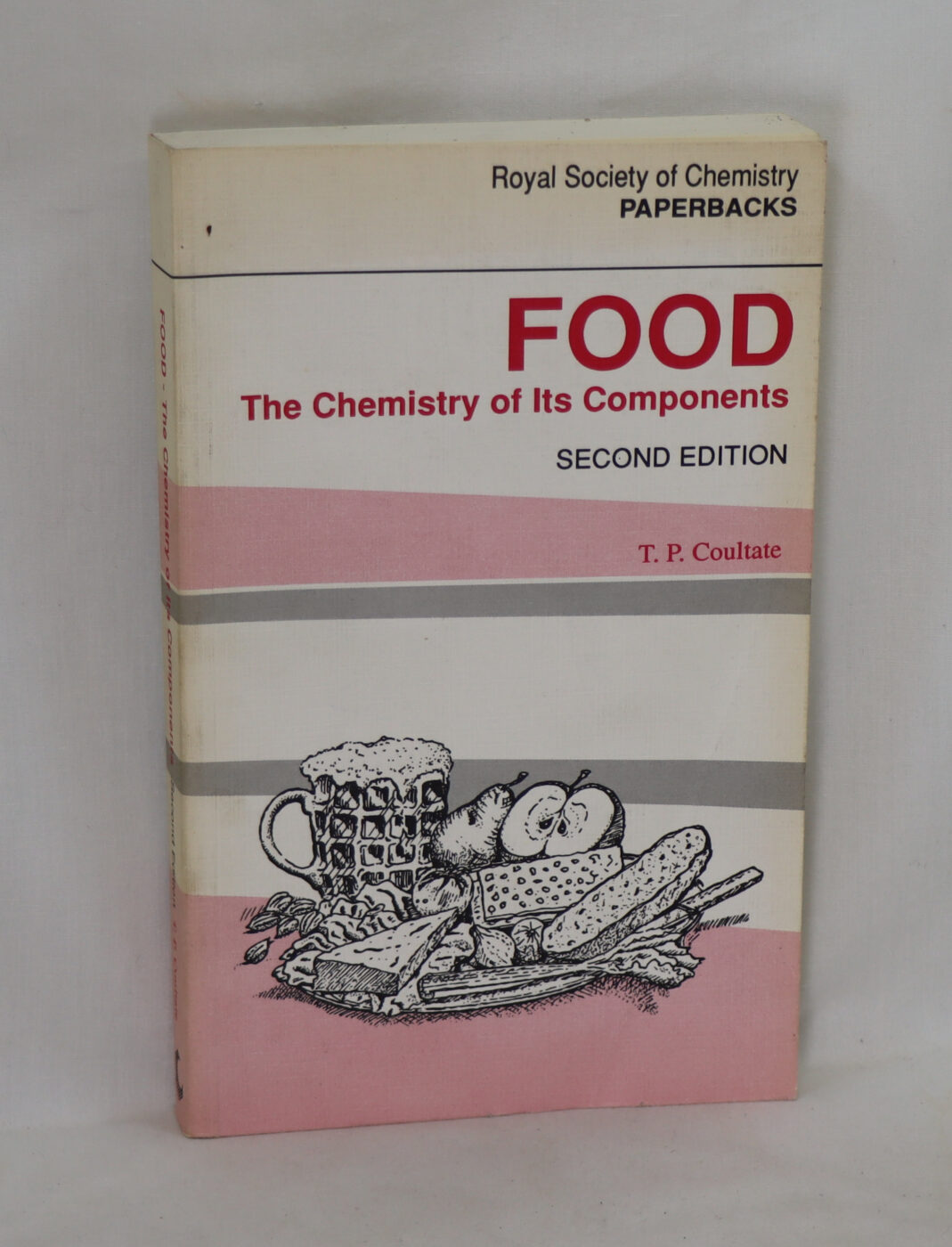
Food - The Chemistry of It's Components.
By T P Coulate
Printed: 1989
Publisher: Royal Society of Chemistry. Cambridge.
| Dimensions | 13 × 21 × 2 cm |
|---|---|
| Language |
Language: English
Size (cminches): 13 x 21 x 2
Condition: Good (See explanation of ratings)
£6.00
Buy Now
Item information
Description
Paperback. White cover with red title
We provide an in-depth photographic presentation of this item to stimulate your feeling and touch. More traditional book descriptions are immediately available
- A £2 reduction when collected from FBA shop
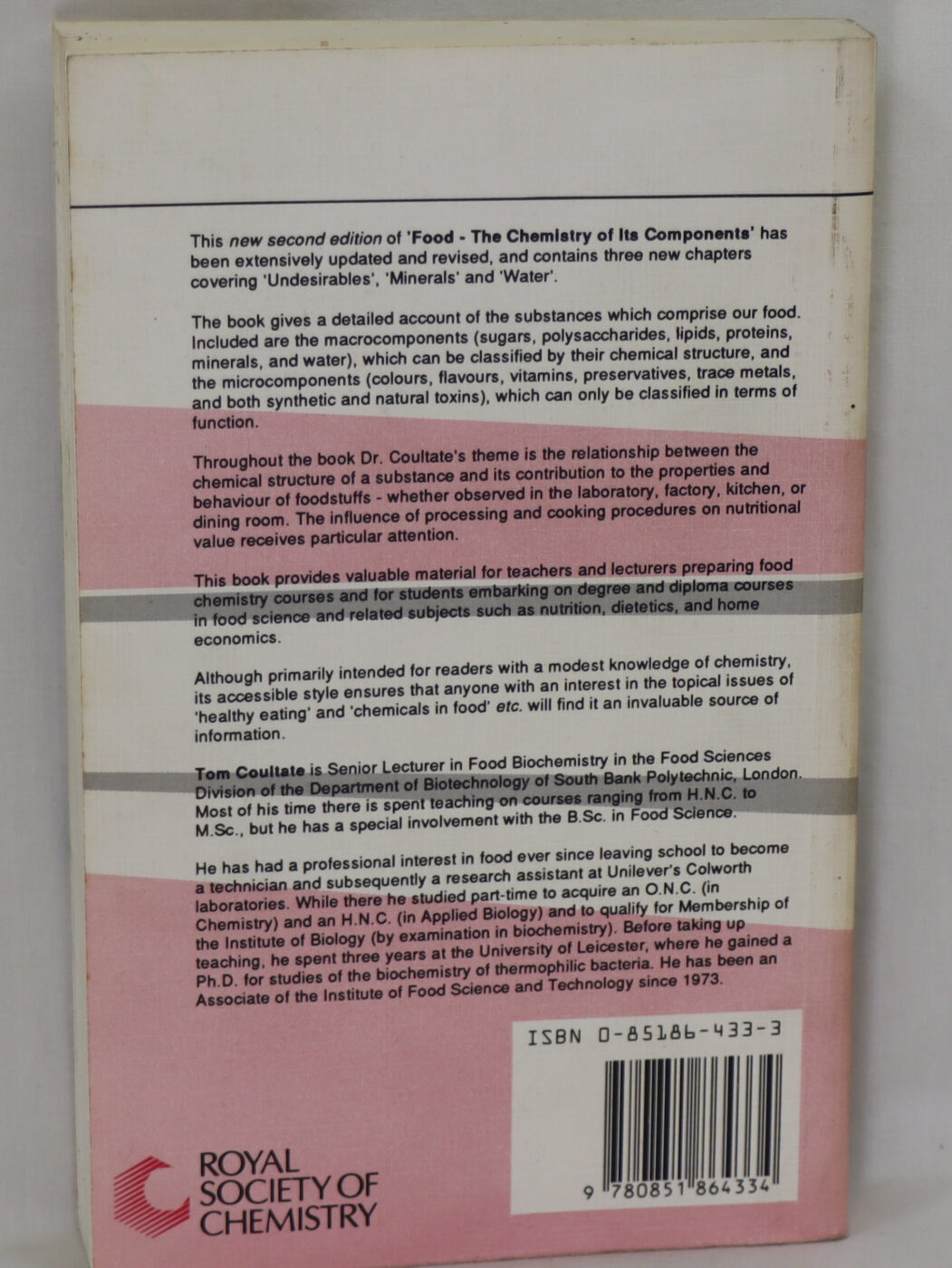
As a source of detailed information on the chemistry of food this book is without equal. With a Foreword written by Heston Blumenthal the book investigates food components which are present in large amounts (carbohydrates, fats, proteins, minerals and water) and also those that occur in smaller amounts (colours, flavours, vitamins and preservatives). Food borne toxins, allergens, pesticide residues and other undesirables are also given detailed consideration. Attention is drawn to the nutritional and health significance of food components. This classic text has been extensively rewritten for its 5th edition to bring it right up to date and many new topics have been introduced. Features include: “Special Topics” section at the end of each chapter for specialist readers and advanced students An exhaustive index and the structural formulae of over 500 food components Comprehensive listings of recent, relevant review articles and recommended books for further reading Frequent references to wider issues e.g. the evolutionary significance of lactose intolerance, fava bean consumption in relation to malaria and the legislative status of food additives. Food: The Chemistry of its Components will be of particular interest to students and teachers of food science, nutrition and applied chemistry in universities, colleges and schools. Its accessible style ensures that that anyone with an interest in food issues will find it invaluable. Extracts from reviews of previous editions: “very detailed and readable … the author is to be congratulated” The British Nutrition Foundation, 1985 “a superb book to have by your side when you read your daily newspaper” New Scientist, 1989 “mandatory reading for food scientists, medical students … and anyone else who has an interest in the food we eat” The Analyst, 1990 “…filled me with delight, curiosity and wonder. All of the chemistry is very clear and thorough. I heartily recommend it.” The Chemical Educator, 1997 “…an invaluable source of information on the chemistry of food. It is clearly written and I can heartily recommend it.” Chemistry and Industry, 2004 New, greatly enlarged or totally revised topics include: Acrylamide Resistant starch Pectins Gellan gum Glycaemic Index (GI) The elimination of trans fatty acids Fractionation of fats and oils Cocoa butter and chocolate The casein micelle Tea, flavonoids and health Antioxidant vitamins Soya phytoestrogens Legume toxins Pesticide residues Cow’s milk and peanut allergies.
Review “Overall this is an extremely detailed and informative book that is extremely accessible. It will appeal to any non-specialist with a keen interest in the food that they eat.””” ― “Carbohydrate Polymers, Vol 33, Issue 1, p 87”
About the Author: Dr Tom Coultate was Principal Lecturer in Food Biochemistry at the School of Applied Science at South Bank University, London, until his retirement in 2000. He first joined the School of Applied Science at South Bank University in 1972, after obtaining his PhD for studies on the biochemistry and physiology of a thermophilic bacterium from Leicester University. Since leaving school he had been first a lab. technician and then research assistant at Unilever’s research laboratories in Bedfordshire (Colworth House) at the same time studying part-time to acquire an ONC, HNC and MIBiol. Having obtained his PhD, Tom embarked on a long and successful professional career fuelled by his fascination for food and the satisfactions of teaching! His particular interest was, and still is, the relationship between the essentially chemical nature of all foods and their distinctive, unique journey from field to plate and beyond. Tom is frequently invited to address local audiences and branch meetings of learned societies such as the RSC and SCI on food topics, and has been an occasional television and radio interviewee. Previous editions of this book have been translated into Chinese, Italian, Portuguese and Spanish and have been used by universities, food scientists and chemists worldwide. Although Tom retired from full-time teaching in 2000 he still maintains his links with professional colleagues including new friends at the nearby Open University campus at Milton Keynes. He continues to contribute articles for technical and trade magazines on food topics.
NOTE: This is an original book from the library gathered by the famous Cambridge Don, computer scientist, food and wine connoisseur, Jack Arnold LANG. Note: Jack founded the Michelin Guide ‘Midsummer House’- Cambridge’s paramount restaurant. This dining experience is hidden amongst the grassy pastures and grazing cattle of Midsummer Common and perched on the banks of the River Cam. The Midsummer House experience is imaginatively curated to delight and amaze, so the surprise set menu changes regularly and is ‘Midsummer’s’ playground to showcase.
In 2008, Jack was one of the co-founders of the Raspberry Pi Foundation, alongside other members of the Department, and acted as the Foundation’s Chair. The project’s original goals were modest: to build and distribute low-cost computers for prospective applicants to our Computer Science degree. Initially the project was a “success disaster”, as Jack would say, as demand far outstripped the low-scale manufacturing plans. Ultimately the Raspberry Pi became the UK’s most successful computer with more than 60 million sold to date. Jack was drawn to the educational possibilities of the Raspberry Pi, its potential uses in emerging economies and the way it could support self-directed learning.
Want to know more about this item?
We are happy to answer any questions you may have about this item. In addition, it is also possible to request more photographs if there is something specific you want illustrated.
Ask a question
Related products

Share this Page with a friend
