
Prideaux's Introduction for reading all sorts of Histories’.
By Mathias Prideaux
Printed: 1655
Publisher: University of Oxford. Oxford
Edition: Third edition
| Dimensions | 17 × 21 × 5 cm |
|---|---|
| Language |
Language: English
Size (cminches): 17 x 21 x 5
Condition: Very good (See explanation of ratings)
£340.00
FREE shipping
Buy Now

Item information
Description
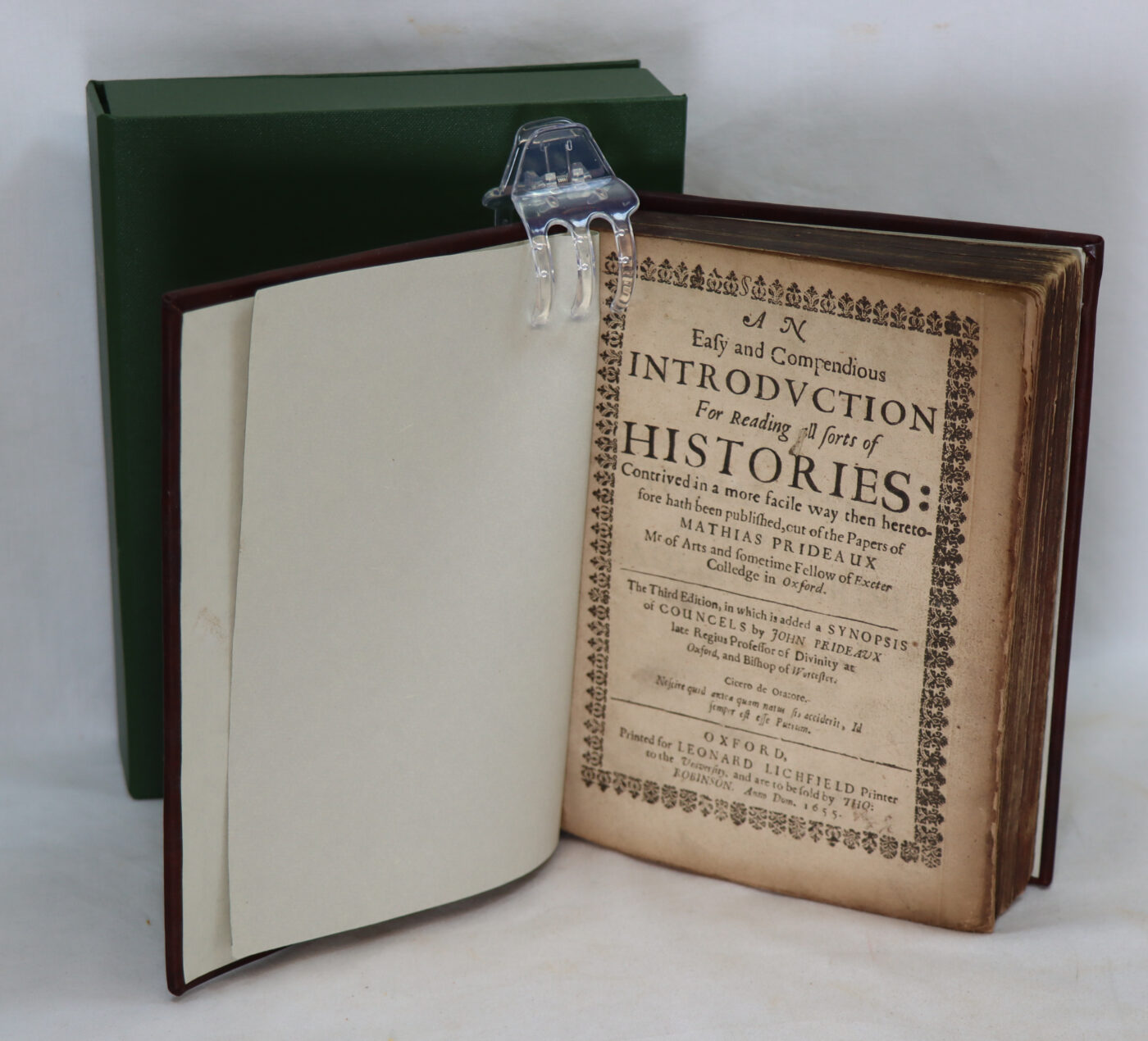
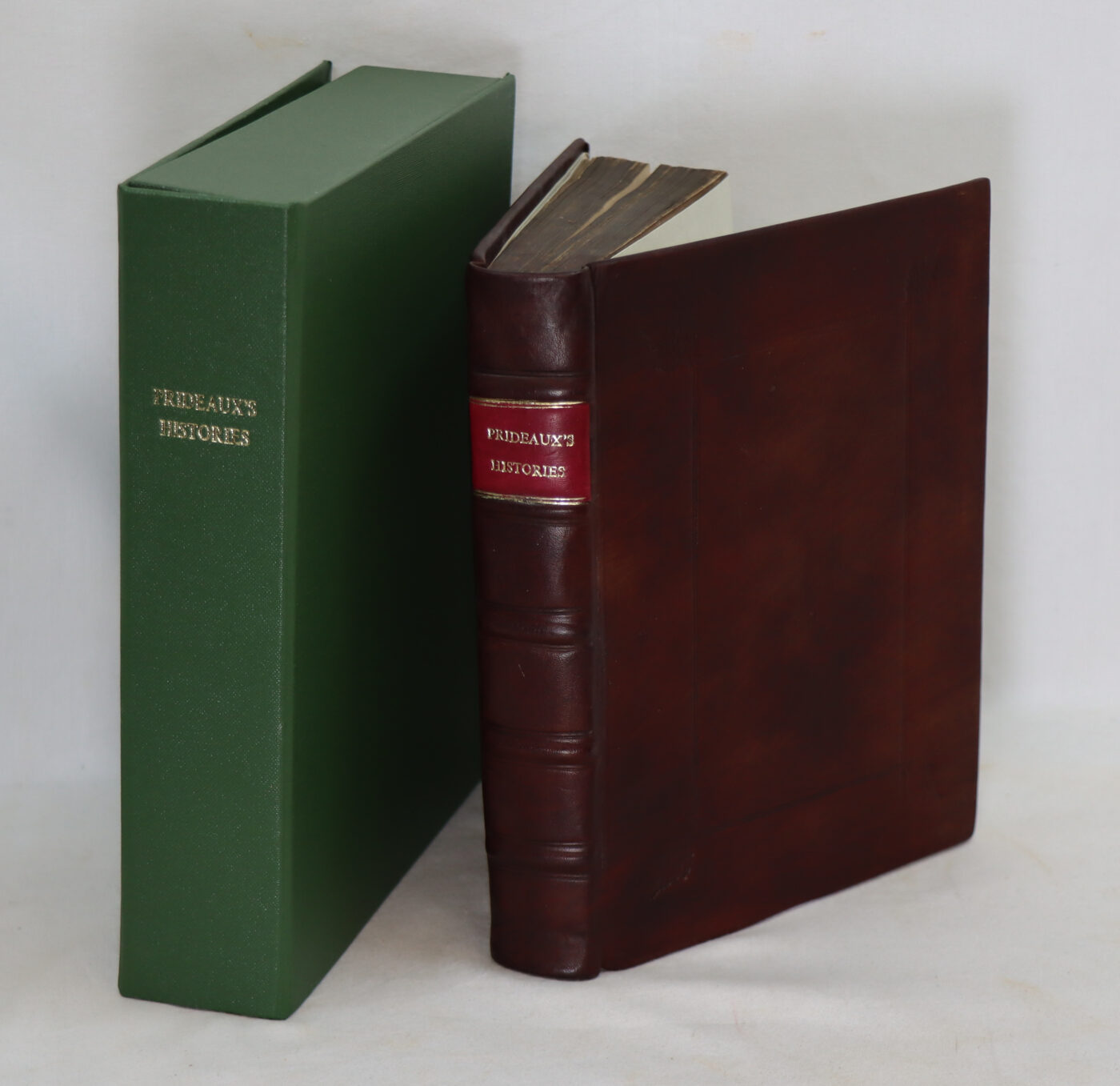
Rebound in brown calf binding with raised banding, red title plate, and gilt title on the spine. Newly boxed in a green protective box. Dimensions are for the box.
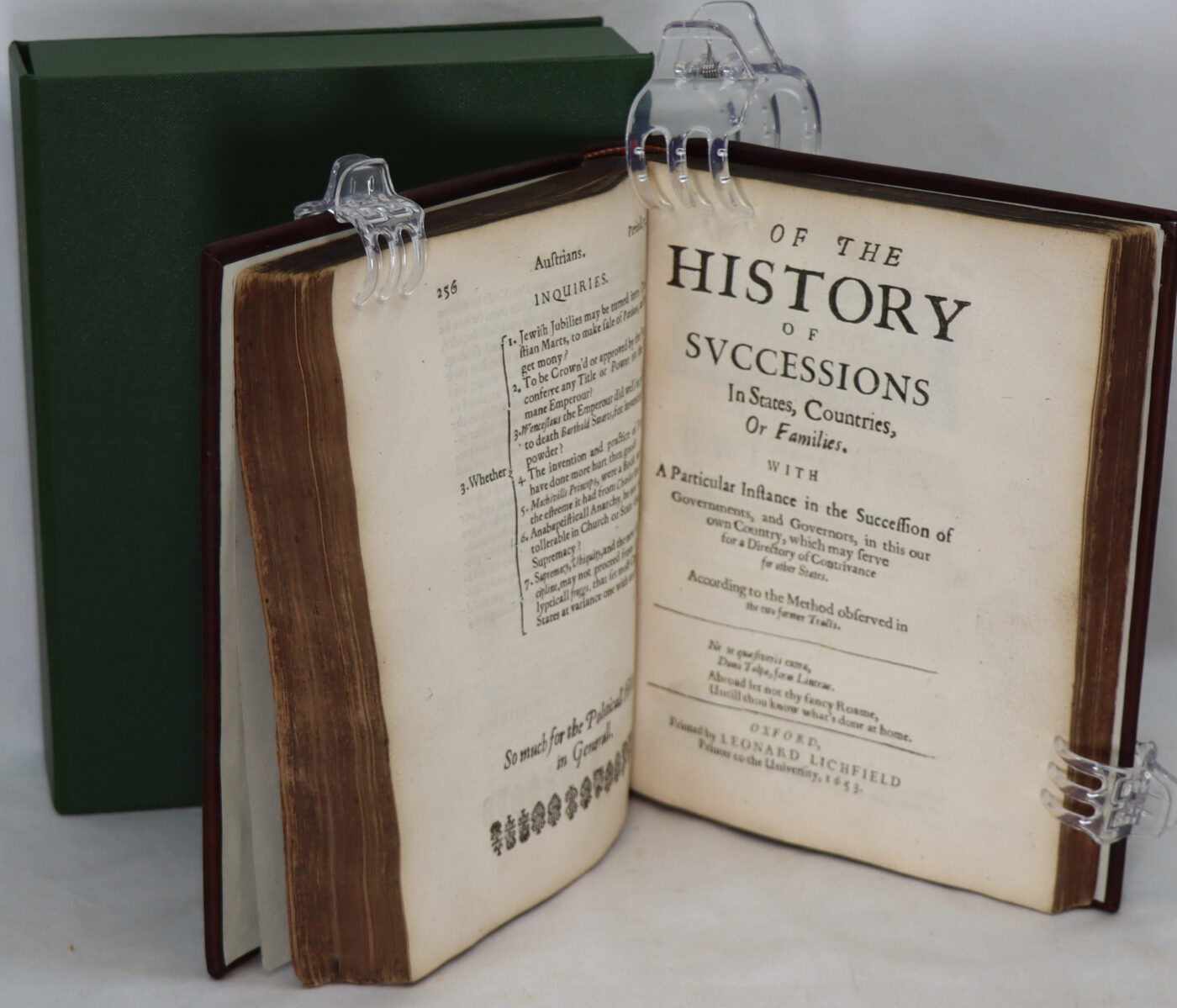
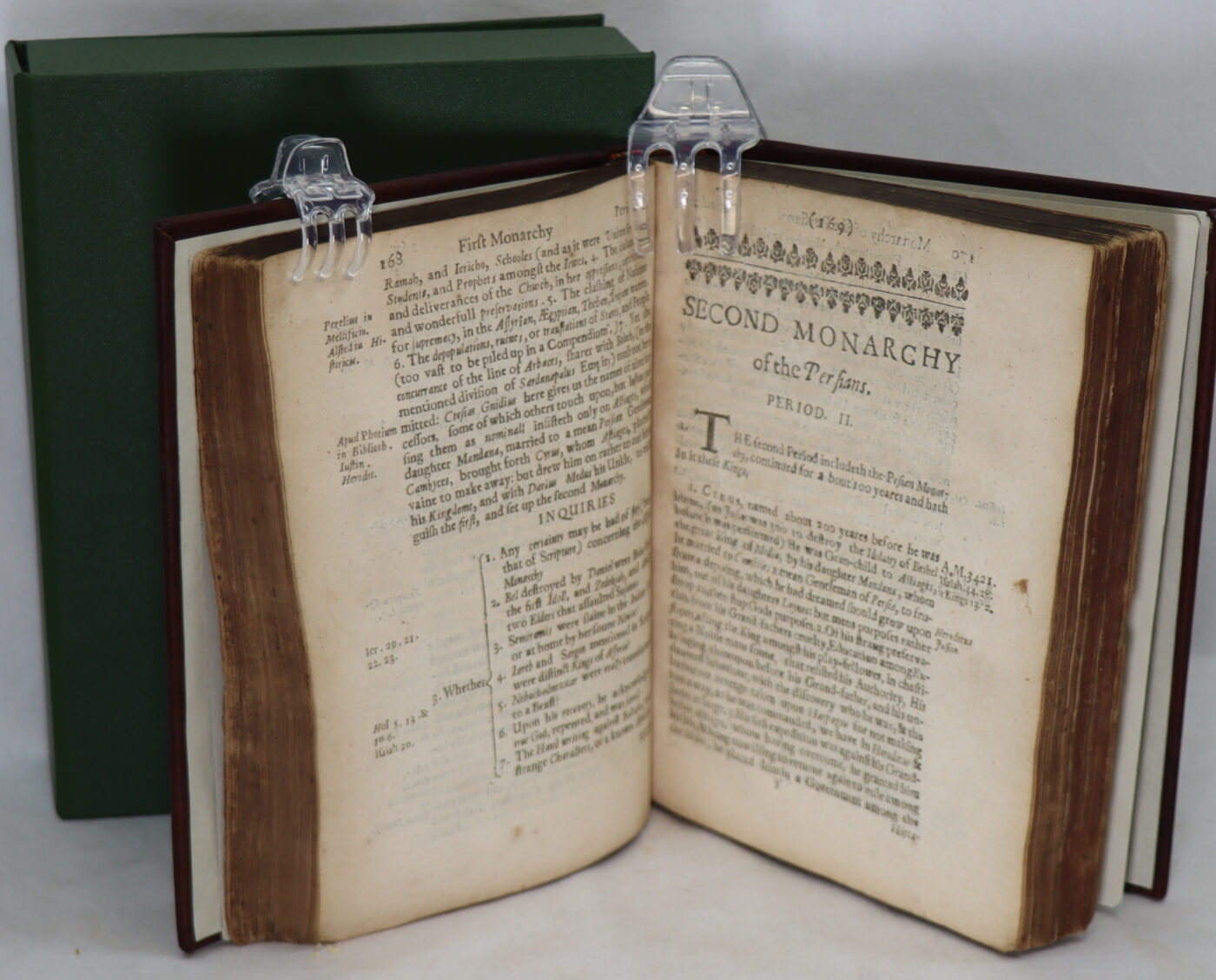
Please view the photographs, refurbished and nicely boxed by Brian Cole.
This (third edition) with John Prideaux’s additional SYNOPSIS was published in 1655 by the University of Oxford’
Fantastic: A joy to hold, linking the reader into the 17th century. You feel why in the 17th century this was England’s most popular book!
Based on historical bibliography records, the work mentioned is:
Mathias Prideaux, An Easy and Compendious Introduction for Reading all sorts of Histories (Oxford: Leonard Lichfield and Tho. Robinson, 1655).
Edition and Content: This 1655 edition is often identified as the third edition (or sometimes early editions, as early copies appear around 1648-1650).
Key Feature: The 1655 edition specifically includes John Prideaux’s Synopsis of Councels.
Background: Mathias Prideaux (1622–1646?) was a Fellow of Exeter College, Oxford, and the son of John Prideaux, who was the Regius Professor of Divinity at Oxford and Bishop of Worcester. The book was edited and published after Mathias’s death by his father, John Prideaux.
Publisher: Leonard Lichfield, the printer to the University of Oxford, was a primary publisher of this work.
The book was a popular 17th-century textbook on historiography, focusing on organizing political history, successions in states, and ecclesiastical councils.
John Prideaux (7 September 1578 – 29 July 1650) was an English academic and Bishop of Worcester. The fourth son of John and Agnes Prideaux, he was born at Stowford House in the parish of Harford, near Ivybridge, Devon, England, on 17 September 1578. His parents had to provide for a family of twelve; John, however, attracted the attention of a wealthy friend, Lady Fowell, of the same parish, and was sent to Oxford at eighteen. He matriculated from Exeter College on 14 October 1596, received a B.A. degree on 31 January 1600, was elected Fellow of Exeter College on 30 June 1601, and received a M.A. degree on 30 June 1603. The College was then under Thomas Holland as Rector and William Helme as tutor. Prideaux took holy orders soon after 1603, and was appointed chaplain to Henry Frederick, Prince of Wales. Matthew Sutcliffe named him in 1609 one of the fellows of his Chelsea College.
Prideaux was admitted B.D. On 6 May 1611, and on 4 April 1612 he was elected Rector of Exeter College, Oxford and was permitted to take the degree of D.D. 30 May 1612, before the statutable period. Exeter was then fifth college numerically in the university, and attracted not only west-countrymen, but also foreign students. Prideaux built on its reputation for scholarship. Philip Cluverius and D. Orville the geographers, James Casaubon and Sixtinus Amama were among the Northern Europeans and others who studied under him. Robert Spottiswoode and James, Duke of Hamilton, were among his Scottish pupils. Prideaux added to the buildings of the college: a new chapel was built in 1624, and consecrated (5 October) with a sermon by him. Anthony Ashley Cooper, his pupil from 1636 to 1638, records that he could be just and kindly to excitable undergraduates. Another of his students was Dutch Reformed theologian Sixtinus Amama.
After the death of Prince Henry in 1612, Prideaux was appointed chaplain to the King. On 17 July 1614, he was collated to the vicarage of Bampton, Oxfordshire, and 8 December 1615 was appointed Regius Professor of Divinity at Oxford University in succession to Robert Abbot; to this office a canonry of Christ Church was annexed. He received subsequently the vicarage of Chalgrove, Oxfordshire, in 1620, a canonry in Salisbury Cathedral 17 June 1620, the rectory of Bladon in 1625, and the rectory of Ewelme, Oxfordshire, in 1629.
Prideaux was in post as Vice-Chancellor of Oxford University (a one-year position at the time) five times: from July 1619 to July 1621, July 1624 to 1626, and from 7 October 1641 to 7 February 1643, although in absentia at the end of his office. In his first year of office, he had to intervene in the dispute raging in Jesus College as to the election of a Principal. In defiance of the fellows, he installed Francis Mansell, the nominee of Lord Pembroke, then chancellor, and expelled most of the dissenters.
It was as Regius Professor of Divinity that Prideaux came most into contact with actual politics. For 26 years, he had to preside over theological disputes, in which the unorthodox found supporters. He maintained a conservative position, without altogether alienating the extremists. To young Gilbert Sheldon, who first at Oxford denied that the Pope was Antichrist, he replied with a joke; and his quarrel with Peter Heylyn, whom in 1627 he denounced as a ‘Bellarminian,’ for maintaining the supremacy of the church in matters of faith, was amicably settled in 1633 by the mediation of William Laud. In 1617, a similar difficulty with Daniel Featley had been composed with the help of George Abbot. His attitude towards Arminian views was unfriendly. On the other hand, Laud respected him, and asked him in 1636 to revise William Chillingworth’s Religion of Protestants, and he always remained one of the royal chaplains.
Prideaux was one of the miscellaneous theologians summoned by the lords’ committee 1 March 1641, to meet in the Jerusalem Chamber and discuss plans of church reform under the lead of John Williams. In the autumn Charles, in filling the five vacant sees, promoted four bishops and appointed Prideaux to the fifth, that of Worcester. Prideaux was consecrated on 19 December 1641, and installed a few weeks later; he was thus engaged at Worcester when Williams and his eleven colleagues assembled to make their protest, 29 December, and so escaped impeachment. He was one of the three peers, all bishops, who dissented when the bill for excluding the spiritual peers from parliament was read a third time, 5 February 1642. That the commons were not hostile to Prideaux was shown by his nomination as one of the Westminster Assembly in April 1642. He never attended any of its meetings, and, returning to Worcester, gradually identified himself with the royalists; so that in the list of the Assembly in the ordinance of June 1643 his name no longer appears.
He was deprived of his See by Parliament on 9 October 1646, as episcopacy was abolished for the duration of the Commonwealth and the Protectorate. He maintained himself in his diocese until the end of the war, and was in Worcester when the city capitulated to Thomas Rainsborough. Deprived of what remained to him of the episcopal estates, he sought a refuge with his son-in-law, Dr Henry Sutton, rector of Bredon, Worcestershire. His last years were spent in comparative poverty, and he had to sell his library to provide for his family. He died of fever at Bredon on 29 July 1650 and was buried in the chancel of the church there 15 August.
Described as one of the most influential Calvinists inside the Church, he was censured in 1631 for his tolerance of preachers in Oxford attacking William Laud.
He was widely disliked by the Laudian party in the Church of England. Richard Montagu, one of Laud’s supporters, called him ‘that jackanapes’ and ‘the Bedlam of Exeter’, hardly complimentary things to say about one of Oxford’s most renowned heads of house. There was an unusually high presence of staunch Protestants at Exeter, and its reputation as anti-Laudian was clear (it was the only college not to have its altar in the position required by the Laudian statutes). Prideaux’s position at the apex of the College allowed his influence to permeate every aspect of its life, academic and religious, and Exeter’s appeal as a centre of Protestant scholarship must have stemmed in large part from him.
Works – Matthias Prideaux, a Royalist soldier, was his son, and predeceased him in 1646. John Prideaux edited his work on history. He wrote a substantial academic treatise, Hypomnemata, as well as theological works.
Prideaux’s Introduction for reading all sorts of Histories’. By Mathias Prideaux Printed: 1655 Publisher: University of Oxford. Oxford Edition: Third edition Language: English Size (inches): 6.8 x 8.4 x 2 Condition: Very good
Bibliographic & Historical Context
- Full Title. An Easy and Compendious Introduction for Reading all sorts of Histories: contrived in a more facile way then heretofore hath been published.
- Authorship & Posthumous Editing. Mathias Prideaux (1622–1646?), a Fellow of Exeter College, Oxford, wrote the core text before his early death. His father, John Prideaux (Regius Professor of Divinity at Oxford and Bishop of Worcester), edited and published the papers posthumously.
- 1655 Third Edition Features. Printed at Oxford by Leonard Lichfield (printer to the University) and Thomas Robinson, this edition was one of the most popular historiography textbooks in 17th-century England. It organizes world history into political history, successions in states and families, and includes John Prideaux’s appended Synopsis of Councels.
Condition & Valuation Notes
- The listed dimensions (6.8 × 8.4 × 2 inches) refer to its accompanying green protective box rather than the quarto text block itself.
- Market Pricing. While later editions (such as the 1673 fifth edition on AbeBooks with detached covers) sell for around £170, an earlier 1655 third edition in very good, rebound, and boxed condition commands a higher retail price of £340.
- Collector Considerations. Because this volume has been rebound and refurbished, collectors typically verify whether the separate internal title pages (for Of Political History in General, Of the History of Successions, and the Synopsis of Councels) are all present and intact, as missing leaves or trimmed margins can affect long-term value.
Biography and chapter headings and price
Mathias Prideaux (1622–1646?) was an English Royalist scholar and soldier at Oxford whose posthumous history textbook became a standard 17th-century reference. The specific 1655 third edition matching your description is currently priced at £340 ($457.06) through Frost Books & Artifacts.
Biography of Mathias Prideaux
- Early Life & Family. Born in the parish of St. Michael’s, Oxford, around 1622 (some family records cite 1625), Mathias was the second son of John Prideaux, the prominent Regius Professor of Divinity at Oxford, Rector of Exeter College, and later Bishop of Worcester.
- Oxford Scholarship. He matriculated at Exeter College on 3 July 1640 and was elected a Fellow of the college on 30 June 1641. Contemporaries regarded him as an ingenious young academic.
- English Civil War & Death. During the Civil War, Prideaux served as a captain in King Charles I’s Royalist army, which earned him an accelerated M.A. degree on 3 December 1645. Following the surrender of Oxford in 1646, he moved to London, contracted smallpox, and died around the age of 20 to 24.
- Posthumous Publication. After Mathias’s death, his father compiled and edited his manuscript notes, first publishing them at Oxford in 1648. The book proved immensely popular, going through at least six editions by 1682.
Book Structure & Chapter Headings
The work is divided into three main sections (with the second and third parts bearing separate internal title pages), followed by an appended treatise by his father:
- Part I: Ecclesiastical History in General. Covers sacred and church history, famously classifying the Popes into eight satirical, Protestant-leaning chapters: Good Bishops, Tollerable Arch-Bishops, Patriarchs, Usurping Nimrods, Luxurious Sodomites, Aegyptian Magitians, Devouring Abaddons, and Incurable Babylonians.
- Part II: Of Political History in General. Surveys ancient and classical monarchies, empires, and civil governance.
- Part III: Of the History of Successions in States, Countries, or Families. Traces royal lineages, genealogies, and chronologies across major European nations and dynasties, alongside lists of notable historians, philosophers, mathematicians, and physicians.
- Appendix: A Synopsis of Councels. Added by Bishop John Prideaux in early editions (including the 1655 third edition), providing a chronological summary of major church councils.
Current Market Pricing
- Exact 1655 Third Edition Copy. The rebound and boxed 1655 copy is listed at £340 ($457.06) with free delivery from Frost Books & Artifacts.
- Later Editions for Comparison. Later 17th-century printings generally trade for slightly less depending on binding condition. A 1673 fifth edition (with detached boards) is listed for £170.41 via Sanctuary Books on AbeBooks, and a complete 1682 sixth edition is priced at $275.00 (approx. £215) at Kline Books.
Condition notes
Rebound
Want to know more about this item?
We are happy to answer any questions you may have about this item. In addition, it is also possible to request more photographs if there is something specific you want illustrated.
Ask a question
Related products

Share this Page with a friend
