
Aspects of a Racinian Tragedy.
By John C Lapp
Printed: 1964
Publisher: University of Toronto Press.
| Dimensions | 15 × 23 × 1.5 cm |
|---|---|
| Language |
Language: English
Size (cminches): 15 x 23 x 1.5
Condition: Fair (See explanation of ratings)
£21.00
Buy Now

Item information
Description
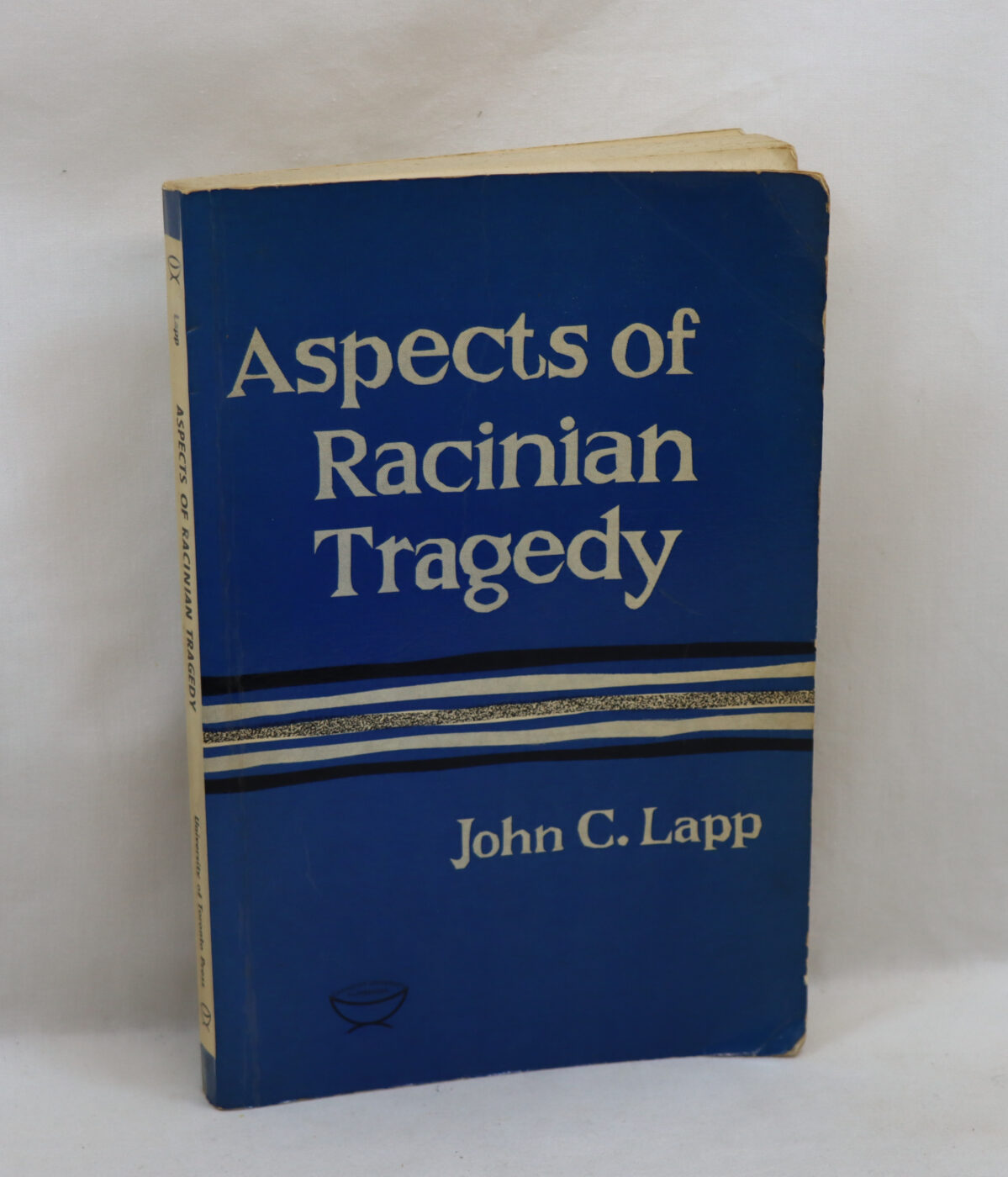
Paperback. Blue cover with white title.
We provide an in-depth photographic presentation of this item to stimulate your feeling and touch. More traditional book descriptions are immediately available
-
THIS FROST PAPERBACK is a USED book which a member of the Frost family has checked for condition, cleanliness, completeness and readability. When the buyer collects their book from Frost’s shop, the delivery charge of £3.00 is deducted.
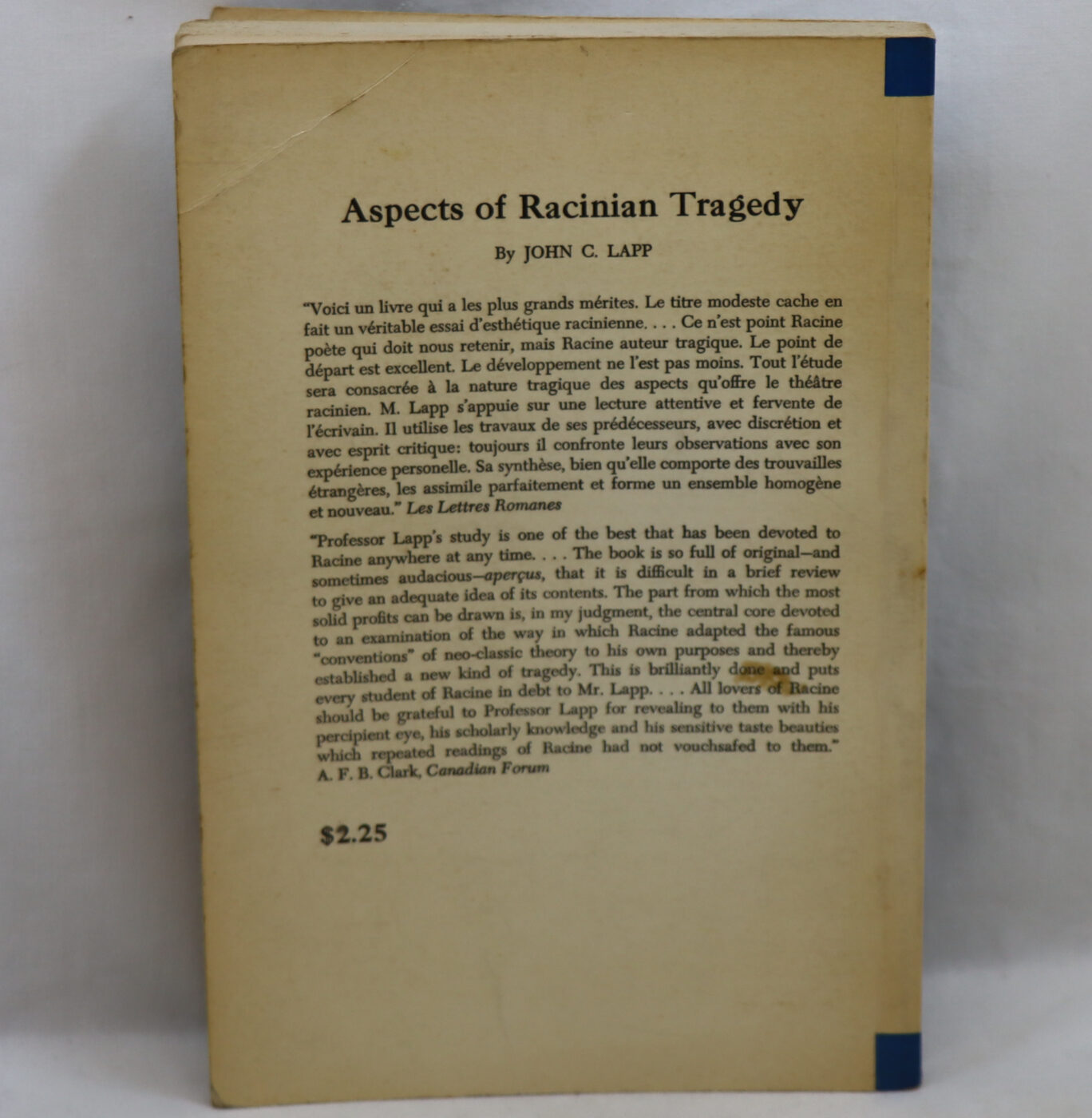
For conditions, please view our photographs. An original book from the library gathered by the famous Cambridge Don, computer scientist, food and wine connoisseur, Jack Arnold LANG. For further details please view the book’s back cover.
This book was the property of Jack’s mother, an ardent theater goer.
Aspects of Racinian Tragedy, by John C. Lapp, published by the University of Toronto Press, is a significant English-language study of Jean Racine’s dramatic art, focusing on its form and offering a fresh perspective by comparing it to Shakespearean tragedy, originally published in 1955 and reissued in 1964 as a paperback in the University of Toronto Romance Series. It delves into Racine’s structure, providing a foundational text for understanding French classical tragedy, especially for English-speaking readers accustomed to Shakespeare, exploring how Racine’s tightly controlled form creates profound effects.
Key Details:
-
Author: John C. Lapp (1917-1977).
-
Title: Aspects of Racinian Tragedy.
-
Publisher: University of Toronto Press (and Oxford University Press in some early editions).
-
Publication Year: 1955 (First Edition), 1964 (Paperback/Second Edition).
-
Language: English.
-
Series: University of Toronto Romance Series, No. 2.
Content & Significance:
-
Focus on Form: Lapp’s main contribution is a detailed analysis of the structural elements of Racine’s plays, arguing that understanding this form is key to grasping his tragic power.
-
Fresh Perspective: Coming from a background of Shakespearean tragedy, Lapp brought an English-language lens to Racine, making French tragedy more accessible and highlighting differences and similarities.
-
Enduring Work: It’s considered a culturally important work, essential for those studying French literature and drama, particularly the classical period.
Racine has been the subject of innumerable critical articles and books since the seventeenth century; of these a small minority has been written in English. Not much remained to be said about Racine as a dramatic artist, but as one brought up to consider Shakespeare as the model of tragedy, the author brings a fresh approach to a dramatist who has been to a great extent a Gallic monopoly. The main road to any understanding of Racinian tragedy must lead through a careful examination of its form, which is chiefly what Lapp contributes to the study of Racine’s form and offers in this book.
Jean-Baptiste Racine ( 22 December 1639 – 21 April 1699) was a French dramatist, one of the three great playwrights of 17th-century France, along with Molière and Corneille, as well as an important literary figure in the Western tradition and world literature. Racine was primarily a tragedian, producing such “examples of neoclassical perfection” as Phèdre, Andromaque, and Athalie. He did write one comedy, Les Plaideurs, and a muted tragedy, Esther, for the young.
Racine’s plays displayed his mastery of the dodecasyllabic (12 syllable) French alexandrine. His writing is renowned for its elegance, purity, speed, and fury, and for what American poet Robert Lowell described as a “diamond-edge”, and the “glory of its hard, electric rage”. Racine’s dramaturgy is marked by his psychological insight, the prevailing passion of his characters, and the nakedness of both plot and stage.
Want to know more about this item?
We are happy to answer any questions you may have about this item. In addition, it is also possible to request more photographs if there is something specific you want illustrated.
Ask a question
Related products
Share this Page with a friend
