
The Slide Rule.
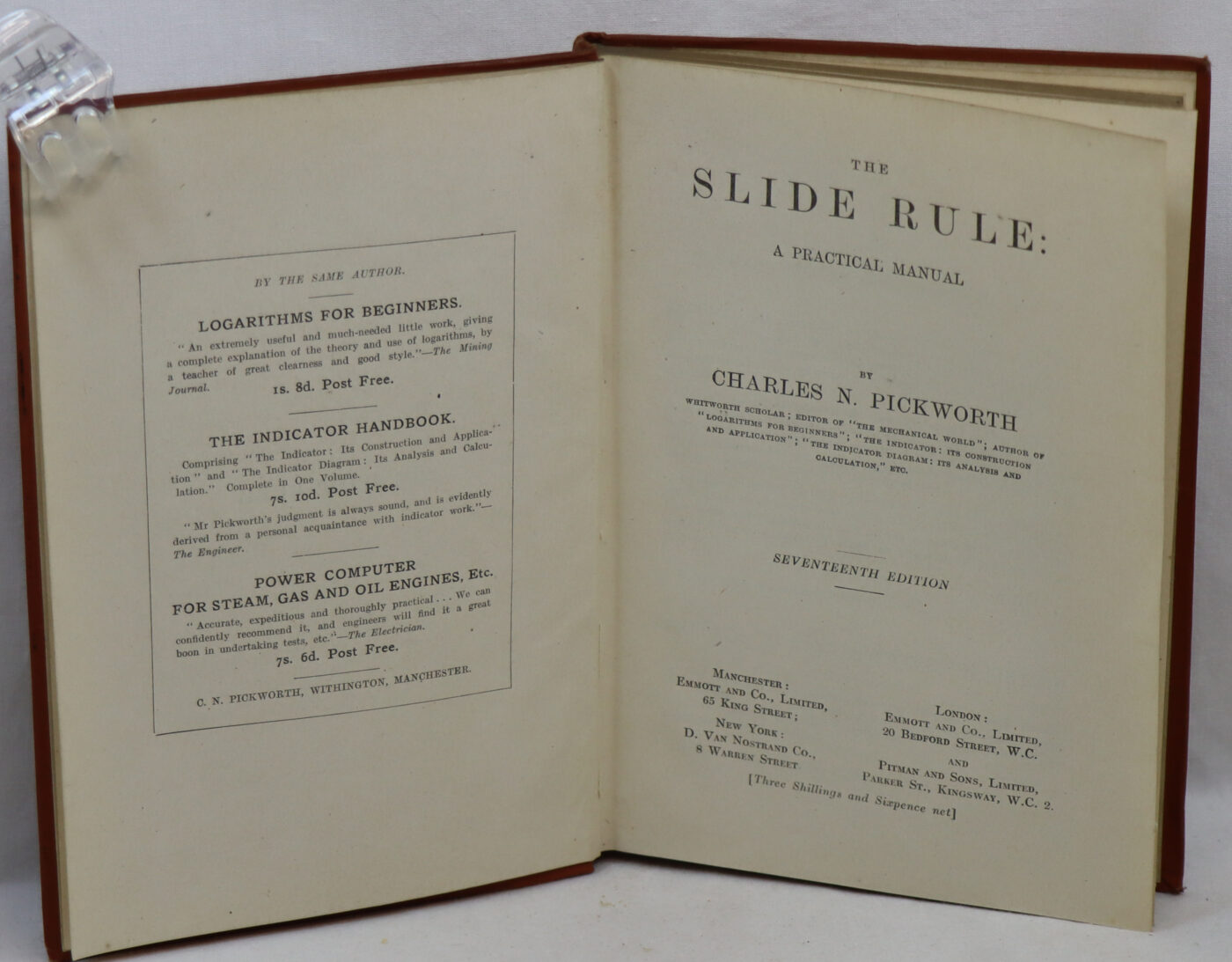
By C N Pickworth
Printed: Circa 1921
Publisher: Pitman & Sons. London
| Dimensions | 13 × 18 × 1 cm |
|---|---|
| Language |
Language: English
Size (cminches): 13 x 18 x 1
Condition: Very good (See explanation of ratings)
£44.00
Buy Now

Item information
Description
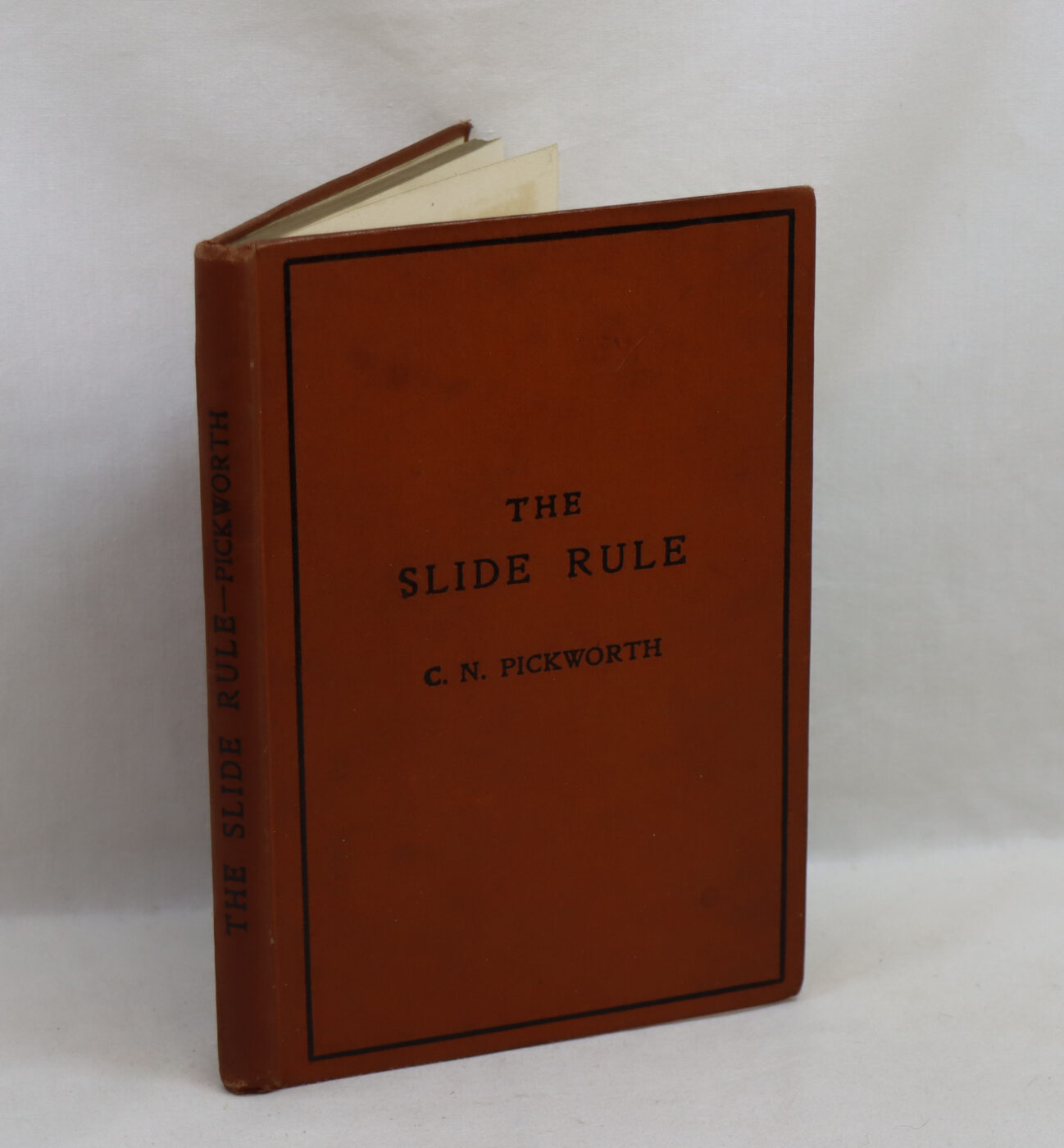
Tan cloth binding with black title on the spine and front board.
We provide an in-depth photographic presentation of this item to stimulate your feeling and touch. More traditional book descriptions are immediately available
- Note: This book carries a £5.00 discount to those that subscribe to the F.B.A. mailing list
For conditions, please view our photographs. A very rare original book from the library gathered by the famous Cambridge Don, computer scientist, food and wine connoisseur, Jack Arnold LANG.
This book was the property of Jack’s father who later became involved in the ‘heavy water research’ and the Manhattan Project.
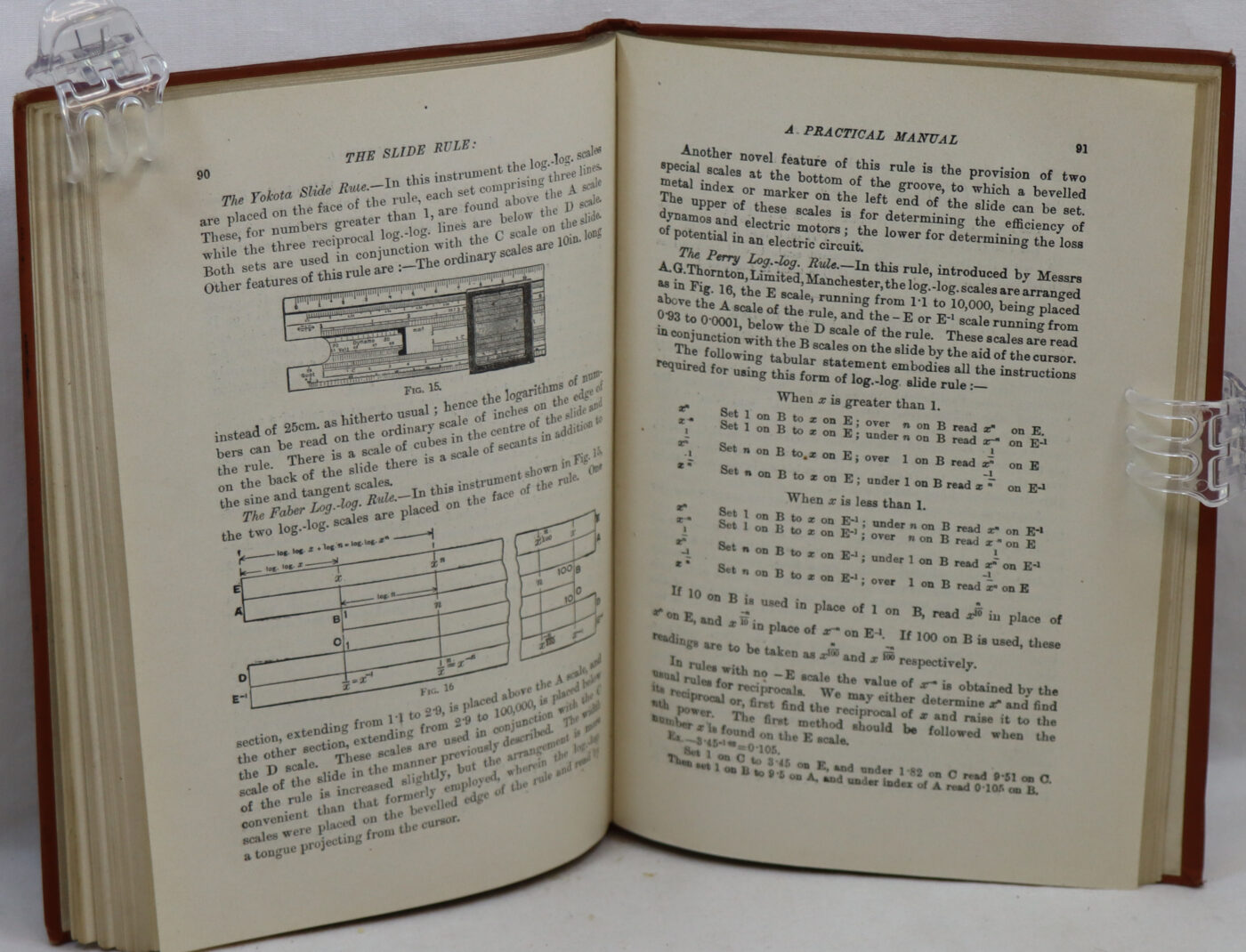
The item described is a classic technical handbook, The Slide Rule: A Practical Manual, by Charles N. Pickworth, published by Sir Isaac Pitman & Sons in London, likely an edition from around 1921, focusing on using the slide rule for calculations, with modern printings available due to its historical importance in mathematics and engineering.
Key Details:
-
Title: The Slide Rule: A Practical Manual
-
Author: Charles Newton Pickworth
-
Publisher: Sir Isaac Pitman & Sons, London (a prominent technical publisher)
-
Circa: 1921 (original editions predate this, but this specific printing is around then)
A slide rule is a hand-operated mechanical calculator consisting of slidable rulers for conducting mathematical operations such as multiplication, division, exponents, roots, logarithms, and trigonometry. It is one of the simplest analog computers.Slide rules exist in a diverse range of styles and generally appear in a linear, circular or cylindrical form. Slide rules manufactured for specialized fields such as aviation or finance typically feature additional scales that aid in specialized calculations particular to those fields. The slide rule is closely related to nomograms used for application-specific computations. Though similar in name and appearance to a standard ruler, the slide rule is not meant to be used for measuring length or drawing straight lines. Maximum accuracy for standard linear slide rules is about three decimal significant digits, while scientific notation is used to keep track of the order of magnitude of results.
English mathematician and clergyman Reverend William Oughtred and others developed the slide rule in the 17th century based on the emerging work on logarithms by John Napier. It made calculations faster and less error-prone than evaluating on paper. Before the advent of the scientific pocket calculator, it was the most commonly used calculation tool in science and engineering. The slide rule’s ease of use, ready availability, and low cost caused its use to continue to grow through the 1950s and 1960s even with the introduction of mainframe digital electronic computers. But after the handheld HP-35 scientific calculator was introduced in 1972 and became inexpensive in the mid-1970s, slide rules became largely obsolete and no longer were in use by the advent of personal desktop computers in the 1980s.
In the United States, the slide rule is colloquially called a slipstick.
Want to know more about this item?
We are happy to answer any questions you may have about this item. In addition, it is also possible to request more photographs if there is something specific you want illustrated.
Ask a question





Share this Page with a friend
