
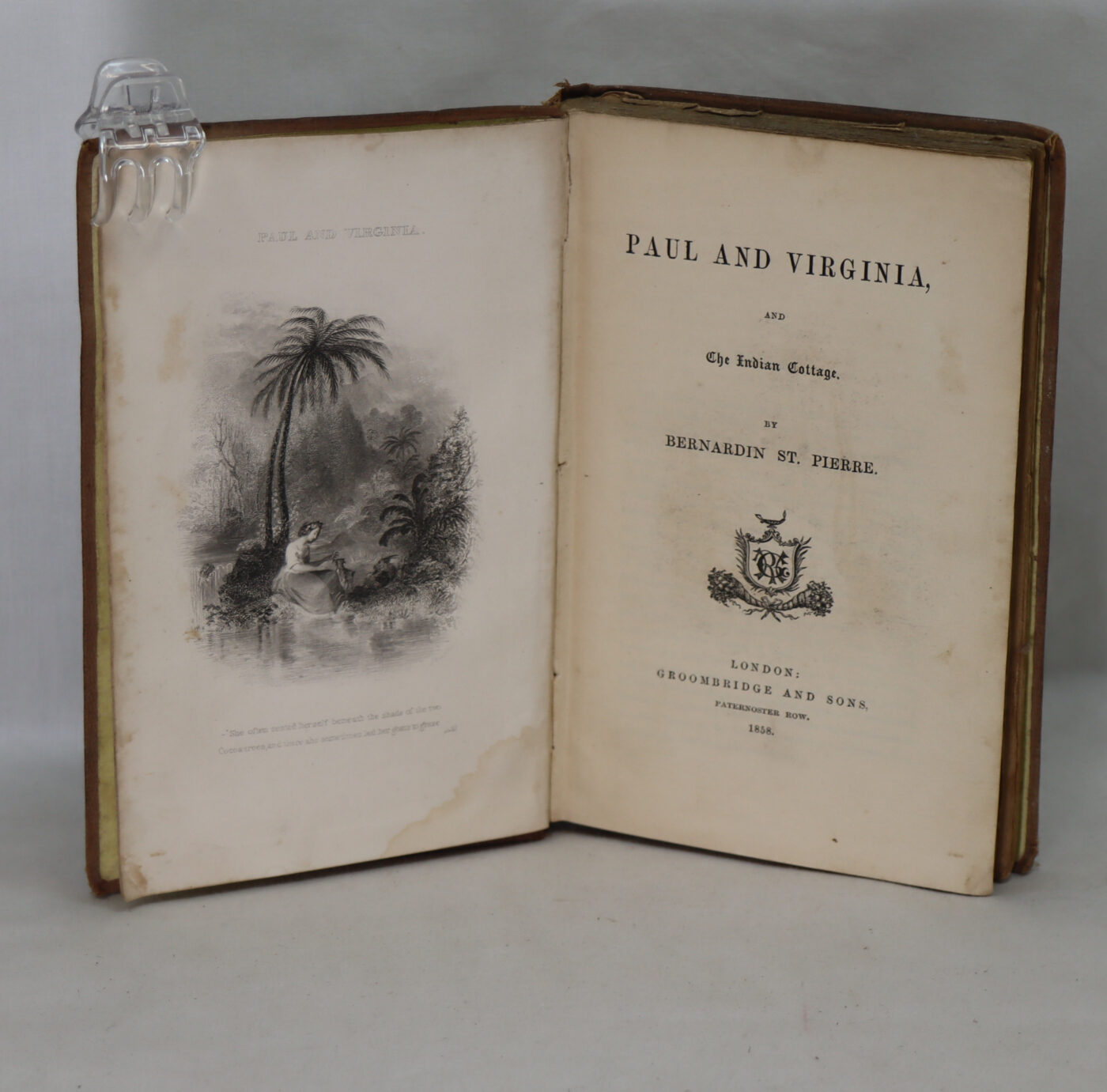
Paul and Virginia.
By Bernardin St. Pierre
Printed: 1858
Publisher: Groombridge & Sons. London
| Dimensions | 12 × 17 × 1 cm |
|---|---|
| Language |
Language: English
Size (cminches): 12 x 17 x 1
Condition: Fair (See explanation of ratings)
£42.00
Buy Now

Item information
Description
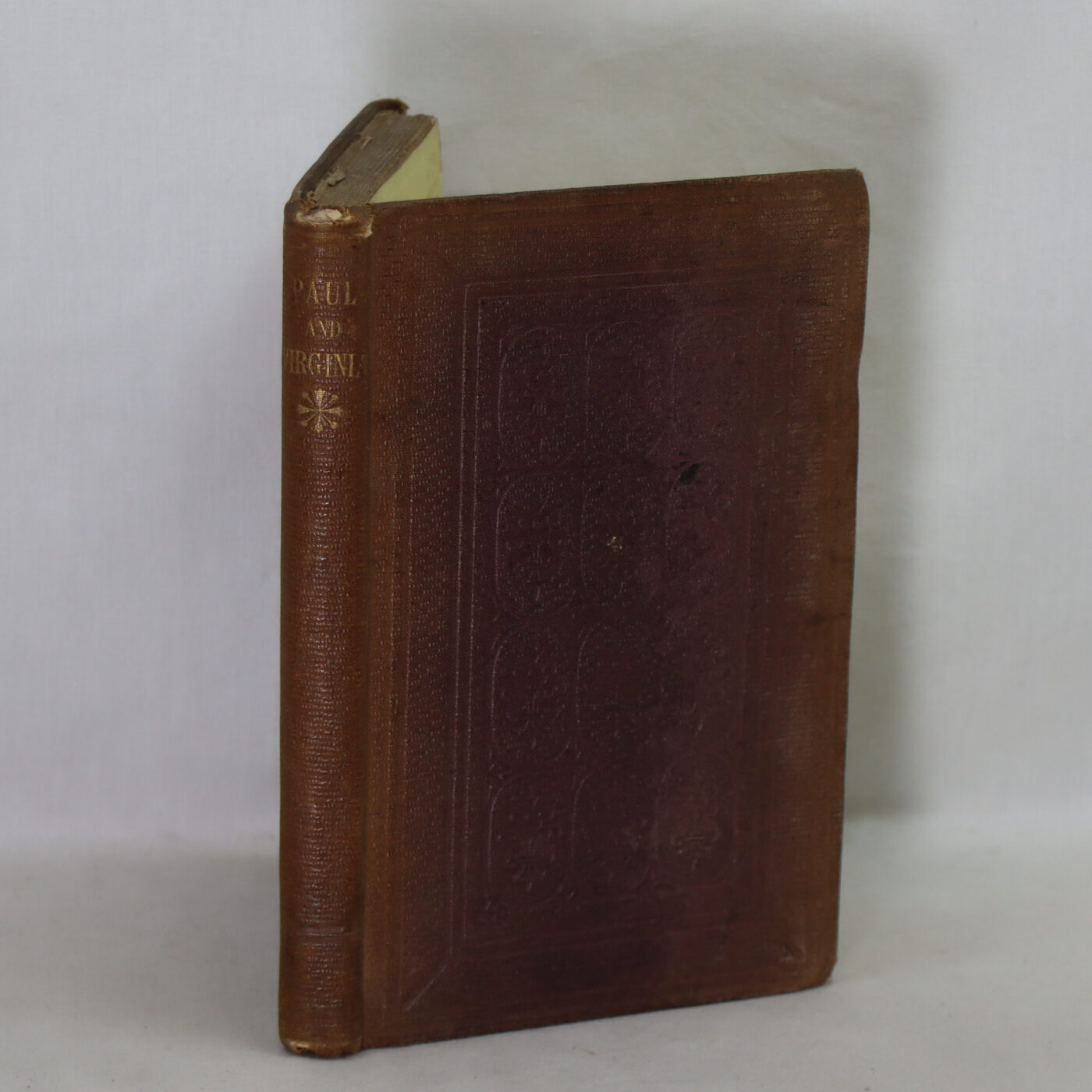
Brown cloth binding with gilt title on the spine.
We provide an in-depth photographic presentation of this item to stimulate your feeling and touch. More traditional book descriptions are immediately available
- Note: This book carries a £5.00 discount to those that subscribe to the F.B.A. mailing list
For conditions please view our photographs. This timeless classic tells the story of two young lovers, Paul and Virginia, who grow up together on a tropical island. Follow their journey as they navigate the challenges and joys of life and love, ultimately discovering the true meaning of happiness.
This English translation was to prove enormously popular, with many printings in England, but this first appearance, thought to have been printed in Paris at the English press of Williams lover, John Hurford Stone. In 1792, two years after her first visit to Paris, Helen Maria Williams returned to live there permanently. Her salon on the rue Helvétius became a meeting place not only for her Girondist circle but also for a large number of British, American and Irish radicals, writers and public figures, including Mary Wollstonecraft, Thomas Paine, Joel Barlow and Charles James Fox. It was at this time that she became involved with John Hurford Stone (1763-1818), a radical English coal dealer who was working as a printer in Paris. Their involvement caused a huge scandal in England, as Stone was married. He divorced his wife in 1794 and it may be that he was married to Williams in the same year. On October 11th, 1793, during tea with Bernardin de Saint-Pierre, Williams had learnt that all British citizens in France were to be arrested, following the French defeat at Toulon. The next day she and her family were taken to the Luxembourg prison where they stayed until 26th October, when they were moved to the English Conceptionist Convent, otherwise known as the Couvent des Anglaises. It was here that Williams began this translation. She was released in April of the following year on the condition that she left Paris: she and Stone went together to Switzerland until they were able to return to Paris in 1795, when Stone printed the completed work. Of the copies listed in ESTC, only three copies, Virginia, Morgan and Penn have the plates, although the BN copy also has the plates. Of the Morgan copy, John Bidwell writes in their catalogue: ‘Given the French origins of the paper, type, plates, and binding, and the quality of the typesetting, this edition was printed in Paris, almost certainly at the English press of the expatriate radical John Hurford Stone, who was living with Helen Maria Williams at the time. The English Press in Paris and its successors. Adding another level to the interchange of nationalities in this edition, although French, the type was of English origin, being cast from Baskerville?s punches by the Dépôt des caractères de Baskerville in Paris, established by Beaumarchais in 1791 and closed c.1795?6. Beaumarchais, a great admirer of Baskerville, purchased the bulk of the Birmingham printer’s punches from his widow after his death The following translation of Paul and Virginia was written at Paris, amidst the horrors of Robespierre?s tyranny. During that gloomy epocha, it was difficult to find occupations which might cheat the days of calamity of their weary length.
Want to know more about this item?
We are happy to answer any questions you may have about this item. In addition, it is also possible to request more photographs if there is something specific you want illustrated.
Ask a question
Related products
Share this Page with a friend
