
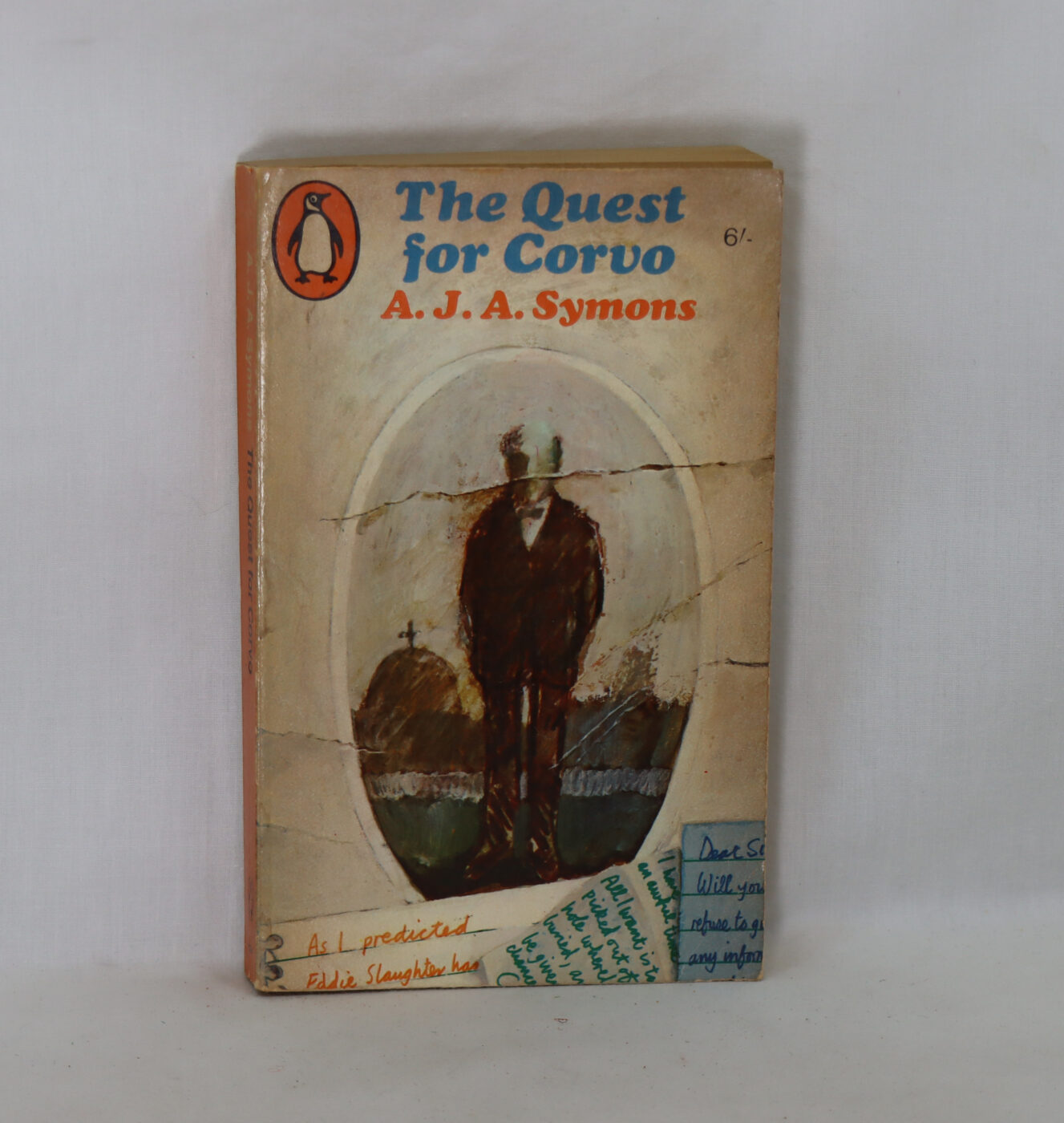
The Quest for Corvo.
By A J A Symons
Printed: 1966
Publisher: Penquin Books. London
| Dimensions | 11 × 18 × 1 cm |
|---|---|
| Language |
Language: English
Size (cminches): 11 x 18 x 1
Condition: Fair (See explanation of ratings)
£8.00
Buy Now
Item information
Description
Paperback. Orange cover with black title.
We provide an in-depth photographic presentation of this item to stimulate your feeling and touch. More traditional book descriptions are immediately available
A FROST PAPERBACK is a loved book which a member of the Frost family has checked for condition, cleanliness, completeness and readability. When the buyer collects their book, the delivery charge of £3.00 is not made
‘What had happened to the lost manuscripts, what train of chances took Rolfe to his death in Venice? The Quest continued’
One summer afternoon A.J.A. Symons is handed a peculiar, eccentric novel that he cannot forget and, captivated by this unknown masterpiece, determines to learn everything he can about its mysterious author. The object of his search is Frederick Rolfe, self-titled Baron Corvo – artist, rejected candidate for priesthood and author of serially autobiographical fictions – and its story is told in this ‘experiment in biography’: a beguiling portrait of an insoluble tangle of talents, frustrated ambitions and self-destruction.
Review: It’s astounding this masterpiece of a book was written in 1934 because even now I can think of only one other book of biographical literature that is so strikingly ground-breaking, so thrillingly compelling in its method of composition – Laurent Binet’s investigation of the assassination of Reinhard Heydrich HHhH. There are similarities between the two books – most obviously how both authors forge an intimacy with their reader by narrating not only personal feelings about their subject but also making a kind of detective story of how they sought and found the necessary source material. It’s like we’re taken inside the process of writing a biography.
There’s no question Symons lucked out with his subject. Frederick Rolfe, also calling himself Baron Corvo, is like a fantastic character from Nabokov. His comic possibilities are almost infinite. Rolfe was a failed painter, photographer, musician and priest before becoming a writer. He experienced his troubles and injustices, actual, threatened or imagined, as more relentless, taxing and dramatic than those of other people. Symons’ interest in him begins when a friend lends him one of Rolfe’s novels, Hadrian the Seventh. Symons is so bewitched by the novel that he wants to find out more about its author. Rolfe’s most passionate ambition was to become a Catholic priest. When he was thrown out of the Scots College in Rome due to “erratic behaviour” he never really recovered from his sense of injustice (toward the end of his life, he signed himself Fr. Rolfe, hoping to be mistaken for a priest) and the persecution complex that follows is without question his most compelling and defining trait. He has the persecution complex to end all persecution complexes. In his novel Hadrian the Seventh he exacts his revenge by appointing himself as Pope and slandering all his enemies, a method of revenge he will employ in all his future fiction. Basically if you get on the wrong side of Rolfe you’re going to be lampooned with brilliant flourishes of venomous wit in his next novel! Symons has an early stroke of luck when he procures a series of magazine articles in which a writer vents an incredibly detailed account of Rolfe’s misdemeanours while living in Aberdeen. Rolfe never has any money and is therefore dependent on patrons. But he is also convinced of his genius and so resentful that the world doesn’t provide him with a living. This grievance he will always take out on his benefactors. No matter how promisingly every new relationship begins you just know it’s only a matter of time before his paranoia kicks in and his vituperative tongue will begin lashing out. Of his many eccentricities one that always brings him into conflict with publishers is his refusal to use conventional spelling. There are many examples of this stubbornness in him, a couple that spring to mind being an insistence on spelling public publick and Cyprus Zyprus. No way will he stand down, even if it means scuppering the deal and returning to extreme poverty. Not that Rolfe consists only of comic flaws. He clearly has a rare insight into the medieval mind and a deep insightful feeling for Italian history – one of his books is a biography of the Borgias. He is also clearly charming when he wants to be. He ends his life in Venice, often reduced to sleeping on a boat and going without food for days on end. Symons’ final quest is to find Rolfe’s missing manuscripts, always ornately handwritten on expensive paper and in various coloured inks, as few of his books were published in his lifetime. Symons’ genuine love for Rolfe’s writing means there’s always a tender, sympathetic side to his portrait of Rolfe. Symons sees the comic charlatan in Rolfe but, thanks to his generosity of imagination he also sees genius and it’s this delicately balanced perspective that makes this such a riveting, hysterically funny and moving book. It’s also an awesome achievement how much material Symons managed to gather given that Rolfe was no more of a public figure than you or I at the time he set out on his quest. Rolfe works his consuming charm on Symons just as he bewitches all his patrons. But Symons was the only one he was unable to turn on and slander. And as a result finally a patron is free to help Rolfe get the recognition he deserves.
Alphonse James Albert Symons (pronounced SIMM-ons; (16 August 1900 – 26 August 1941) was an English writer and bibliographer.
Want to know more about this item?
We are happy to answer any questions you may have about this item. In addition, it is also possible to request more photographs if there is something specific you want illustrated.
Ask a question
Related products
Share this Page with a friend
