
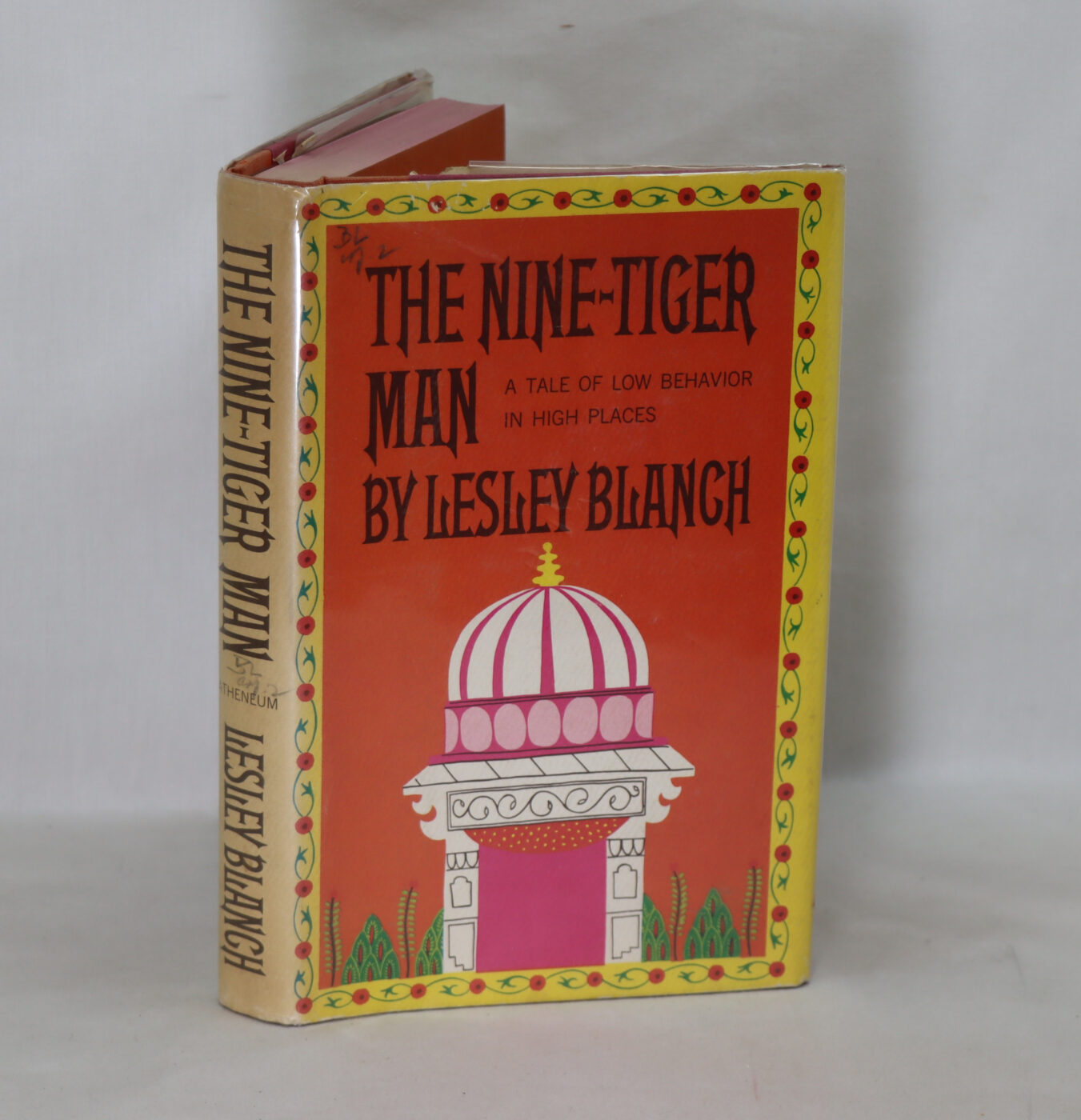
The Nine Tiger Man.
By Lesley Blanch
Printed: 1965
Publisher: Atheneum. New York
Edition: First edition
| Dimensions | 14 × 21 × 2 cm |
|---|---|
| Language |
Language: English
Size (cminches): 14 x 21 x 2
Condition: Good (See explanation of ratings)
£18.00
Buy Now

Item information
Description
In the original dust jacket. Red cloth binding with gilt title on the spine.
We provide an in-depth photographic presentation of this item to stimulate your feeling and touch. More traditional book descriptions are immediately available
- Note: This book carries a £5.00 discount to those that subscribe to the F.B.A. mailing list
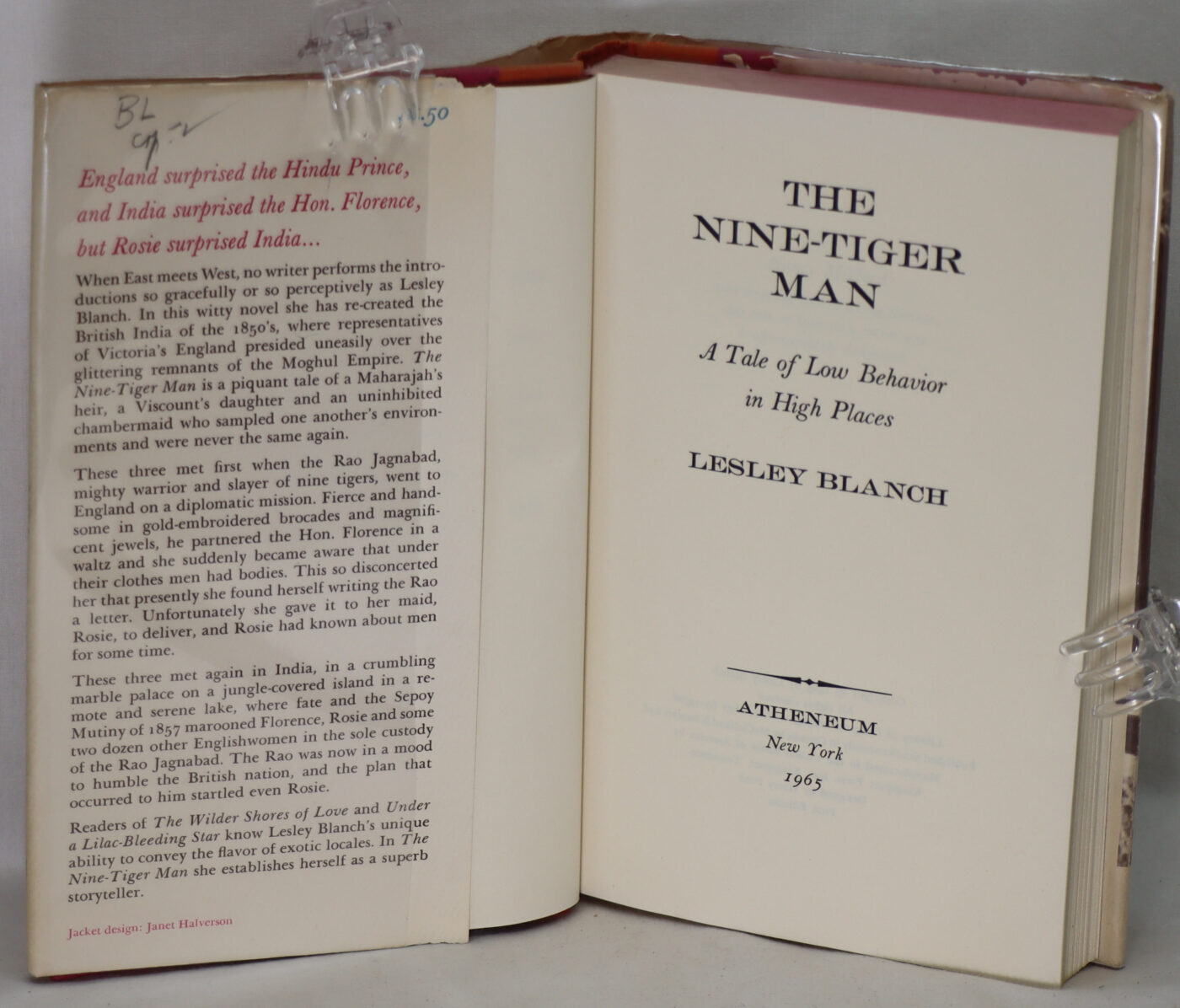
For conditions, please view the photographs. Erotica. The Nine Tiger Man is a satirical romance involving a Maharajah’s heir, a Viscount’s daughter and an uninhibited chambermaid who sample one another’s environments and are never the same again
When East meets West: in this satirical romance, Lesley Blanch recreates the British India of the 1850’s where representatives of Victoria’s England preside uneasily over the glittering remnants of the Moghul Empire. She pillories well-bred, seemingly charming individuals who behave exceedingly badly, and exposes their vices, in the piercing vein of Nancy Mitford and Evelyn Waugh. The governing class is shown to be decadent and depraved.
The ‘Rao’ divided women into two categories: those with bodies and those with jewels . . . Prim and proper Lady Florence and her down-to-earth maid, Rosie, first encounter a Maharajah’s heir, the Rao Jagnabad, warrior and slayer of nine tigers, when he visits England on a diplomatic mission. Fierce and handsome in gold-embroidered brocades and magnificent jewels, his powerful masculinity is overwhelming and unforgettable. Fate decrees that, some years later, the two women are marooned in a crumbling palace on a remote, jungly island during the Indian Mutiny. They find themselves in the sole custody of the ‘Rao’ along with two dozen other Englishwomen. A razor-sharp satire on class and Empire, Lesley Blanch’s only novel is outrageous and written with high-spirited panache.
Press Comments:
- JOHN BARKHAM, NEW YORK WORLD — “A delicious tale of low behaviour in high places; with particular attention to the activities of an irresistible and gifted East Indian Prince who takes his own form of revenge against the entire English Empire by inducting a bevy of highborn English females into the fine points of Oriental eroticism, proving that Debrett’s Peerage is no match at all for the Karma Sutra.”
- TIME — “Wildly funny.”
- REBECCA WEST — “This book is exquisite, and a new story.”
- OBSERVER — “A mocking confrontation of the attitudes of Clarissa and Fanny Hill set against an exotically sensuous Indian background.”
- DAILY MAIL — “Cynical, sensual, amusing.”
Review: Rattigan called it a black comedy, which in a way it is. Certainly a very dry and ironic humour laces through a tale of race- and class-prejudices. I read it because I thought it was about the Mutiny, and that is the setting but it only serves as a backdrop to a more individual, personal and ambiguous revenge. What I particularly liked were the descriptions (the sense of place is cinematically vivid) and the way that the author doesn’t feel the need to filter different cultures and attitudes to be palatable or even comprehensible to each other. Everybody here is othered, whether British or Indian, especially if they aren’t working class. Talking of which, the extreme helplessness of the British women did make me wonder — could none of them but their “Admirable Crichton” rise to the challenge of the situation? Maybe that’s true, but there must have been an awful lot of fearsome ex-Roedean gals even in 1857.
Lesley Blanch was a cult literary figure who influenced and inspired generations of writers, readers and critics. Her lifelong passion was for Russia, the Balkans and the Middle East. At heart a nomad, she spent the greater part of her life travelling about those remote areas her books record so vividly.
Born in London in 1904, Blanch’s first career was as a book illustrator and caricaturist, and scenic and costume designer for the theatre, before turning to writing. While her reputation now rests primarily on three works of non-fiction − ‘The Wilder Shores of Love’, ‘Journey into the Mind’s Eye’ and ‘The Sabres of Paradise’ − her early journalism brings to life the artistic melting pot that was London between the wars, and her books, something of the Middle East as it once was, before conflict and turmoil became the essence of relations between the Arab World and the West.
She left England in 1946, never to return, except as a visitor. Her marriage to Romain Gary, the French novelist and diplomat, afforded her many years of happy wanderings. After their divorce, in 1963, Blanch was seldom at her Paris home longer than to repack.
Blanch was well ahead of her time and prescient in the way she attempted to bridge West and East – especially the West and Islam – a topic that is highly relevant today. She was modern and free, with tremendous wit and style; and a traveller who took risks and relished writing about her adventures. Her life reads like a novel and sets her apart as being a true original. She died in Menton in the South of France, aged 103.
Condition notes
slight wear on binding
Want to know more about this item?
We are happy to answer any questions you may have about this item. In addition, it is also possible to request more photographs if there is something specific you want illustrated.
Ask a question
Related products
Share this Page with a friend
