
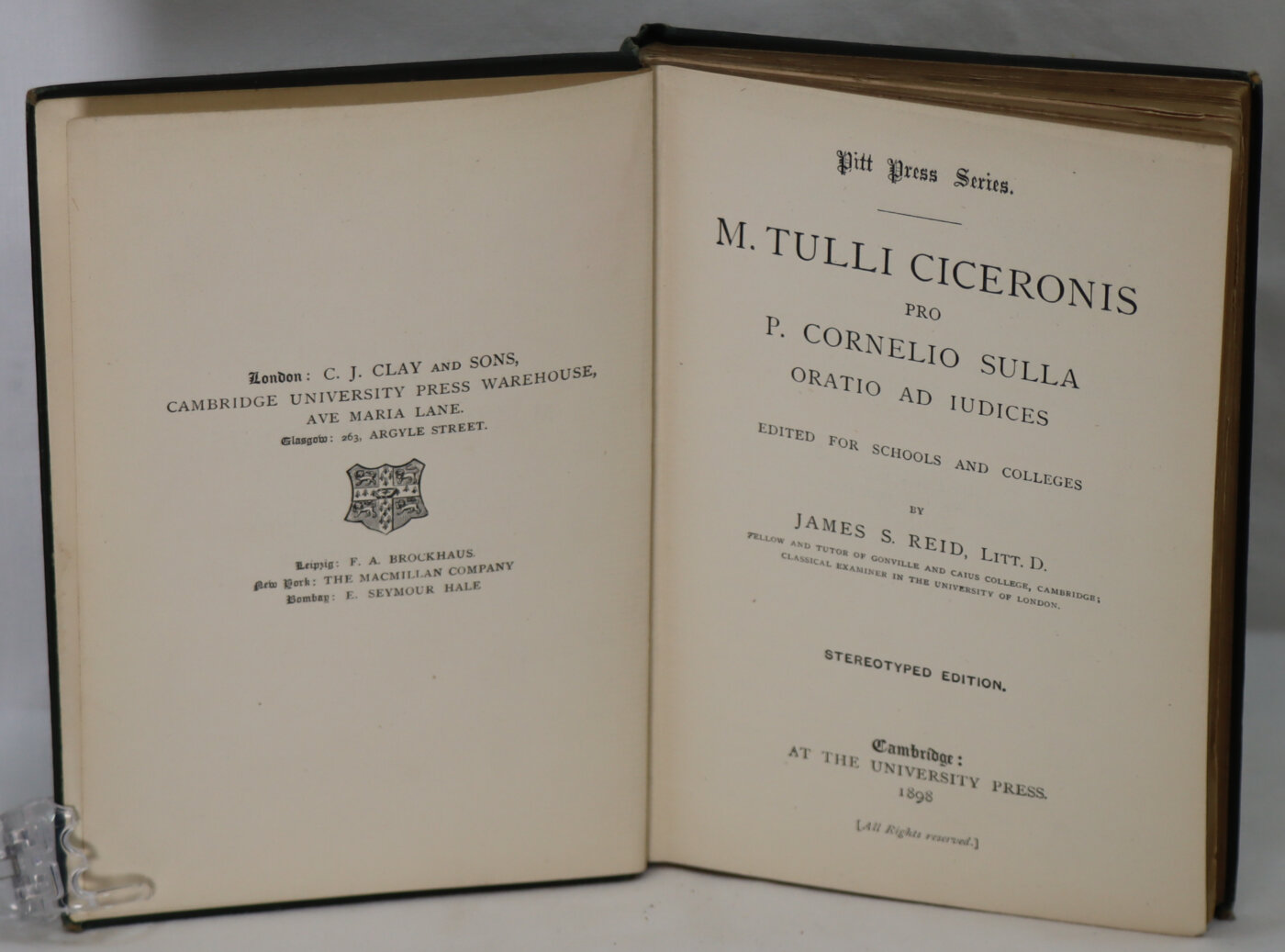
M. Tulli Ciceronis pro P Cornelio Sulla.
By James H Reid
Printed: 1898
Publisher: Cambridge University Press.
| Dimensions | 12 × 17 × 1.5 cm |
|---|---|
| Language |
Language: English
Size (cminches): 12 x 17 x 1.5
Condition: Good (See explanation of ratings)
£47.00
Buy Now

Item information
Description
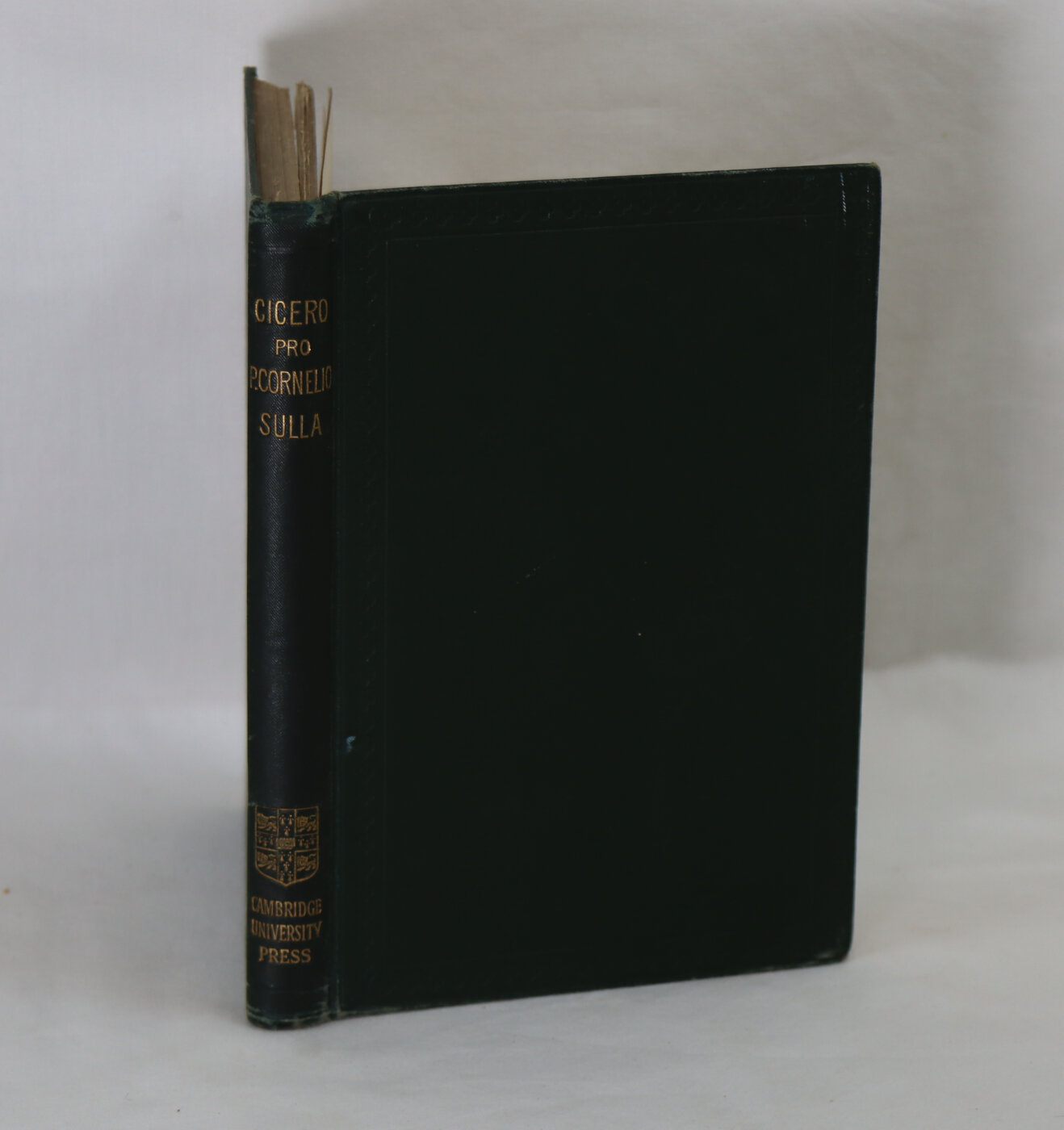
Green cloth binding with gilt title on the spine.
- We provide an in-depth photographic presentation of this item to stimulate your feeling and touch. More traditional book descriptions are immediately available
Note: This book carries a £5.00 discount to those that subscribe to the F.B.A. mailing list
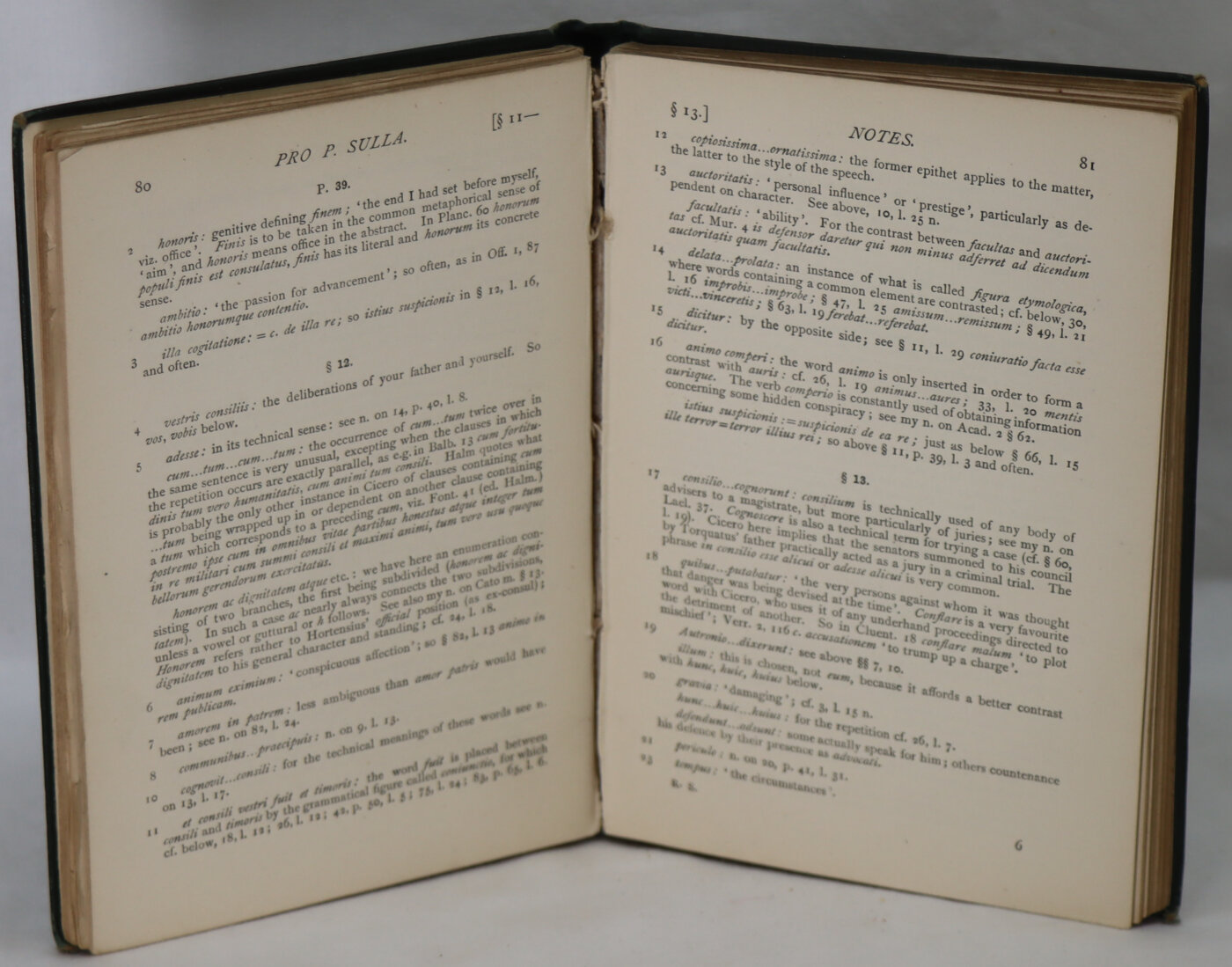
Condition: Used – Good. Cloth. 8vo. x & 371 pp. Introductory text in English, main text in Latin. Noticeable shelf wear and scuffing to boards. Altogether a very sound working copy.
Marcus Tullius Cicero; 3 January 106 BC – 7 December 43 BC) was a Roman statesman, lawyer, scholar, philosopher, writer and Academic skeptic, who tried to uphold optimate principles during the political crises that led to the establishment of the Roman Empire. His extensive writings include treatises on rhetoric, philosophy and politics. He is considered one of Rome’s greatest orators and prose stylists and the innovator of what became known as “Ciceronian rhetoric”.Cicero was educated in Rome and in Greece. He came from a wealthy municipal family of the Roman equestrian order, and served as consul in 63 BC.
He greatly influenced both ancient and modern reception of the Latin language. A substantial percentage of his work has survived, and he was admired by both ancient and modern authors alike. Cicero adapted the arguments of the chief schools of Hellenistic philosophy in Latin and coined a large portion of Latin philosophical vocabulary via lexical innovation (e.g. neologisms such as evidentia, generator, humanitas, infinitio, qualitas, quantitas), almost 150 of which were the result of translating Greek philosophical terms.
Though he was an accomplished orator and successful lawyer, Cicero believed his political career was his most important achievement. It was during his consulship that the Catiline conspiracy attempted to overthrow the government through an attack on the city by outside forces, and Cicero (by his own account) suppressed the revolt by summarily and controversially executing five conspirators without trial, an act which would later lead to his exile. During the chaotic middle period of the first century BC, marked by civil wars and the dictatorship of Julius Caesar, Cicero was a supporter of the Optimates faction. Following Caesar’s death, Cicero became an enemy of Mark Antony in the ensuing power struggle, attacking him in a series of speeches. He was proscribed as an enemy of the state by the Second Triumvirate and consequently executed by soldiers operating on their behalf in 43 BC, having been intercepted during an attempted flight from the Italian peninsula. His severed hands and head (taken by order of Antony and displayed representing the repercussions of his anti-Antonian actions as a writer and as an orator, respectively) were then displayed on the Rostra.
Petrarch’s rediscovery of Cicero’s letters is often credited for initiating the 14th-century Renaissance in public affairs, humanism, and classical Roman culture. According to Polish historian Tadeusz Zieliński, “the Renaissance was above all things a revival of Cicero, and only after him and through him the rest of Classical antiquity.” The peak of Cicero’s authority and prestige came during the 18th-century Enlightenment,and his impact on leading Enlightenment thinkers and political theorists such as John Locke, David Hume, Montesquieu, and Edmund Burke was substantial. His works rank among the most influential in global culture, and today still constitute one of the most important bodies of primary material for the writing and revision of Roman history, especially the last days of the Roman Republic.
Publius Cornelius Sulla (died c. 45 BC) was a politician of the late Roman Republic and the nephew of Lucius Cornelius Sulla. He was also a brother-in-law of Pompey, having married his sister Pompeia. Publius Cornelius Sulla was the son of an otherwise unknown brother of Lucius Cornelius Sulla. Despite being Sulla’s nephew, Publius does not seem to have played a prominent role in either the civil war or the dictatorship of his famous uncle. However, he may have served as a junior officer during this time, alongside his contemporary Lucius Sergius Catilina, who is known to have served with distinction in the Sullan Civil Wars. Publius was later to be closely associated with Catiline, and it is possible that it was as fellow officers under his uncle that this association began.
In 81 BC, during the dictatorship of his uncle, Cicero records that Publius used what influence he had through his close familial connection to request mercy for several of the proscribed, and was successful in having them spared. Following the death of Lucius Cornelius Sulla in 78 BC, Publius likely inherited a portion of his estate.
In 80 BC Publius set up the city of Pompeii as a Roman colony under the name of ‘Colonia Cornelia Veneria Pompeianorum’. The name means Pompeii, a colony of the Cornelii dedicated to Venus. The people of Pompeii seem to have liked him as they came in support of him in his trial in 62 BC.
Having presumably worked his way up the cursus honorum, achieving the pre-requisite offices of quaestor and praetor at an earlier date, in 66 BC Sulla stood for election to the consulship (to assume office in 65 BC). Sulla was elected consul by the unanimous vote of all the centuries, with Publius Autronius as his colleague. However, the two were not to enjoy their success for long as, soon after the result had been declared, Lucius Manlius Torquatus and Lucius Aurelius Cotta, who had both stood against Sulla in the election and lost, accused those who had defeated them of bribery. Impeached on this charge, Sulla and Autronius were tried, convicted and, under the Lex Acilia Calpurnia, deprived of their office and expelled from the Senate.
A second round of elections were held in which Torquatus and Cotta were successful, replacing those they had removed as the consuls-designate for 65 BC. It was now that the so-called First Catilinarian Conspiracy was allegedly hatched.
It is alleged by the Roman historian Sallust that Catiline, a friend of both Sulla and Autronius, attempted to stand in the second round of elections against Torquatus and Cotta but was prevented in doing so because he had only recently emerged from a trial for extortion and, although he had been acquitted, was not permitted to stand for any office until three weeks had elapsed. This was the second time Catiline had been denied his chance at the consulship, and, incensed, he formed a conspiracy along with the deposed Sulla and Autronius, as well as Gnaeus Piso, against Cotta and Torquatus. The plan was apparently no less than to murder the two new Consuls-Elect on the very day they were to assume office, 1 January 65 BC, and to seize the government and Consulship for themselves. The preparations of the conspirators were however detected and they first postponed their planned coup to February, before abandoning it altogether; the conspiracy therefore coming to naught.
There is much doubt as to whether the First Catilinarian Conspiracy ever took place at all, and that it was instead later invented to blacken Catiline further following the Second Catilinarian Conspiracy. An alternative view is that Catiline himself was not involved, but Sulla and Autronius on their own plotted the assassination of their rivals. In any case, no attempt was made on the lives of Cotta or Torquatus and the two assumed the consulship without incident.
Following the disgrace of his conviction and expulsion from the Senate, Sulla’s political career and reputation was completely destroyed and he could play no further part in public life. Humiliated and impoverished, Sulla reputedly joined the disreputable circle of desperate and dissolute nobles gathering around Catiline to form the Second Catilinarian Conspiracy. Catiline and his followers believed they had been robbed of the power that was rightfully theirs, and were committed to take it by any means necessary.
Sulla, his cousins Publius and Servius, as well as his former colleague Autronius, were implicated in the conspiracy. Following the failure of the Conspiracy in late 63 and Catiline’s death in January 62, Sulla was put on trial for his alleged complicity by Lucius Manlius Torquatus, the son of the man who had impeached him in 66. Sulla managed to secure both Marcus Tullius Cicero and Quintus Hortensius, the two greatest orators of the age, for his defence, and was acquitted of all charges. This was the occasion for Cicero delivering his Pro Sulla speech. Neither Sulla’s cousins nor Autronius were so fortunate, as Cicero believed them to be guilty and refused their similar requests for defence.
In 49 BC, when Julius Caesar crossed the Rubicon and ignited the Civil War, Sulla chose to support him against the Senate. Given command in the Caesarian army, Sulla accompanied Caesar on his campaign in Greece against Pompey. At Dyrrachium, Sulla was left in charge of Caesar’s camp and successfully repulsed a Pompeian attack which broke through the fortifications while the bulk of the army was elsewhere fighting with Caesar. Upon driving the Pompeians back, Sulla determined not to pursue and instead withdrew back to the camp. Caesar remarks in his commentaries that if Sulla had instead pursued the fleeing enemy and followed up on his victory, the entire Civil War might have ended on that day. However, he does not blame Sulla’s cautious conduct or his decision to stay in the camp, which was his responsibility to protect.
Sulla commanded the right wing of Caesar’s army at the Battle of Pharsalus. In the battle, the Cesarians were victorious and the defeated Pompey fled to Egypt, where he was murdered.
Publius Cornelius Sulla died in 45 BC.
Condition notes
Spine frail
Want to know more about this item?
We are happy to answer any questions you may have about this item. In addition, it is also possible to request more photographs if there is something specific you want illustrated.
Ask a question
Related products

Share this Page with a friend
