
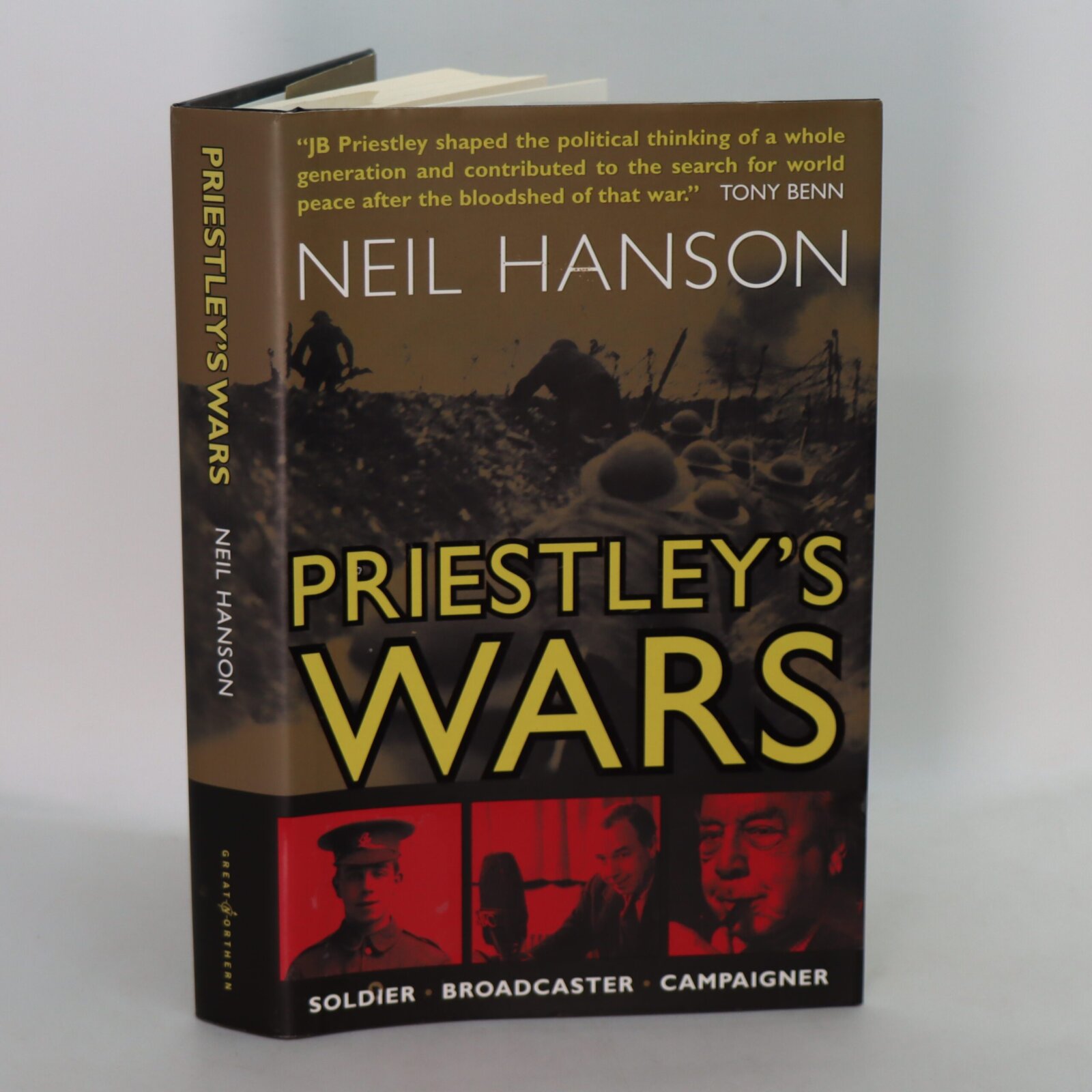
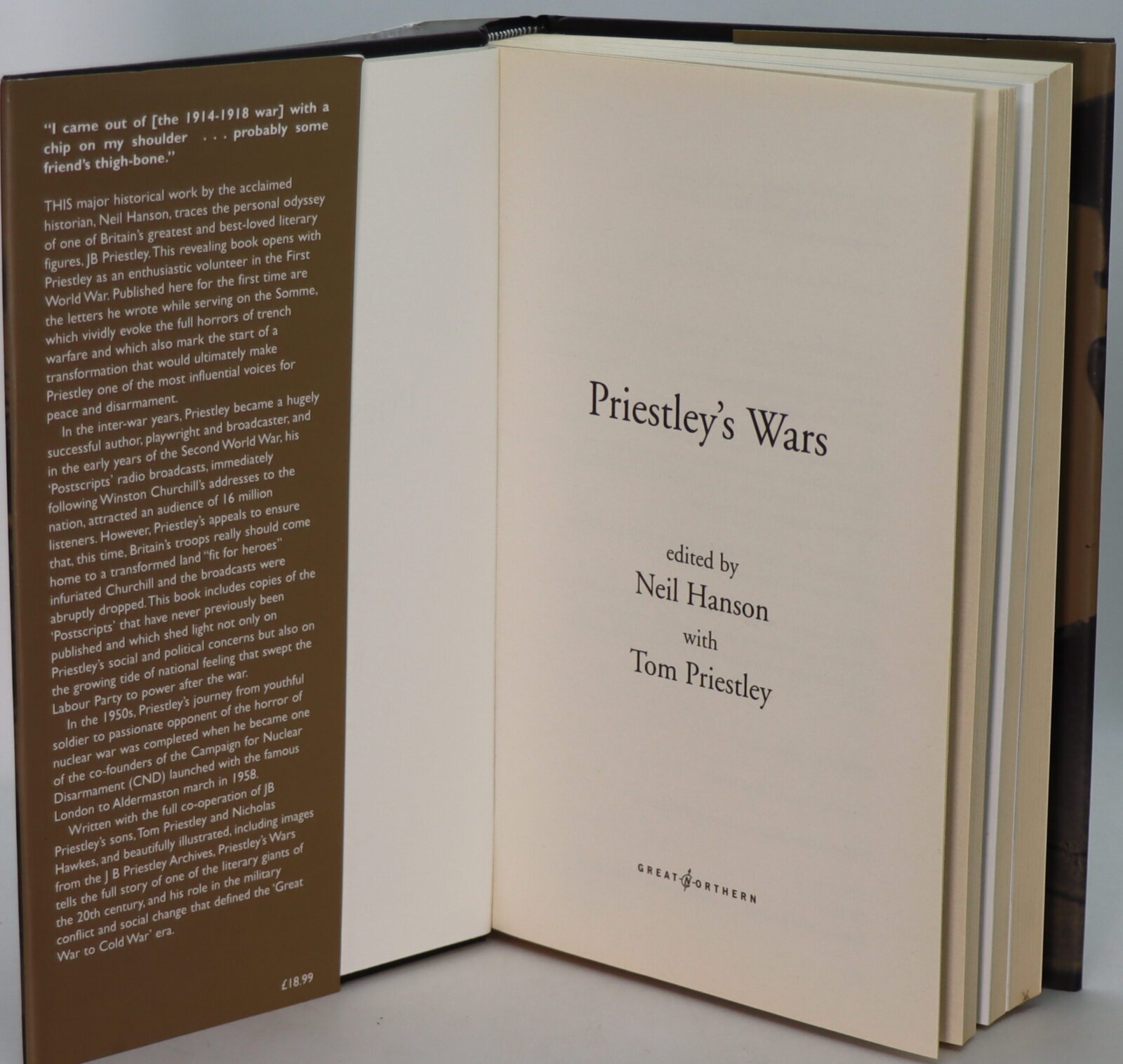
Preistley's Wars.
By Neil Hanson
ISBN: 9781905080366
Printed: 2008
Publisher: Great Northern Books.
| Dimensions | 17 × 24 × 4 cm |
|---|---|
| Language |
Language: English
Size (cminches): 17 x 24 x 4
Condition: Fine (See explanation of ratings)
£8.00
Buy Now

Item information
Description
In the original dustsheet. Black cloth binding with silver title on the spine.
F.B.A. provides an in-depth photographic presentation of this item to stimulate your feeling and touch. More traditional book descriptions are immediately available.
A book that deserves to be read.
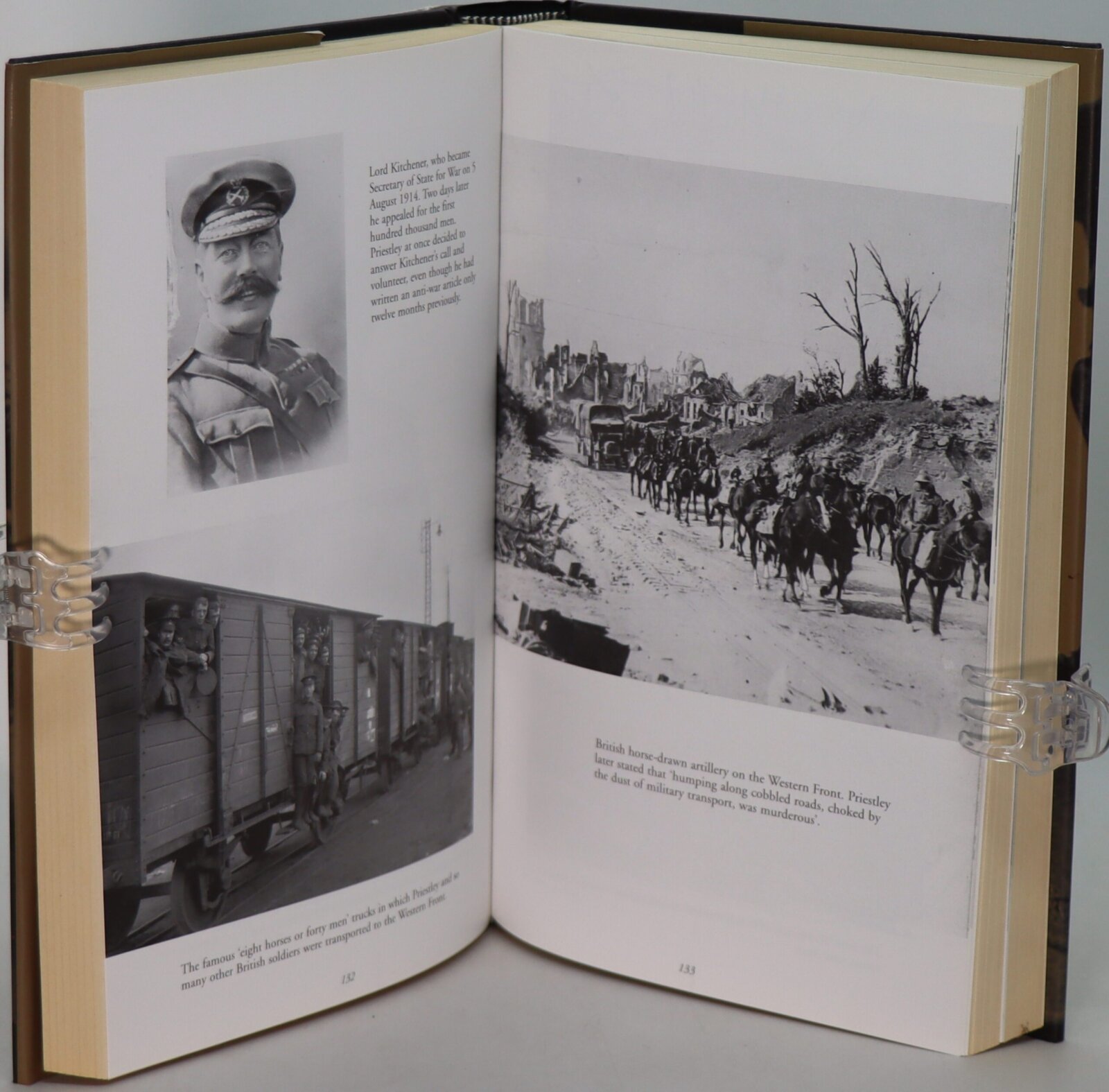
Soldier, writer, broadcaster, and peace campaigner. This book tells the untold story of J B Priestley’s role at the centre of British 20th century history. It is timed with the 90th anniversary of the end of WW1 and the 50th anniversary of the formation of CND. It provides a unique insight into the two world wars and the foundation of the CND movement through the eyes of one of the century’s greatest writers. It contains previously un-published letters from the WW1 battlefields, and the ‘Postscripts’ broadcasts that Churchill tried to ban. “I came out of [the 1914-1918 war] with a chip on my shoulder…probably some friend’s thighbone. “This major historical work by the acclaimed historian, Neil Hanson, traces the personal odyssey of one of Britain’s greatest and best-loved literary figures, JB Priestley. This revealing book opens with Priestley as an enthusiastic volunteer in the First World War. Published here for the first time are the letters he wrote while serving on the Somme, which vividly evoke the full horrors of trench warfare, and which also mark the start of a transformation that would ultimately make Priestley one of the most influential voices for peace and disarmament. In the inter-war years, Priestley became a hugely successful author, playwright and broadcaster, and in the early years of the Second World War, his ‘Postscripts’ radio broadcasts, immediately following Winston Churchill’s addresses to the nation, attracted an audience of 16 million listeners. However, Priestley’s appeals to ensure that, this time, Britain’s troops really should come home to a transformed land “fit for heroes” infuriated Churchill and the broadcasts were abruptly dropped. This book includes copies of the ‘Postscripts’ that have never previously been published and which shed light not only on Priestley social and political concerns but also on the growing tide of national feeling that swept the Labour Party to power after the war. In the 1950s, Priestley’s journey from youthful soldier to passionate opponent of the horror of nuclear war was completed when he became one of the cofounders of the Campaign for Nuclear Disarmament (CND) launched with the famous London to Aldermaston march in 1958.Written with the full co-operation of JB Priestley’s sons, Tom Priestley and Nicholas Hawkes, and beautifully illustrated, including images from the J B Priestley Archives, “Priestley’s Wars” tells the full story of one of the literary giants of the 20th century, and his role in the military conflict and social change that defined the ‘Great War to Cold War’ era.
Review: Priestley is best-known as a playwright, so you may wonder what he knows about war. This book sets out his experience of war, serving the trenches of World War One, his wartime service in broadcasting between 1939 and 1945 and his attitude to war as set out in his journalism both between the wars and after 1945. The first section on his experiences between 1914 and 1918 are especially evocative, and are based on letters and other written memoirs. It’s six months since I read this book, but I can still remember his descriptions of the training camps, the trenches but (most surprisingly), his surreal account of being posted to a French village behind the lines. The section I really bought the book for was the `Postscripts’, broadcast by the BBC between 1940 and 1941 at the end of the news once a week. These were a kind of “Thought of the Week”, a reminder from a respected and eloquent figure on why the war was being fought. These are reproduced in full, the only place I have been able to find them. Having read Simon Garfield’s excellent edited books of Mass Observation diaries (“We Are At War” and “Private Battles”) it is notable that these were important to many people and made quite an impact. Unfortunately, as the book sets out, the biggest impact was with Churchill who did not like them at all. The point of disagreement was that Priestley wanted to set out Britain’s “war aims”, what type of society we wanted to see at the end of the war, something better than the 1930s (see Priestley’s book “An English Journey” for an account of his travels around the country and the conditions he encountered). Churchill preferred a more emotional appeal to the defence of our home, our nation, without getting involved in specifying war aims and pressure was placed on the BBC to find someone else to deliver the Postscripts from 1941. The rest of the book is about Priestley’s peacetime newspaper and magazine articles and his letters regarding war. Perhaps the most interesting aspect of this was seeing how an educated and proud Englishman could advocate peace at the start of the 1930s but accept war by the end of the decade.
The book is a pretty comprehensive account of Priestley’s writing on war. If you’re a Priestley scholar this will be a goldmine. If you’re a general reader, you’ll probably want to dip into parts of this – at 384 pages long it would be a long slog to get from cover-to-cover. My recommendation would be the early chapters on the 1914-1918 war and the Postscripts; skim the rest.
Neil Hanson is the author of an acclaimed series of narrative histories: The Custom of the Sea; The Dreadful Judgement; The Confident Hope of a Miracle; The Unknown Soldier: The Story of the Missing of the Great War; and, most recently, First Blitz: The Secret German Plan to Firebomb London and Paris in 1918. They have been hailed by critics on four continents as “brilliant”, “stunning”, “haunting”, “exceptional”, “magnificent”, “superlative”, “unforgettable”, “a triumph” and “a masterpiece”, and led one critic and professor of history to compare him to “Siegfried Sassoon, Robert Graves and a dozen other immortals”. He was appointed to a Fellowship of the Royal Literary Fund in 2007. Tom Priestley is the son of J.B. Priestley. He forged a highly successful career as a film editor having worked on such well-known movies as Deliverance, The Great Gatsby, Tess and 1984. He is president of the JB Priestley Society. Nicholas Hawkes is the son of Jacquetta Hawkes, J.B. Priestley’s third wife. He has carried out first-hand research of his mother’s and stepfather’s correspondence and other archives relating to Priestley’s ‘postscripts’ broadcasts. John Boynton Priestley (1894-1984) was pre-eminently a dramatist and a novelist. Many of his works have become 20th century literary classics, among them ‘The Good Companions’, ‘Angel Pavement’, ‘Bright Day’, ‘An Inspector Calls’ and ‘Time and the Conways’. He was the most versatile writer of his time, producing essays, short stories, verse, literary criticism, social histories, travel books and film scripts, as well as an opera libretto and an autobiography. During the 1939 – 1945 world war, his short radio talks, the famous ‘Postscripts’ established Priestley as a wartime broadcaster second only to Winston Churchill in importance and influence. These broadcasts were listened to by millions of people. Priestley also played many roles as a political activist and commentator. He was a founder of the Campaign for Nuclear Disarmament and a champion of public lending rights. In literary, social, and political terms he was very much ‘a man for all seasons’.
John Boynton Priestley OM; 13 September 1894 – 14 August 1984) was an English novelist, playwright, screenwriter, broadcaster and social commentator.
His Yorkshire background is reflected in much of his fiction, notably in The Good Companions (1929), which first brought him to wide public notice. Many of his plays are structured around a time slip, and he went on to develop a new theory of time, with different dimensions that link past, present and future.
In 1940 he broadcast a series of short propaganda radio talks, which were credited with strengthening civilian morale during the Battle of Britain. In the following years his left-wing beliefs brought him into conflict with the government and influenced the development of the welfare state.
Want to know more about this item?
We are happy to answer any questions you may have about this item. In addition, it is also possible to request more photographs if there is something specific you want illustrated.
Ask a question
Share this Page with a friend
