
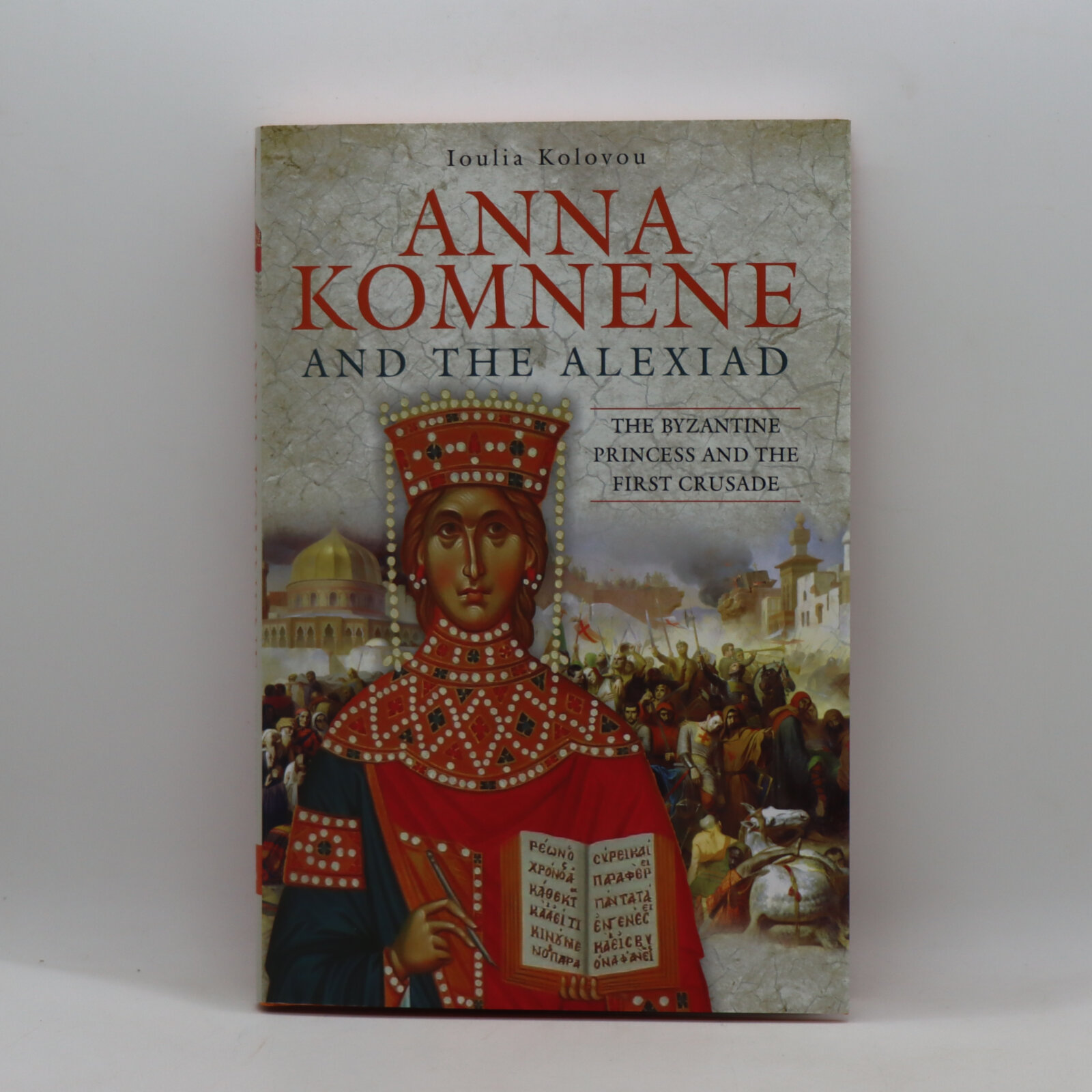
Anna Komnene and the Alexiad.
By Ioulian Kolovou
Printed: 2020
Publisher: Pen & Sword History. Barnsley
Edition: First edition
| Dimensions | 17 × 25 × 2.5 cm |
|---|---|
| Language |
Language: English
Size (cminches): 17 x 25 x 2.5
Condition: As new (See explanation of ratings)
£18.00
Buy Now


Item information
Description
In the original dustsheet. Orange cloth binding with black title on the spine.
F.B.A. provides an in-depth photographic presentation of this item to stimulate your feeling and touch. More traditional book descriptions are immediately available.
Anna Komnene is one of the most curious figures in the history of an intriguing empire. A woman of extraordinary education and intellect, she was the only Byzantine female historian and one of the first and foremost historians in medieval Europe. Yet few people know of her and her extraordinary story. Subsequent historians and scholars have skewed the picture of Anna as an intellectual princess and powerful author. She has been largely viewed as an angry, bitter old woman, who greedily wanted a throne that did not belong to her. Accusations of conspiracy and attempted murder were hurled at her and as punishment for her transgressions’ she was to live the last days of her life in exile. It was during her time in a convent, where she was not a nun, that she composed the Alexiad, the history of the First Crusade and the Byzantine Emperor, Alexios I Komnenos (1081-1118), her father. This book aims to present Anna Komnene – the fascinating woman, pioneer intellectual, and charismatic author – to the general public. Drawing on the latest academic research to reconstruct Anna’s life, personality, and work, it moves away from the myth of Anna the conspirator and ‘power-hungry woman’ which has been unfairly built around her over centuries of misrepresentation. It places Anna Komnene in the context of her own time: the ancient Greek colony and medieval Eastern Roman empire, known as Byzantium, with the magnificent city of Constantinople at its heart. At the forefront of an epic clash between East and West, this was a world renowned for its dazzling wealth, mystery, and power games. It was also known for a vigorous intellectual renaissance centuries before its western counterpart. This was a world with Anna Komnene directly at the centre.
Ioulia Kolovou is a Greek-born writer and researcher based in Scotland. She has studied and taught Classics, History, Archaeology and Linguistics in Greece, Argentina and Scotland. She holds a PhD in English Literature: Creative Writing (University of Glasgow) and an MSc with Distinction in Creative Writing (University of Edinburgh). She is a member of the Society of Authors and has published fiction, academic work, and translations. Her research interests include reception of Byzantium, gender studies, Anna Komnene, Sir Walter Scott, historical fiction, and historiography. She lives in Glasgow.
———————————-
Reviews
This is a book that should be read not only by anyone with an interest in the Roman Empire, but also by those who are interested in seeing women restored to their rightful place in history and society and who wish to highlight women of the past whose lives should be examined and celebrated. For too long, has the reputation of Anna Komnene, a highly intelligent woman of strong character, suffered under the scrutiny of misogynistic historians and writers. This book has done Anna’s memory a great service by bringing her out of the
shadows and rectifying the false impressions created by those same writers. It is a sad fact of life that an error, or even a lie, if repeated enough times, becomes an accepted fact. A great deal of effort and research is required to reveal the truth, which is something Dr Kolovou has managed to achieve in this book.
The author states that she wrote this “in an effort to give the general public an idea of Anna Komnene and her world”. An admirable objective – this was also a brave thing to do. She states that “not many people know her [Anna] outside the narrow field of Byzantine studies”. It could also be pointed out that the Empire itself is also very little known “outside the narrow field of Byzantine studies”.
In my view, she has fully achieved her objective. Her target audience is the general public. Her book (her first, apparently) is well researched and written in an easy and entertaining style that makes it very readable and interesting, even if you are coming to this part of history for the first time. Although I have read The Alexiad before, I found myself constantly referring to it as I read this book and will definitely be looking at it again – this time, through Dr Kolovou’s eyes.
The author begins by setting the scene with a cast of characters, followed by an account of the rise to power of Anna’s family, the Komnenoi. What follows is not so much a history of the Empire but a history of Anna’s life against the background of the turbulent events in the Empire during the 11th and 12th centuries, including the First Crusade. There are some very useful sections including a glossary of terms, a family tree, a chronology of Anna’s life and some fine illustrations, slightly marred by a few of Pen and Sword’s rather dull maps in their standard format. (The author clearly intended for there to be more maps – on page 43 she refers to maps 6/7 – they are not there in my edition).
Her chapter 9 is a very interesting account of other writers, mainly women, who have written about Anna.
There is also a section towards the end of the book in which the author painstakingly describes the sources she has researched and used for all of her conclusions, including a substantial section on further reading, chapter by chapter. Everything in the book is justified by reference to those sources – very important for an author’s credibility.
Apart from a few “typos”, my only complaint about the book is the dismal little page entitled “Significant Dates in the History of the Byzantine Empire”. It takes up less than a page and incredibly, lists only ten dates for a period of over a thousand years since the fall of the western Empire – and two of them are wrong. They are, Manzikert, which should be 1071 and Myriokephalon, which should be 1176. In view of the author’s lengthy and careful research my instinct tells me that this page is down to Pen and Sword, not the author. It is also important to remember that, in fact, the correct title of the Empire was the Roman Empire, as the author states. There never was any such political entity as the Byzantine Empire. Although Constantinople was founded on the site of the old Greek town of Byzantium, it was simply another Roman capital. The term “Byzantine” (with all its negative connotations) was coined by western writers and others with a view to denying the simple fact that this was the Roman Empire which had carried on after the fall of the Western provinces. If you read the Alexiad, you’ll see how Anna herself refers to her country and her people.
Personally, I also dislike CE/BCE as a substitute for the more correct AD/BC – it seems to me as much of a cultural denigration as the term “Byzantine” itself, as those who use CE/BCE seek to distance us from our heritage. Curiously, both AD and CE are used when referring to different dates in the book, which I suspect may be an editing issue rather than a preference of the author.
However, don’t let any of that put you off what is a really good, well-written and informative read.
If you think you know Anna Komnene, the 12th Century Byzantine princess, as a ruthless and ambitious shrew who plotted to kill her brother and take the throne, then Ioulia Kolovou is here to put you straight. Anna was none of those things. She was a pioneering intellectual, opinionated, strong in character, and a victim of historical misunderstanding and misogyny.
Kolovou sets the scene with the cast of characters inhabiting the opulence of mediaeval Byzantium. Anna Komnene sits in a nunnery in 1147, writing a eulogy to her father, Alexios I Komnenos, called The Alexiad. Kolovou uses that piece of historical fiction to introduce Anna, her history, and its impact on future historians. Kolovou draws back to narrate the rise of the Komnenoi family in Byzantium. It wasn’t pretty, but in his ascendancy Alexios I Komnenos married and united two great families and secured the throne. Anna’s birth consolidated the dynastic marriage. Kolovou follows Anna as she grew up in Byzantium; her family life in the Imperial palace; her betrothal and moving in with her intended in-laws at 7; her return at 12 after all that fell apart; and her education. Then came marriage to a suitable, beautiful, noble match, when she was 14. Her husband, Nikephoros Bryennios, encouraged Anna’s studies, and she was a brilliant student. She also had children, and Kolovou highlights that it is easier to recover Anna’s boys than her girls in the historical record. With that Kolovou takes us on a tour of the Imperial family and the nature of power in Byzantium.
In 1118, Alexios died, setting off a power struggle that Kolovou presents through the various sources, concluding with a discussion of Anna’s role in it against her brother. Kolovou moves on to Anna writing the Alexiad in the nunnery. She takes great pains to point out that Anna was not forced into the convent, or that she lived out her life as a nun; this was just her new home. With her husband’s death in 1138, Anna was free to pursue her intellectual life and writing her famous history. Kolovou analyses Anna’s take on the First Crusade in a lengthy exegesis for what is a relatively short biography. That precedes her account of Anna’s death as a proper nun in 1153 and a discussion of her legacy. Kolovou tidies up her biography with appendices of maps, genealogy, and chronology.
Kolovou’s hope for her biography of Anna Komnene is that you will read The Alexiad with a new understanding of the woman who wrote it. She therefore writes in a looser style for public consumption rather than for academic scrutiny, but still with authority. Kolovou succeeds in penetrating the elite Byzantine world and making it accessible, which is no mean feat. She also rescues Anna from the talons of misogynist historians and places her where she belongs as an extraordinary, but very human, woman, not the monster we have been led to expect. In doing so, Kolovou has performed a useful service to Anna Komnene and history.
Want to know more about this item?
We are happy to answer any questions you may have about this item. In addition, it is also possible to request more photographs if there is something specific you want illustrated.
Ask a question




Share this Page with a friend
