
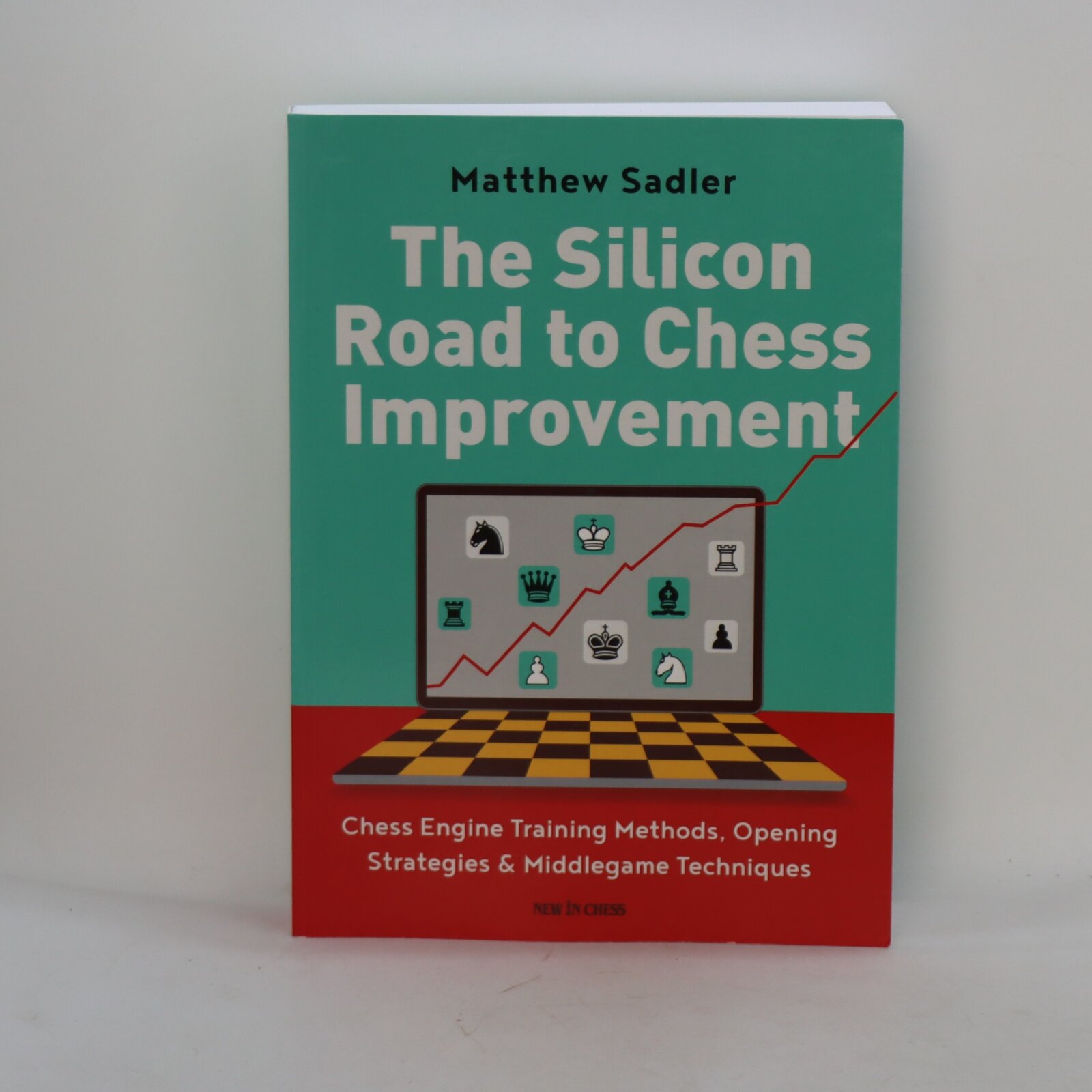
The Silicon Road to Chess Improvement.
By Matthew Sadler
Printed: 2021
Publisher: New in Chess. Netherlands
| Dimensions | 17 × 20 × 3.5 cm |
|---|---|
| Language |
Language: English
Size (cminches): 17 x 20 x 3.5
Condition: As new (See explanation of ratings)
SORRY, THIS ITEM HAS SOLD
Item information
Description
Softback. Green binding with white title and chessboard image on the front board.
F.B.A. provides an in-depth photographic presentation of this item to stimulate your feeling and touch. More traditional book descriptions are immediately available.
Surprise Package: Unexpected and Amazing Highlights
Many thanks, Mr. Sadler, for this extraordinary and, from my point of view, very successful course. A well-structured introduction to the game-play of chess engines that leaves nothing to be desired, at least for me. The technical notes and the selection of games and game fragments on which you show the strategic and tactical peculiarities of various top engines are excellent. The topics you present with entertaining passion provide me with many new ideas, whether for training with engines or for the application of positional patterns previously unknown to me. Thanks again. Recommended.
Chess is a board game for two players. It is sometimes called Western chess or international chess to distinguish it from related games, such as xiangqi (Chinese chess) and shogi (Japanese chess). The current form of the game emerged in Spain and the rest of Southern Europe during the second half of the 15th century after evolving from chaturanga, a similar but
much older game of Indian origin. Today, chess is one of the world’s most popular games, played by millions of people worldwide. Chess is an abstract strategy game and involves no hidden information. It is played on a chessboard with 64 squares arranged in an eight-by-eight grid. At the start, each player controls sixteen pieces: one king, one queen, two rooks, two bishops, two knights, and eight pawns. The player who moves first controls white pieces, and the other controls black pieces. The object of the game is to checkmate the opponent’s king, whereby the king is under immediate attack (in “check”) and there is no way for it to escape. There are also several ways a game can end in a draw. Organised chess arose in the 19th century. Chess competition today is governed internationally by FIDE (International Chess Federation). The first universally recognised World Chess Champion, Wilhelm Steinitz, claimed his title in 1886; Magnus Carlsen is the current World Champion. A huge body of chess theory has developed since the game’s inception. Aspects of art are found in chess composition, and chess in its turn influenced Western culture and art, and has connections with other fields such as mathematics, computer science, and psychology. One of the goals of early computer scientists was to create a chess-playing
machine. In 1997, Deep Blue became the first computer to beat the reigning World Champion in a match when it defeated Garry Kasparov. Today’s chess engines are significantly stronger than the best human players and have deeply influenced the development of chess theory.
Want to know more about this item?
We are happy to answer any questions you may have about this item. In addition, it is also possible to request more photographs if there is something specific you want illustrated.
Ask a question
Related products
Share this Page with a friend
