
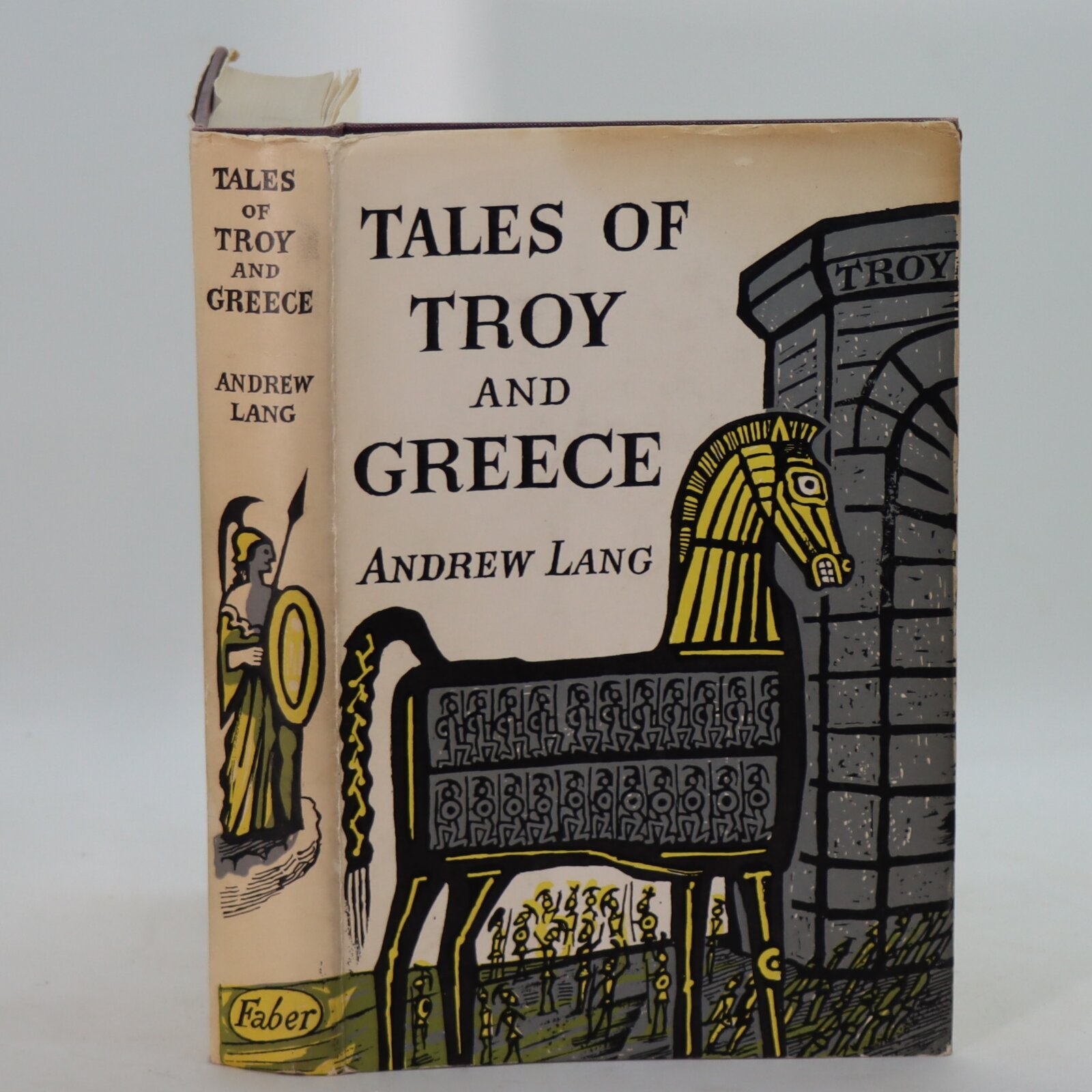
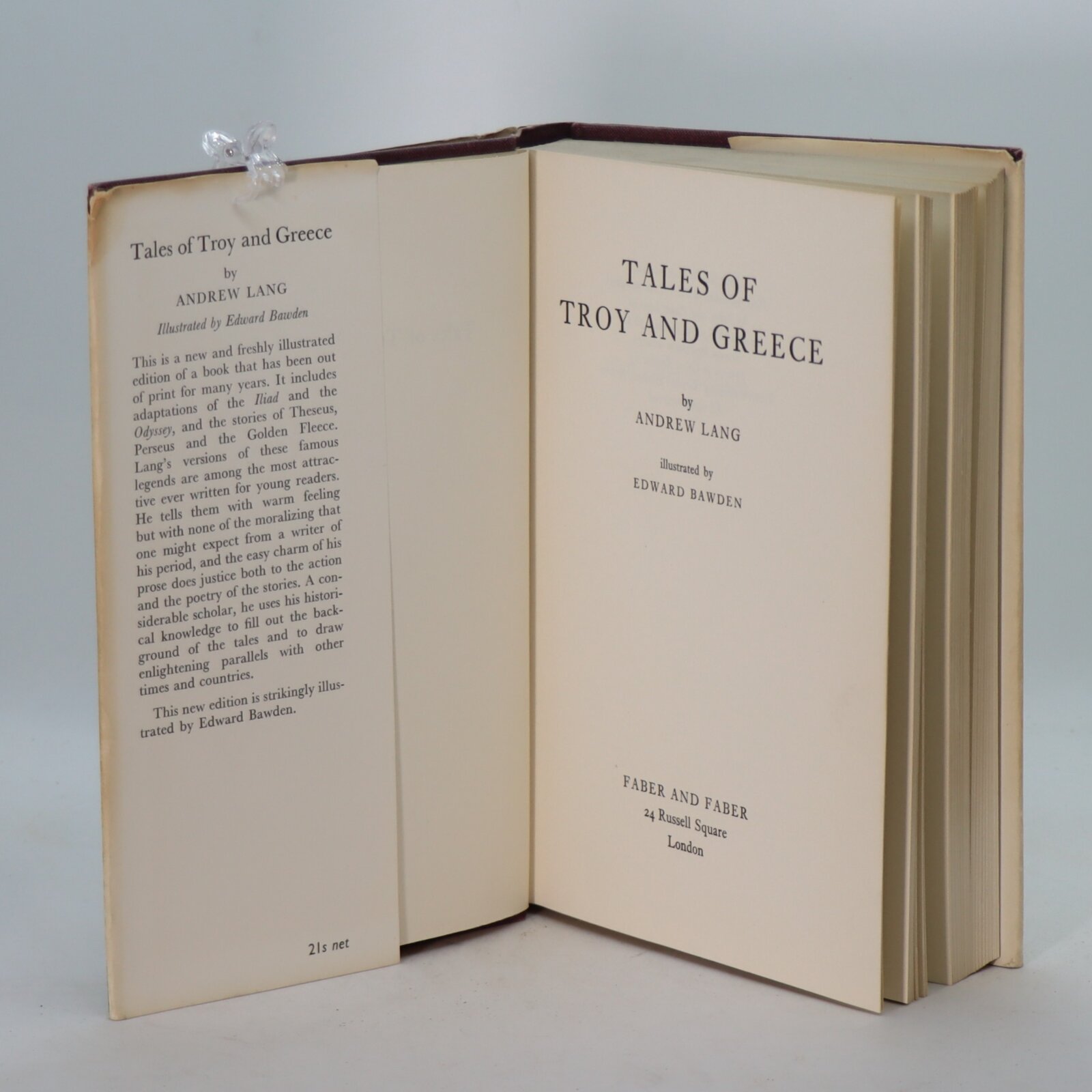
Tales of Troy and Greece.
By Andrew Lang
Printed: 1962
Publisher: Faber & Faber. London
| Dimensions | 15 × 21 × 3 cm |
|---|---|
| Language |
Language: English
Size (cminches): 15 x 21 x 3
Condition: Very good (See explanation of ratings)
SORRY, THIS ITEM HAS SOLD

Item information
Description
In the original dust sheet. Purple cloth binding with gilt title on the spine.
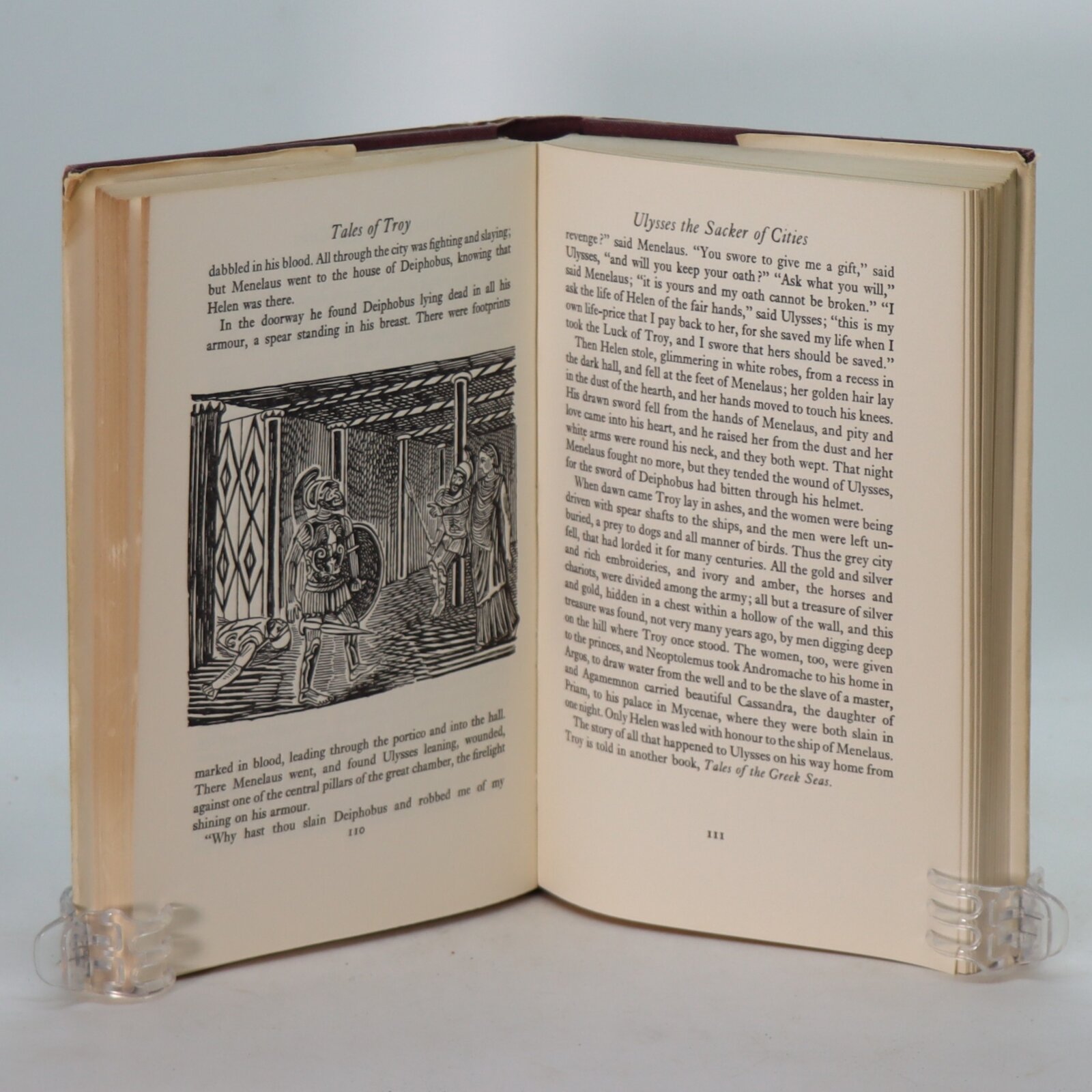
F.B.A. provides an in-depth photographic presentation of this item to stimulate your feel and touch. More traditional book descriptions are immediately available.
Troy or Ilium was an ancient city located at Hisarlik in present-day Turkey, 30 kilometres (19 mi) south-west of Çanakkale. It is known as the setting for the Greek myth of the Trojan War.
In Ancient Greek literature, Troy is portrayed as a powerful kingdom of the Heroic Age, a mythic era when monsters roamed the earth and gods interacted directly with humans. The city was said to have ruled the Troad until the Trojan War led to its complete destruction at the hands of the Greeks. The story of its destruction was one of the cornerstones of Greek mythology and literature, featuring prominently in the Iliad and the Odyssey, as well as numerous other poems and plays. Its legacy played a large role in Greek society, with many prominent families claiming descent from those who had fought there. In the Archaic era, a new city was built at the site where legendary Troy was believed to have stood. In the Classical era, this city became a tourist destination, where visitors would leave offerings to the legendary heroes.
Until the late 19th century, scholars regarded the Trojan War as entirely legendary. However, starting in 1871, Heinrich Schliemann and Frank Calvert excavated the site of the classical era city, under whose ruins they found the remains of numerous earlier settlements. Several of these layers resemble literary depictions of Troy, leading some scholars to conclude that there is a kernel of truth to the legends. Subsequent excavations by others have added to our understanding of the site, though the exact relationship between myth and reality remains unclear.
The archaeological site of Troy consists of nine major layers, the earliest dating from the Early Bronze Age, the latest from the Byzantine era. The mythic city is typically identified with one of the Late Bronze Age layers, such as Troy VI, Troy VIIa, or Troy VIIb. The archaeological site is open to the public as a tourist destination, and was added to the UNESCO World Heritage list in 1998.
Troy and Greece is set in the Bronze Age
The Bronze Age is a historic period, approximately 3300 BCE to 1200 BCE, that was characterized by the use of bronze, in some areas proto-writing, and other early features of urban civilization. The Bronze Age is the second principal period of the three-age Stone-Bronze-Iron system, as proposed in 1836 by Christian Jürgensen Thomsen, for classifying and studying ancient societies and history.
An ancient civilization is deemed to be part of the Bronze Age because it either produced bronze by smelting its own copper and alloying it with tin, arsenic, or other metals, or traded other items for bronze from production areas elsewhere. Bronze was harder and more durable than other metals available at the time, allowing Bronze Age civilizations to gain a technological advantage.
While terrestrial iron is naturally abundant, its high melting point of 1,538 °C (2,800 °F) placed it out of reach of common use until the end of the second millennium BCE. Tin’s low melting point of 231.9 °C (449.4 °F) and copper’s relatively moderate melting point of 1,085 °C (1,985 °F) placed them within the capabilities of the Neolithic pottery kilns, which date back to 6,000 BC and were able to produce temperatures greater than 900 °C (1,650 °F). Copper/tin ores are rare, since there were no tin bronzes in Western Asia before trading in bronze began in the 3rd millennium BCE. Worldwide, the Bronze Age generally followed the Neolithic period, with the Chalcolithic serving as a transition.
Bronze Age cultures differed in their development of the first writing. According to archaeological evidence, cultures in Mesopotamia (cuneiform script) and Egypt (hieroglyphs) developed the earliest practical writing systems.
Andrew Lang FBA (31 March 1844 – 20 July 1912) was a Scottish poet, novelist, literary critic, and contributor to the field of anthropology. He is best known as a collector of folk and fairy tales. The Andrew Lang lectures at the University of St Andrews are named after him.
He collaborated with S. H. Butcher in a prose translation (1879) of Homer’s Odyssey, and with E. Myers and Walter Leaf in a prose version (1883) of the Iliad, both still noted for their archaic but attractive style. He was a Homeric scholar of conservative views. Other works include Homer and the Study of Greek found in Essays in Little (1891), Homer and the Epic (1893); a prose translation of The Homeric Hymns (1899), with literary and mythological essays in which he draws parallels between Greek myths and other mythologies; Homer and his Age (1906); and “Homer and Anthropology” (1908).
Want to know more about this item?
We are happy to answer any questions you may have about this item. In addition, it is also possible to request more photographs if there is something specific you want illustrated.
Ask a question
Related products
Share this Page with a friend
