
Jokerby, Etc.
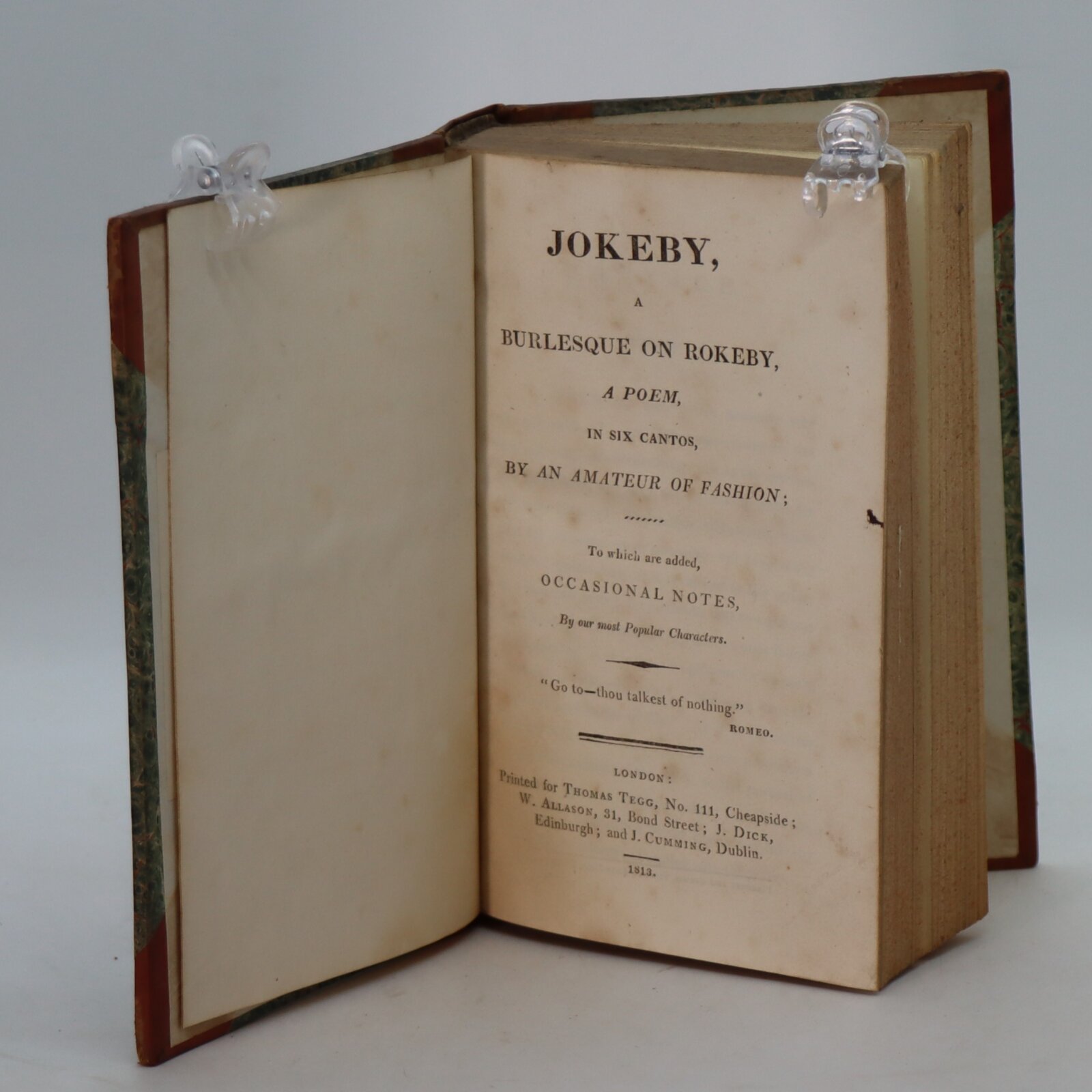
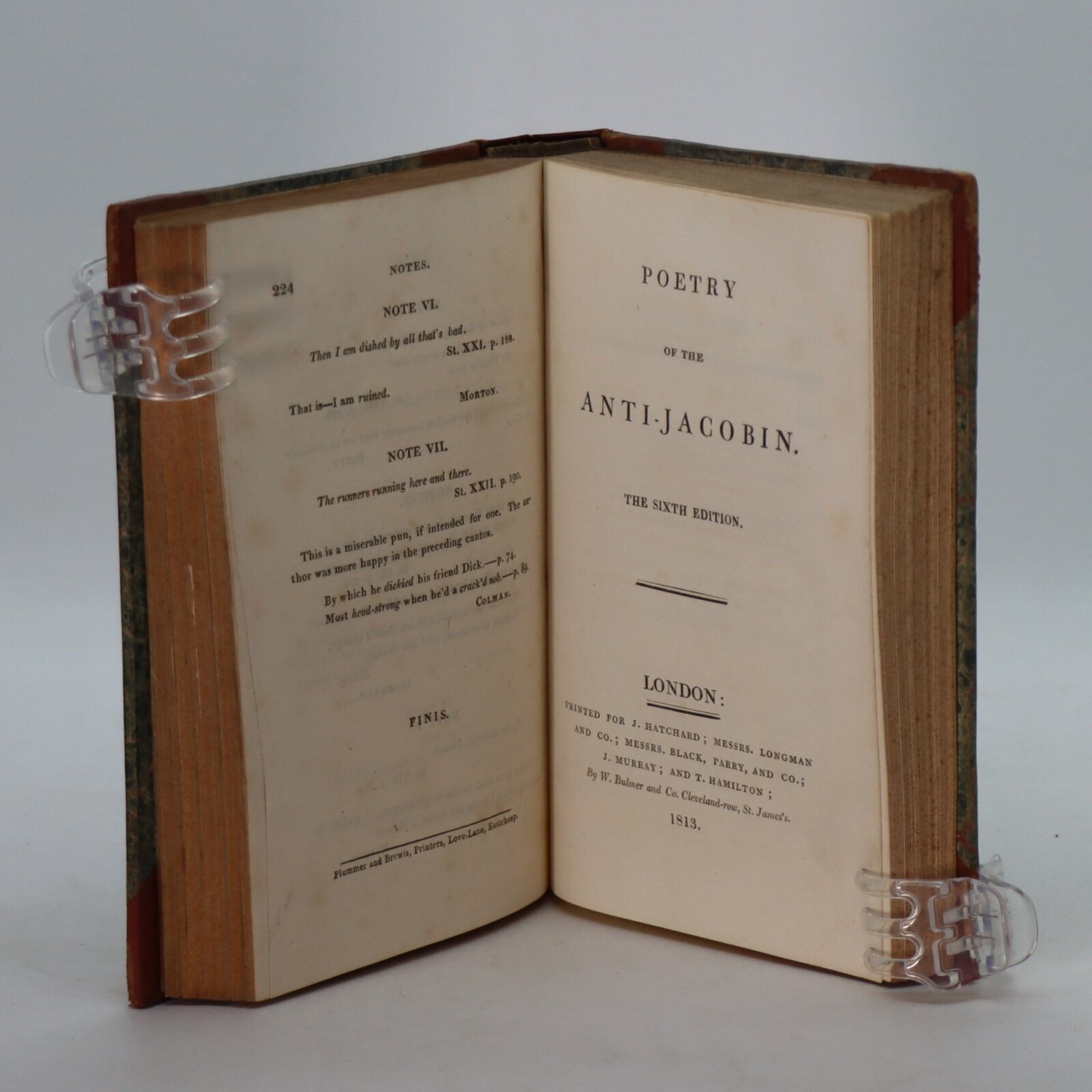
Printed: 1813
Publisher: Thomas Tegg. London
| Dimensions | 11 × 16 × 3 cm |
|---|---|
| Language |
Language: English
Size (cminches): 11 x 16 x 3
Condition: Fine (See explanation of ratings)
THIS ITEM WILL BE AVAILABLE SOON
SORRY, THIS ITEM HAS SOLD
Item information
Description
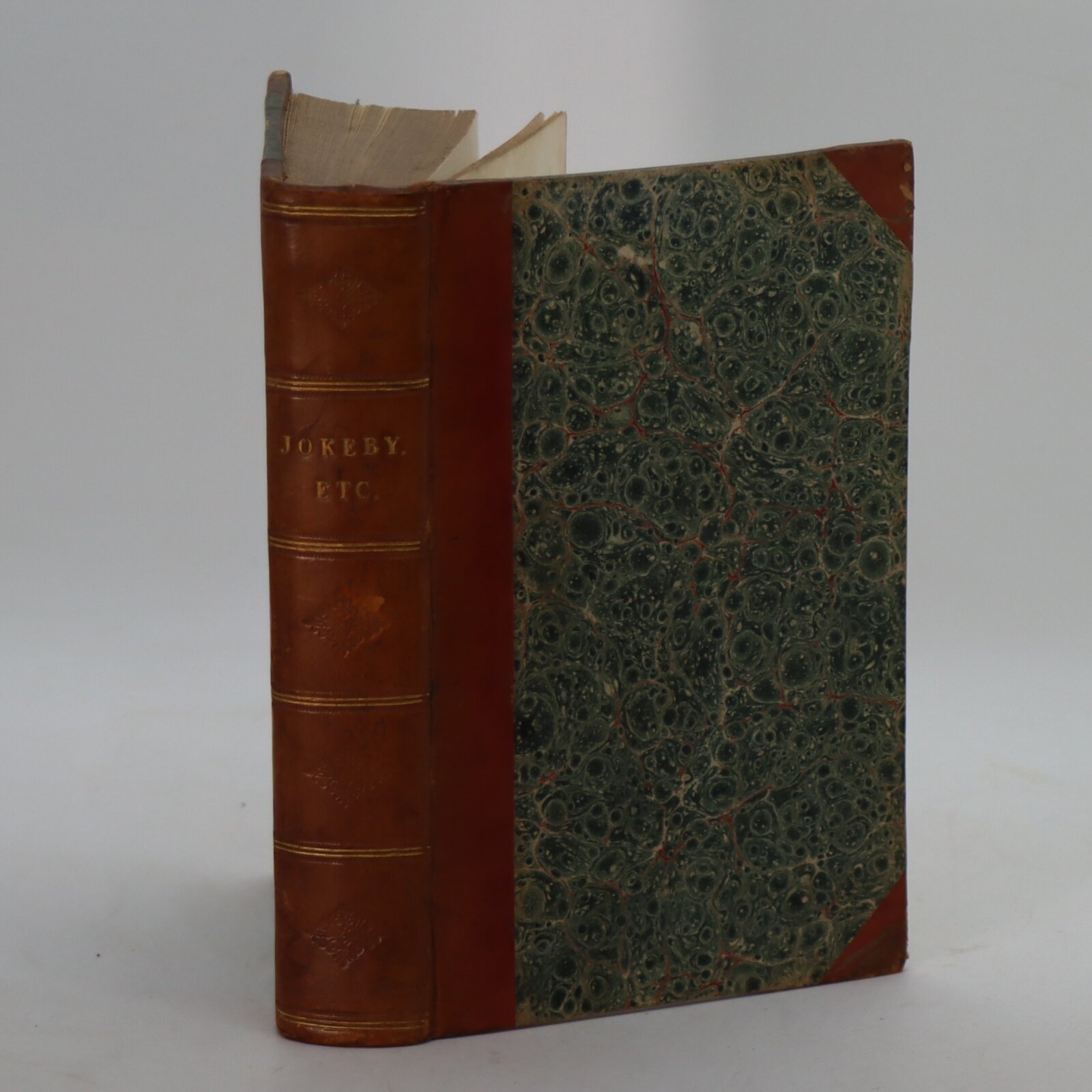
Tan calf spine with gilt title and banding. Green and white marbled boards. Two volumes bound as one.
F.B.A. provides an in-depth photographic presentation of this item to stimulate your feel and touch. More traditional book descriptions are immediately available.
A unique book compendium
An amazing compendium of two polemics
Two books are to be found within this binding: Rokeby and Poetry of the Anti-Jacobin.
- Jokerby was written as a skit on Sir Walter Scott’s book Rokeby. There are two and more writers (James Kirke Paulding and John Roby) to whom the skit authorship may pertain.
- Poetry of the Anti-Jacobin is another well-known work.
JOKERBY
Rokeby (1813) is a narrative poem in six cantos with voluminous antiquarian notes by Walter Scott. It is set in Teesdale during the English Civil War.
The first hint of Rokeby is found in a letter of 11 January 1811 from Scott to Lady Abercorn in which he says that although he is not currently engaged on a new poem he has ‘sometimes thought of laying the scene during the great civil war in 1643’. In June he was offered 3000 guineas for the poem, which had not yet been begun. By 10 December he is thinking of setting the new work ‘near Barnard Castle’, and on the 20th he writes to his friend J. B. S. Morritt, owner of Rokeby Park, that he has in mind ‘a fourth romance in verse, the theme during the English civil wars of Charles I. and the scene your own domain of Rokeby’, and asking for detailed local information. The proceeds of the poem will help finance building work at his new home, Abbotsford. Composition seems to have started in the spring of 1812, but the first canto ran into problems. On 2 March he told Morritt that he had destroyed it ‘after I had written it fair out because it did not quite please me’. In the later spring he was at work again, now accompanied by the sound of the builders extending the cottage at Abbotsford. In the middle of July he sent the new Canto 1 for comment by James Ballantyne and William Erskine, but their verdict was unfavourable, sapping his confidence. He decided to burn what he had written, having ‘corrected the spirit out of it’, but by 2 September he had ‘resumed the pen in [his] old Cossack manner’ and ‘succeeded rather more to [his] own mind’. Thereafter composition proceeded briskly, though at one stage Scott contemplated reducing the length to five cantos to enable publication for the Christmas market. He paid Rokeby a visit in late September and early October to gather local colour. The work was completed on the last day of 1812
James Kirke Paulding (August 22, 1778 – April 6, 1860) was an American writer and, for a time, the United States Secretary of the Navy. Paulding’s early writings were satirical and violently anti-British, as shown in The Diverting History of John Bull and Brother Jonathan (1812). He wrote numerous long poems and serious histories. Among his novels are Konigsmarke, the Long Finne (1823) and The Dutchman’s Fireside (1831). He is best known for creating the inimitable Nimrod Wildfire, the “half horse, half alligator” in The Lion of the West (1831), and as collaborator with William Irving and Washington Irving in Salmagundi. (1807–08). Paulding was also, by the mid-1830s, an ardent and outspoken defender of slavery, and he later endorsed southern secession from the union.
John Roby (5 January 1793 – 18 June 1850) was an English banker, poet, and writer.
Roby was born in Wigan, England in 1793, the son of Mary Aspull and a schoolmaster named Nehemiah Roby. He began his career as a banker in Rochdale, Lancashire. In his work Lancashire Sketches, Edwin Waugh recalled that, while Roby was working for the firm of Fenton and Roby in Rochdale, Waugh worked as an apprentice at the bookshop next door.
For the clergy of the district, and for a certain class of politicians, this shop was the chief rendezvous of the place. Roby used to slip in at evening, to have a chat with my employer [Thomas Holden], and a knot of congenial spirits who met him there. In the days when my head was yet but a little way higher than the counter, I remember how I used to listen to his versatile conversations.
Roby died in a shipwreck in June 1850. Despite clear weather, the S. S. Orion struck rocky bottom at Portpatrick en route from Liverpool to Glasgow.
Poetry of the Anti-Jacobin
The Anti-Jacobin, or, Weekly Examiner was an English newspaper founded by George Canning in 1797 and devoted to opposing the radicalism of the French Revolution. It lasted only a year, but was considered highly influential, and is not to be confused with the Anti-Jacobin Review, a publication which sprang up on its demise. The Revolution polarized British political opinion in the 1790s, with conservatives outraged at the killing of the king Louis XVI of France, the expulsion of the nobles, and the Reign of Terror. Great Britain went to war against Revolutionary France. Conservatives castigated every radical opinion in Great Britain as “Jacobin” (in reference to the leaders of the Terror), warning that radicalism threatened an upheaval of British society. The Anti-Jacobin sentiment was expressed in print. William Gifford was its editor. Its first issue was published on 20 November 1797 and during the parliamentary session of 1797–98 it was issued every Monday.
The Anti-Jacobin was planned by Canning when he was Under-Secretary of State for Foreign Affairs. He secured the collaboration of George Ellis, John Hookham Frere, William Gifford, and some others. William Gifford was appointed working editor.
Canning founded it, in his words, “…to be full of sound reasoning, good principles, and good jokes and to set the mind of the people right upon every subject.” One of Canning’s biographers described its purpose as to “…deride and refute the ideas of the Jacobins, present the government’s point of view on the issues of the day and expose the misinformation and misinterpretation which filled the opposition newspapers.” In its first issue Canning said he and his friends:
…avow ourselves to be partial to the COUNTRY in which we live, notwithstanding the daily panegyrics which we read and hear on the superior virtues and endowments of its rival and hostile neighbours. We are prejudiced in favour of her Establishments, civil and religious; though without claiming for either that ideal perfection, which modern philosophy professes to discover in the more luminous systems which are arising on all sides of us.
Canning set out his “most serious, vehement and effective onslaught in verse” on the values of the French Revolution in a long poem, New Morality, published in the last issue of the Anti-Jacobin (No. 36, 9 July 1798). Canning considered these values as “French philanthropy” that professed a love of all mankind whilst eradicating every patriotic impulse. He described anyone in Great Britain who held these values as a “pedant prig” who “…disowns a Briton’s part, And plucks the name of England from his heart…”:
To publicise the Anti-Jacobin, Canning paid the cartoonist James Gillray to publish plates themed on the Anti-Jacobin’s principles, and some believe that twenty Gillray plates were the fruit of this arrangement.
No – through th’extended globe his feelings runAs broad and general as th’unbounded sun!
No narrow bigot he; – his reason’d view
Thy interests, England, ranks with thine, Peru!
France at our doors, he sees no danger nigh,
But heaves for Turkey’s woes the impartial sigh;
A steady patriot of the world alone,
The friend of every country – but his own.
William Pitt the Younger, the Prime Minister, also contributed to the newspaper.
The Anti-Jacobin estimated that its total readership was 50,000. They multiplied the regular weekly sale of 2,500 by seven (arriving at 17,500) because that was the average size of a family—and added 32,500 based on the assumption that many readers lent their copies to their poorer neighbours.
Want to know more about this item?
We are happy to answer any questions you may have about this item. In addition, it is also possible to request more photographs if there is something specific you want illustrated.
Ask a question
Related products



Share this Page with a friend
